Blood Draws
Lab work is how you tell whether your HRT is actually doing what you think it is. Symptoms lag, and "I feel fine" can coexist with testosterone that's still in cis-male range. This page covers what to order, when to draw, how often to repeat, and where to get the work done.
For interpreting results once you have them, see Hormone Levels.
Why monitor
Three reasons:
- Efficacy — confirm estradiol is in target range and testosterone is suppressed. Without numbers, you're titrating blind.
- Safety — estrogen affects clotting and lipids; spironolactone affects potassium and kidneys; cyproterone affects the liver and prolactin. Periodic labs catch problems early.
- Adjustment — different dose, route, or regimen changes need lab confirmation that the change worked, not just that it felt different.
The Endocrine Society 2017 guideline calls for hormone levels every 3 months in the first year of HRT and every 6–12 months after that, with additional safety panels driven by which drugs are in the regimen.
What to order
Three tiers — the essentials, the standard add-ons most providers also include, and the situational tests that depend on your regimen or symptoms.
Tier 1 — every test
| Test | What it tells you |
|---|---|
| Estradiol (E2) | Whether your estrogen is in target range (typically 100–200 pg/mL for MtF on HRT) |
| Total testosterone | Whether T is suppressed (target <50 ng/dL) |
If you're only going to order two things, order these.
Tier 2 — standard add-ons (most providers include)
| Test | When to include |
|---|---|
| Free testosterone or SHBG | When total T looks suppressed but androgenic symptoms persist (oral E2 raises SHBG, which can mask high free T) |
| LH / FSH | Useful early on to confirm pituitary suppression; less informative later |
| Prolactin | Endocrine Society recommends periodic checks on estrogen; especially important if on cyproterone (prolactinoma risk) |
| Comprehensive metabolic panel | Liver enzymes (ALT, AST), kidney function (BUN, creatinine), glucose, electrolytes |
| Lipid panel | Estrogens shift cholesterol; baseline + periodic |
| CBC | General health; flags anemia, infection |
Tier 3 — situational
| Test | When to include |
|---|---|
| Potassium (specifically) | If on spironolactone — required at baseline and periodically |
| Liver function tests (LFTs) | If on cyproterone, bicalutamide, or flutamide — required, often more frequent than the standard panel |
| Progesterone (P4) | Only meaningful if you're supplementing it; rectal/vaginal P4 produces dramatically higher serum levels than oral |
| DHT | If you have specific concerns about scalp hair loss, body hair, or acne — most labs don't include it by default; ask explicitly |
| PSA (prostate-specific antigen) | Generally screen in patients over 50 (or earlier with family history) |
| Bone density (DEXA scan) | Long-term, especially if on a GnRH agonist or post-orchiectomy with sub-therapeutic estrogen |
| Vitamin D, B12 | If symptoms of deficiency or risk factors |
When to test
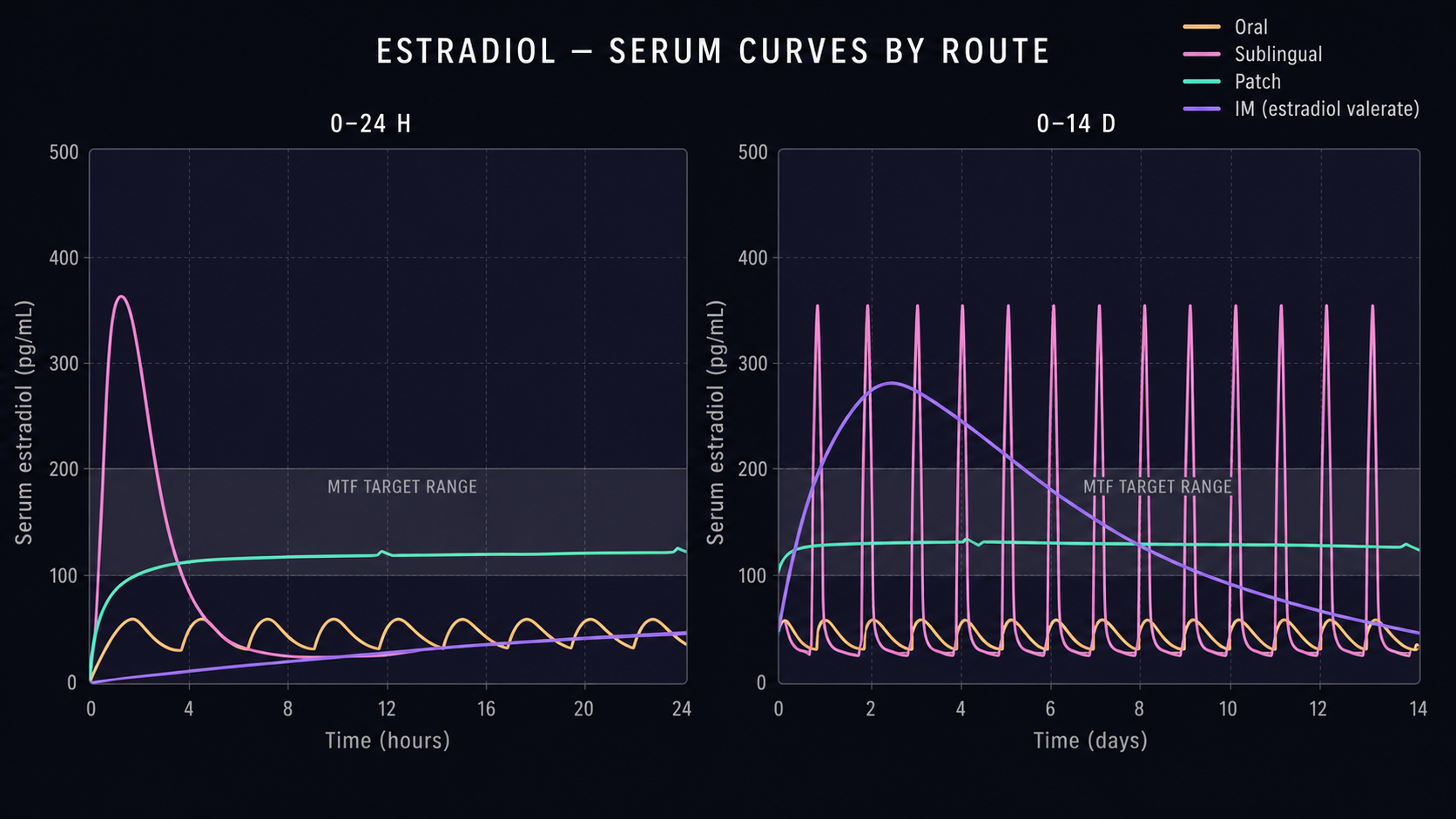
Timing matters more than dose for getting interpretable numbers. The biggest variable is route:
| Route | When serum E2 peaks | What to test |
|---|---|---|
| Oral / sublingual estradiol | ~2–6 hours after dose | Test ~midway between doses for an "average," or right before next dose for trough |
| Transdermal patch / gel | Steady-state after 1–2 weeks | Any time once steady; drawing during the patch's "wear" period |
| Estradiol valerate IM | Day 2–3 after injection (peak ~400–600 pg/mL with 4–5 mg) | Trough (just before next injection) is the most clinically meaningful single number |
| Estradiol cypionate IM | Day 2–4 after injection | Trough as above; cypionate's longer duration (14–18 days) gives a broader trough window |
Two practical rules:
- Always note when you took your last dose when you submit a sample — without that, the result is uninterpretable. A 400 pg/mL E2 four hours after a sublingual is healthy; a 400 pg/mL trough on injectables is high.
- Don't change your regimen in the week before a test. If you've just up-dosed, your levels are still moving — wait ~2 weeks for steady state on a stable dose before retesting.
For injectables specifically, recent research (Endocrine Practice 2024 scoping review) found that current dosing guidelines often produce target-exceeding peaks with sub-target troughs — so testing only at peak gives a falsely reassuring picture. Trough is the safer single time-point.
How often
| Phase | Frequency |
|---|---|
| Baseline (before starting) | Full panel — establishes pre-treatment values |
| Titration phase (first 6–12 months) | Every 3 months per Endocrine Society; some providers do every 6–8 weeks while actively adjusting |
| Maintenance | Every 6–12 months, with safety panels (LFTs, K+, lipids) annually |
| After any regimen change | 2–6 weeks after the change took effect (allow steady state) |
| Symptom-driven | Any time symptoms suggest something is off (mood, libido, fatigue, headache, breast pain) |
How to interpret
Lab values aren't directly comparable between labs — each runs its own assay calibration. Interpret your result against your lab's reference range (printed on the report), not against a universal number.
For target ranges relevant to MtF HRT (and the cis male/female reference values), see Hormone Levels.
Where to get tested
Two basic paths:
Through a provider
PCP, endocrinologist, or trans-care telehealth (Plume, FOLX, QueerDoc, GenderGP) writes the order; you go to a Quest or LabCorp draw site (or equivalent in your country); insurance typically covers the labs if your provider is in-network.
Direct-to-consumer (DTC)
For people without a trans-friendly provider, or who want to monitor more frequently than a provider will order. Several services maintain their own physician network to legally order labs in your state, then route the draw to Quest or LabCorp:
- United States: Private MD Labs, LabsMD, Quest DirectAccess (in some states), LabCorp OnDemand (in some states)
- United Kingdom & Ireland: Medichecks, Thriva, Forth, Numan
- Canada: BloodTestsCanada
- Sweden: Werlabs
- International (mail kits): LetsGetChecked — capillary blood spot, ships to most Western countries
The full list with category breakdowns is on the Resources page.
US state-level barriers
DTC labs work because the service provides its own licensed physician to sign your order — but state law varies. In some US states (NY, NJ, RI being the most restrictive), DTC ordering of certain tests is limited or blocked. If a DTC service refuses your order, that's usually why. Some workarounds: mail a sample from a friend in a permissive state, or use a service whose physician network covers your state.
Cost expectations (rough, US, 2026)
A "feminizing HRT panel" through a DTC lab typically runs \(90–\)180 self-pay (E2 + total T + LH/FSH + prolactin + CMP + CBC + lipids). Smaller panels (just E2 + total T) are \(40–\)80. With insurance through a provider it's usually \(0–\)30 copay. UK Medichecks "transgender hormone health" panels are roughly £80–£140. LetsGetChecked international is more expensive ($129+ for a hormone panel).
Sources
- Hembree WC et al. Endocrine Treatment of Gender-Dysphoric/Gender-Incongruent Persons. Endocrine Society Clinical Practice Guideline. J Clin Endocrinol Metab. 2017;102(11):3869–3903. doi:10.1210/jc.2017-01658
- UCSF Gender Affirming Health Program — Overview of feminizing hormone therapy
- ARUP Consult — Endocrine Testing in Transgender Adults
- BU Medicine — Practical Guidelines for Transgender Hormone Treatment
- Approach to Interpreting Common Laboratory Pathology Tests in Transgender Individuals — PMC review
- Laboratory Monitoring in Transgender and Gender-Diverse Individuals — Clinical Chemistry 2025
- The Use of Injectable Estradiol in Transgender and Gender Diverse Adults: A Scoping Review of Dose and Serum Estradiol Levels — Endocrine Practice 2024 — peak/trough data
- FOLX — Estrogen HRT Labs — patient-facing panel guidance
- Trans Harm Reduction — Blood tests — community guide
- KFF Policy Tracker — Gender-Affirming Care State Policy — current state restriction landscape