Lip Lift & Lip Augmentation
Two related procedures targeting the upper lip — and for most FFS patients, best performed together, not separately.
- Lip lift addresses position and proportion: it surgically shortens the philtrum (the cutaneous strip from nose base to upper-lip vermilion) and increases tooth show at rest.
- Lip augmentation addresses volume: it adds bulk to the vermilion itself.
Doing only one risks an unnatural result. A lift without augmentation can look "thin and drawn" because pulling the skin upward reduces apparent red-lip height. Augmentation alone on a long masculine philtrum produces a "bottom-heavy" or duck-mouthed look — bulky lips still positioned too low on the face.
The strongest perioral feminizing cue
Increased upper incisor show at rest is the single most powerful perioral cue the brain reads as feminine. It's not the volume of the lip per se — it's the relationship between the lip, the teeth, and the philtrum. That's why lip lift, with its 4–7 mm of skin excision, has perceptual impact disproportionate to its physical scale.
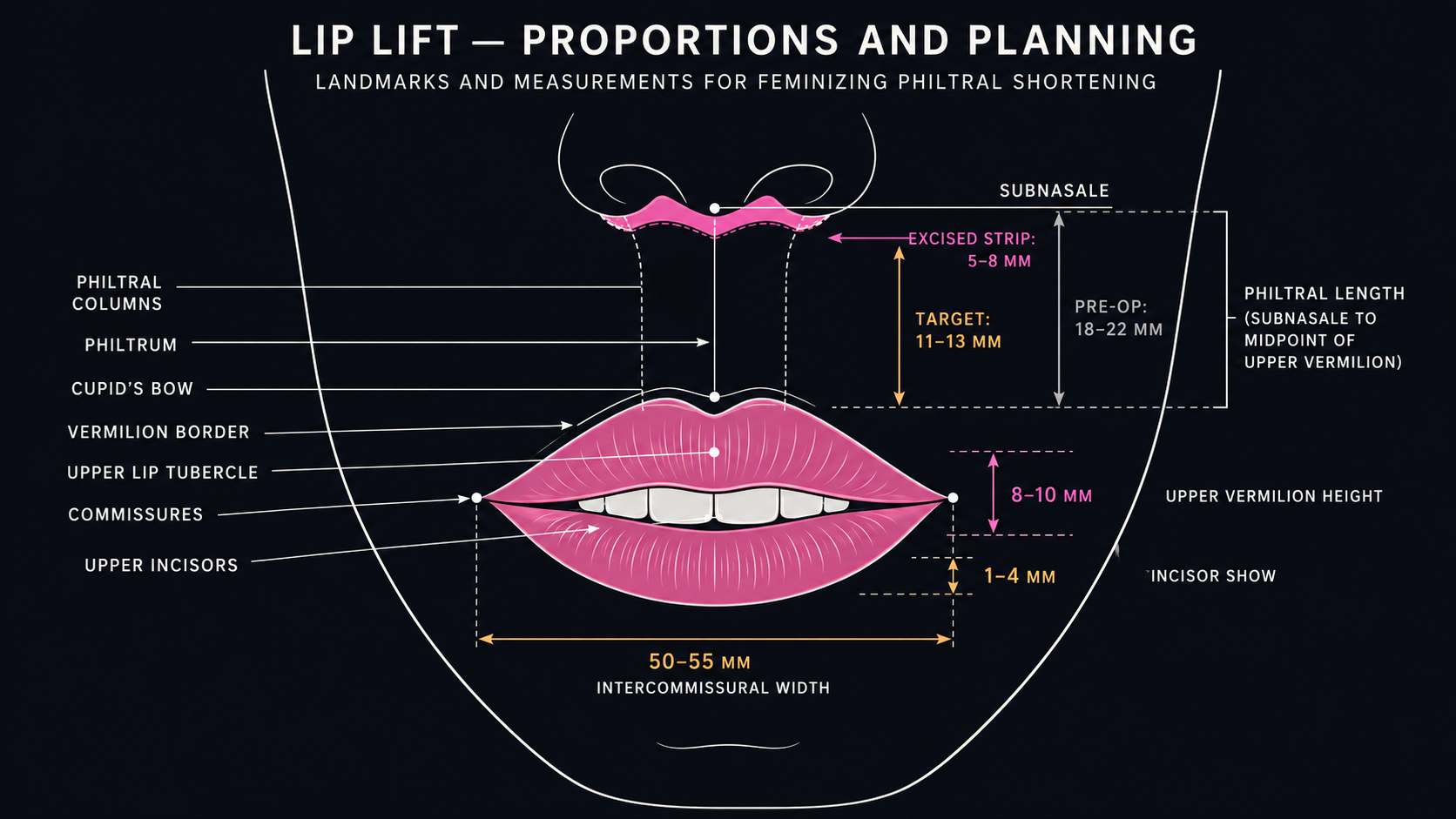
What "feminine" means in lip and philtrum anatomy
Population averages with substantial overlap, and ethnicity shifts the numbers meaningfully:
| Feature | Typical male | Typical female | Surgical implication |
|---|---|---|---|
| Philtrum length (subnasale to upper-lip vermilion) | 13–15 mm | 11–13 mm | Lip-lift target; ethnicity-dependent |
| Upper-incisor show at rest | 0 mm (often) | 2–4 mm | Driven by philtrum length, not lip volume |
| Upper-incisor show on full smile | 0–4 mm | 6–8 mm | Same |
| Vermilion fullness | Flatter, thinner | Fuller, more everted | Augmentation target |
| Cupid's bow | Less defined | More defined | Both lift and augmentation can sharpen this |
| Upper-to-lower vermilion ratio | ~1:2 to 1:1.6 | ~1:1.6 (more balanced) | Modern proportional target |
Caveat on "norms": Indonesian, Korean, Nepalese, and Sub-Saharan African populations have longer baseline philtral measurements than the Caucasian Farkas norms most often cited in surgical textbooks. Forcing every patient to a 12 mm philtrum can produce ethnically incongruous results. The current best-practice planning target is proportional (3:1 philtrum-to-upper-vermilion, ~1:1.6 upper-to-lower vermilion) with the absolute millimeter value being whatever achieves those proportions in the specific face.
Aging matters too: everyone's philtrum lengthens, vermilion thins, and Cupid's bow flattens with age. A lift performed in your 30s is durable but partial re-lengthening over decades is realistic.
Lip lift techniques
Subnasal bullhorn (the FFS workhorse)
Originally described in the early 1970s and refined by Reed and Millard. The incision traces a bull's-horn-shaped curve hidden in the natural crease at the columellar base, runs into each nostril sill, and curves out under each ala. A strip of skin is excised between two parallel curved lines and the lower edge sutured upward to the upper, shortening the philtrum.
The 2026 PRISMA systematic review (Komisarek et al., 1,754 patients across 7 studies) documents the typical result:
| Measurement | Pre-op | Post-op |
|---|---|---|
| Philtral length | 14.0–14.5 mm | 10.8–12.0 mm |
| Vermilion height | 5–6 mm | 7–9 mm |
| Incisor show at rest | 1.5–2.0 mm | 3.5–5.0 mm |
Mean satisfaction: 4.4/5. Revision rates: 0.6–6.7%. FFS-specific protocols typically aim for a final philtrum of 11–13 mm and 3–5 mm of incisor show at rest, with excisions usually between 3 and 7 mm.
The scar sits in the natural shadow of the nostril sills — usually inconspicuous at conversational distance once mature, though almost never invisible on close inspection.
Deep-plane bullhorn vs skin-only
A traditional bullhorn is essentially a skin-only operation. A deep-plane lip lift dissects beneath the SMAS, releases the pyriform ligament, and suspends deeper tissues directly to the periosteum at the nasal base. The theoretical advantage: tension is borne by deep tissue rather than skin, which should reduce scar widening and slow long-term relapse.
Evidence is suggestive but not definitive — there are no head-to-head long-term randomized trials. Talei's 823-patient deep-plane series shows excellent results but lacks a comparator. Mahmood's 2025 "Tri-Lift" comparison (n=243) found 78.7% rated "very much improved" vs 43% for traditional bullhorn at 6 months. Deep-plane techniques are increasingly favored at high-volume FFS centers, but this reflects expert preference more than randomized proof.
Corner lift (grin lift)
Small wedge excisions just above and lateral to each corner of the mouth, used for downturned commissures. Major drawback: scar visibility in a high-tension dynamic zone, with hypertrophic scarring rates of 4.6–12.5% (roughly 2–3× the bullhorn). Adding depressor anguli oris release reduces this. In FFS, usually combined with a bullhorn lift — rarely performed alone. Patients with darker skin or scar-prone phenotypes need careful counseling.
Italian (two-incision) lift
Two short incisions, one along each alar groove, leaving the columellar base untouched. Avoids the most-visible central segment of the bullhorn scar but doesn't lift the central philtrum or Cupid's bow — exactly what most FFS patients need. Most useful as a revision option when a prior bullhorn over-lifted the center, or in patients with an already-defined Cupid's bow needing only lateral elevation. Rarely first-choice for FFS.
Direct (vermilion border) lift — avoid
Incision along the white roll of the upper lip itself. Produces visible, often disfiguring scarring across one of the most aesthetically scrutinized lines on the face. Almost universally avoided in FFS and a frequent driver of regret and revision requests in patients who received it elsewhere.
Augmentation options
Hyaluronic acid (HA) fillers
The most common augmentation modality and the only category with robust randomized-trial evidence.
| Detail | |
|---|---|
| Common products | Juvederm Volbella / Ultra / Vollure; Restylane Kysse / Silk / Refyne |
| Duration | 6–18 months in lips (shorter than other facial regions due to constant motion) |
| Cost | \(600–\)1,200 per syringe; 1–2 syringes typical; touch-ups every 6–12 months |
| 5-year cumulative | \(4,000–\)10,000 — comparable to or exceeding a one-time Permalip |
| Reversibility | Yes — hyaluronidase dissolves within minutes to hours |
The decisive safety advantage of HA is reversibility, which is the foundation of vascular-occlusion rescue protocols. Vascular occlusion is rare (~1 in 6,558 in a Dutch prospective registry, ~0.015%) but can cause skin necrosis or, when retrograde flow reaches ophthalmic vessels, blindness. Hyaluronidase rescue window is ~90 minutes; any reputable injector should have it on-site with a written protocol.
Lips are also a high-risk site for delayed inflammatory nodules (0.6–0.8%) and biofilm formation, sometimes triggered weeks to years later by viral illness, vaccination, or dental procedures.
Strategic role of HA in FFS: as a trial. You can experiment with shape and volume, see how you feel, and refine your preferences before committing to permanent surgical augmentation.
Autologous fat grafting
Fat harvested from abdomen or inner thighs by liposuction, processed, and microinjected. Survival is the central problem.
| Detail | |
|---|---|
| Retention | ~47% pooled at 3–12 months (range 26–83%); lips have among the lowest retention of any facial site |
| Overcorrection | 20–40% standard practice |
| Repeat sessions | Common at 6–9 months |
| Cost (standalone) | \(2,000–\)5,000; effectively free if already harvesting fat for other FFS |
| Permanence | Surviving fraction stable after 3–6 months |
Pros: autologous, no foreign body, natural feel, free if already doing liposuction. Cons: unpredictable retention, lumpiness, oil cysts, donor-site bruising, rare but devastating intravascular injection events. A meta-analysis of 5,479 facial fat-grafting patients reported 7.7% overall complication rate, with intravascular events ~24% of those.
SMAS / dermis-fat / dermal grafts
Autologous solid-tissue strips harvested from concurrent procedures (facelift SMAS, abdominoplasty dermis-fat, hairline-advancement scar revision) and tunneled submucosally through small commissure incisions.
The 5-year SMAS graft data (JAMA Facial Plast Surg 2016) is the longest published lip-augmentation outcome study and shows durable enhancement at 5 years. Best longevity-per-dollar option when graft material is already being harvested. Texture is firmer than fat early on, softening over months.
AlloDerm (acellular dermal matrix, ~$1,000+ per graft) has similar longevity but adds material cost and a small theoretical infectious-disease risk.
Permalip implants
Soft solid silicone rod available in lengths of 55, 60, 65 mm and diameters of 3, 4, 5 mm. Inserted through small commissure incisions in 15–20 minutes under local anesthesia.
Permalip is FDA off-label for lips
The FDA issued a warning letter to SurgiSil in April 2019 stating that Permalip is not FDA-cleared specifically for lip augmentation, although SurgiSil's silicone implants are cleared for facial use generally. Permalip has European CE Mark approval and is widely used off-label in lips. This is something to discuss with your surgeon.
The 5-year Permalip series (Surek et al., 832 implants in 420 patients) reported:
| Complication | Rate |
|---|---|
| Total complication rate | 12.3% |
| Malposition | 6.6% |
| Capsular contracture | 1.4% |
| Infection / extrusion / palpability | <1% each |
Implants are permanent but removable — the smooth coating resists tissue ingrowth, so explant is straightforward. Cost: \(3,000–\)5,000 one-time.
V-Y advancement (lip rolling)
Purely surgical, intraoral. A "W"-shaped incision on the inner lip, three musculomucosal flaps advanced outward and closed in a "Y" configuration, rolling additional wet mucosa onto the dry vermilion.
Jacono and Quatela's 2004 series documented 75% increase in upper red-lip vertical height, 66% increase in surface area, 40% increase in projection. No external scar.
Best for patients who want more eversion and pout without bulk. Pairs well with a subnasal lift (the lift addresses the white lip; V-Y addresses the red lip). Permanent and irreversible. Risks: intraoral scarring, transient numbness, asymmetry, rare flap necrosis.
Choosing among options
| Priority | Best-fit option |
|---|---|
| Subtle hydration only | Soft HA (e.g., Volbella) |
| Trial before committing | HA filler |
| Permanent surgical augmentation | Implant, graft, or V-Y + lift |
| Eversion / pout without bulk | V-Y |
| Already harvesting graft material in same FFS session | SMAS / dermis-fat graft (best longevity-per-dollar) |
| Avoid foreign body and recurring needles | Fat grafting + V-Y |
| Avoid surgery entirely | HA filler (recurring) |
| Maximum durability with minimum sessions | Permalip or graft + lift |
How much philtrum to remove
The single most contested planning question.
The 25% rule
Never excise more than 25% of the original philtral length (Salibian/Bluebond-Langner; Altman 2012). For a 16 mm pre-op philtrum: ~4 mm max. For 20 mm: ~5 mm max. Most FFS lip lifts excise 3–7 mm.
Beyond the ceiling, planning has shifted decisively from fixed millimeter targets to proportion-based planning — driven by the ethnic-norm issue described above.
The risks at each end are asymmetric:
- Over-shortening produces "monkey mouth" — a snarl/simian look from a permanently retracted upper lip exposing too much gum, visible incisors at rest >5 mm, and inability to fully close the lips. The hardest complication to fix. Skin can't easily be added back; minor cases may be balanced with filler to the lower lip; major cases require full-thickness skin grafts with predictably poor cosmetic results.
- Under-shortening produces insufficient feminization — the leading reason for revision requests. Revision lifts to take more skin are technically harder than the primary procedure but feasible.
Most experienced FFS surgeons therefore err slightly toward conservatism. Standard planning steps:
- Calipers and standardized photography (frontal, oblique, profile, at rest, smiling, "E"-sound), increasingly with 3D imaging like VECTRA.
- Pinch test with the patient awake and upright — preview the result and confirm the patient can still close the lips.
- Proportional targets: 3:1 philtrum-to-upper-vermilion ratio and ~1:1.6 upper-to-lower vermilion ratio.
- The Lee et al. 2025 protocol marks the lip-lift incision first, before rhinoplasty markings, because it sets alar width and provides the foundation for everything else.
Recovery
Two protocols matter throughout the year:
- Sun protection is non-negotiable: SPF 30+ broad-spectrum daily for 6–12 months. UV during scar maturation causes permanent darkening.
- Silicone gel or sheets, applied 12–24 hours daily for 2–3 months starting once epithelialized, are the best-evidence non-prescription scar treatment and outperform onion-extract creams (Mederma) in head-to-head comparisons.
| Phase | What to expect |
|---|---|
| Days 0–3 | Swelling peaks at 48–72h; upper lip can look dramatically pouty and distorted. Pain better described as tightness than sharpness; most rate it 2–4/10 and stop opioids by day 3–5. No straws, no biting into anything, soft non-acidic diet cut into small pieces. Sleep with head elevated 30–45°. |
| Days 5–7 | Sutures removed (mildly stinging, easier than expected). Most patients return to desk work between days 3–7. |
| Day 7–10 | Bruising fades. Big grins, belly laughs, and exaggerated yawns avoided through 2–3 weeks (incision tension). |
| Week 2 | Swelling 70–80% resolved; bruising gone. Scar pink-red and slightly raised — normal. Comfortable in public for most patients between days 8–14. Lipstick over the incision can usually start a week after suture removal. |
| Weeks 2–4 | Light cardio at 2 weeks; resistance training at 3–4 weeks. Gentle scar massage 1–2 minutes 2–3×/day usually starts here. |
| Months 2–3 | Maturation phase: scar redness fades, tightness eases, sensation continues recovering. Hypertrophic thickening at 4–8 weeks if it appears → intralesional triamcinolone is the standard intervention. |
| Month 6 | Most patients describe lips as feeling "natural" and forgetting about the surgery day-to-day. Scar typically a faint thin line. |
| Month 12 | Final result and final scar appearance. Don't judge before this. |
Numbness around the central upper lip is universal in the first weeks because small cutaneous branches of the infraorbital nerve are disrupted. Most sensation returns within 3–6 months. Permanent altered sensation along the immediate scar line is possible but doesn't typically affect lip function. Motor branches to the orbicularis oris aren't in the surgical field, so smiling and lip closure motor function are preserved. Tightness and reduced smile dynamism for 2–4 months are common and expected.
Risks and complications
Across the systematic-review literature, lip-lift revision rates run 0.6–6.7%, with single-surgeon series up to 10–15% if minor scar revisions are included. Patient satisfaction averages 4.4/5.
| Complication | Reported rate | Notes |
|---|---|---|
| Visible scarring (patient complaint) | ~4.4% (Zhao 2023) | Usually a thin pale line at 12 months; almost never invisible on close inspection. Worsened by tension, sun, infection, smoking, Fitzpatrick IV–VI |
| Hypertrophic / keloid scarring | Self-reported keloid rates ~16% in Black populations, <0.1% in Fitzpatrick I; >50% of keloid patients have positive family history | Markedly elevated risk in Fitzpatrick IV–VI and family-history-positive |
| Asymmetry | Low single-digit % | Most minor cases resolve as swelling settles |
| Over-correction ("monkey mouth") | Rare but devastating | Hardest to fix; prevention is conservative excision + pinch test |
| Under-correction | Most common revision driver | Feasible to revise — take more skin in a second procedure |
| Numbness | Universal in first weeks | Resolves 3–6 months in most |
| Infection | <3% | Robust perioral blood supply; further reduced by prophylactic antibiotics + valacyclovir for HSV-positive patients |
| Wound dehiscence | <1% | Almost always associated with smoking, excessive tension, premature aggressive movement, or trauma |
| Total complication rate | 5.1% (532-patient bullhorn series, Kochneva) |
Augmentation-specific risks
| Modality | Key risks | Rates |
|---|---|---|
| HA filler | Vascular occlusion (rescue with hyaluronidase, 90-min window); delayed nodules | Vascular occlusion ~1/6,558 (~0.015%); delayed nodules 0.6–0.8% |
| Fat grafting | Volume loss; intravascular injection (rare but devastating) | 30–70% volume loss in first year; 7.7% overall complication rate (5,479-patient meta-analysis); intravascular ~24% of those |
| Permalip | Malposition, capsular contracture, off-label use | 12.3% total; 6.6% malposition; 1.4% capsular contracture |
| V-Y advancement | Intraoral scarring, asymmetry, rare flap necrosis | Generally low |
Aging considerations
The philtrum naturally re-lengthens with age in everyone — soft-tissue descent, perioral skeletal resorption, and orbicularis attenuation all contribute. An early lip lift remains durable, but gradual partial relapse over decades is realistic. Repeat or revision lifts later in life are feasible.
Combining with other FFS procedures
The most consequential interaction is between rhinoplasty and lip lift. The columellar base and the subnasal incision share a vascular bed, and the procedures pull in opposite directions:
- A rhinoplasty that rotates the tip upward can make the upper lip look longer.
- A lip lift exerts upward tension at the alar bases and can subtly increase alar width — a 2018 series documented 2.2% alar-width increase, 4.6° decrease in nasolabial angle, and 1.5 mm increase in tooth show after isolated subnasal lifts.
Open rhinoplasty + lip lift + alar wedge in one session
This combination has been associated with skin necrosis in published reports. The columellar/subnasal skin bridge is at risk when all three procedures pull on the same vascular territory simultaneously. Some surgeons stage the procedures; others use the lip-lift incision as the columellar base for open rhinoplasty (eliminating the bridge entirely).
Surgeons handle the rhinoplasty interaction in three ways:
- Combined in one stage when alar-base reduction isn't needed and tip work is limited. A 2024 systematic review of 361 patients reported high satisfaction and minimal complications with proper selection.
- Stage rhinoplasty first, lip lift 2–6 months later — particularly when alar-base reduction is needed, the patient smokes, or revision rhinoplasty is in play.
- Stage lip lift first to gauge final nasal-base tension before nose work (less common).
Chin and jaw surgery (genioplasty, mandibular contouring) doesn't directly interact with the lip lift mechanically, but lower-face proportion drives the planning. Most surgeons plan these together.
Forehead, brow, and hairline work have minimal interaction.
In the typical FFS journey, lip lift sits as a secondary or "finishing" procedure — combined with the major bony work in single-stage FFS at high-volume centers, or performed as a touch-up months after major bony work has settled, allowing evaluation of how skeletal changes affected perioral appearance before committing to lift dimensions.
Pre-operative considerations
Smoking cessation
The single strongest evidence-based pre-op intervention for any lip lift. Nicotine vasoconstriction, carbon monoxide hypoxia, impaired collagen synthesis, and immune dysfunction all elevate dehiscence, infection, and necrosis rates.
Level 1 evidence supports minimum 4 weeks pre-op cessation, with most plastic-surgery sources recommending 4–6 weeks before and 2–4 weeks after. Nicotine itself drives most of the harm — patches and gum are safer than smoking but still impair healing. Most surgeons require complete nicotine abstinence. Vaping is not a safe alternative; case reports document flap necrosis in vape users.
Hormone therapy
Older guidance routinely paused estrogen 2–6 weeks pre-op based on extrapolation from oral-contraceptive and post-menopausal HRT data. Modern feminizing regimens use 17β-estradiol (lower VTE risk than the older synthetic ethinyl estradiol that drove the highest signals), and transdermal carries lower VTE risk than oral.
Recent FFS-specific data:
- Deschamps-Braly/Ousterhout 953-patient cohort (2024): 0.10% VTE incidence with 99.1% of patients continuing GAHT through surgery.
- 2025 systematic review of 11 studies: 0.49% VTE in patients who stopped GAHT vs 0.11% who continued — no statistically significant difference.
WPATH SOC8 (2022) and current Endocrine Society guidelines now support continuing estrogen perioperatively for trans women without specific VTE risk factors. For lip lift specifically — a short, often local-anesthesia procedure with early ambulation — the case for pausing is particularly weak. Some surgeons still default to pausing; if yours does, it's reasonable to discuss the recent evidence.
Skin type
Fitzpatrick I–II: more prone to lingering pink/red scars during the 6–12 month maturation. III–IV: typically scars most favorably. V–VI: higher post-inflammatory hyperpigmentation and keloid risk; warrants extra-careful incision design and aftercare.
Standard pre-op restrictions
NSAIDs, aspirin, therapeutic anticoagulants, vitamin E, fish oil, ginkgo, garlic, ginseng, St. John's wort — typically held 1–2 weeks pre-op. GLP-1 agonists (semaglutide etc.) raise aspiration concerns; current ASA guidance suggests holding the day of surgery or longer.
Cost
| Component | Typical US 2025–26 range |
|---|---|
| Lip lift standalone | \(2,000–\)8,000+ (national avg \(3,100–\)4,500) |
| HA filler | \(600–\)1,200/syringe; 1–2 syringes typical |
| Fat transfer (standalone) | \(2,000–\)5,000 |
| Permalip implants | \(3,000–\)5,000 |
| Lift + augmentation combined | \(4,000–\)10,000 |
| Incremental cost when bundled in FFS | \(1,500–\)3,500 (facility / anesthesia shared) |
Insurance coverage is fragmented. Lip lift specifically is one of the procedures most often denied as cosmetic even when other FFS procedures in the same surgery are covered. About a quarter of major private insurers have explicit FFS policies; ~92% still default to classifying FFS as cosmetic. Documentation typically required: persistent gender dysphoria diagnosis, 12+ months of HRT (unless contraindicated), prescriber letter, photographs, CPT-coded surgical plan, sometimes a second mental-health letter.
Realistic expectations
HRT does affect the face — over 2+ years, malar fat volume increases by ~2 cm³, temporal fat by ~0.8 cm³, dermis subtly thickens. Some patients perceive softening of perioral lines and slightly fuller-looking lips from improved hydration.
But hormones do not shorten the philtrum, do not meaningfully increase vermilion height, and do not increase tooth show at rest. These are determined by skeletal anatomy, skin redundancy, and lip position relative to the maxilla — none of which estrogen can change. Patients sometimes spend years on HRT hoping the philtrum will shorten; recognizing earlier that it won't helps with surgical planning.
The lift itself has limits too. Most lifts are 4–7 mm changes — small in absolute terms, large in proportional and perceptual terms because the brain reads lip-tooth relationship as a strong gender cue. An ideal result will not, by itself, "cross" a face that has prominent supraorbital bossing, a strongly square mandible, or a prominent thyroid cartilage.
Non-surgical alternatives
Filler-only approaches add vermilion volume and can mildly evert the lip, creating subtle illusion of more red-lip show. They don't shorten the philtrum, don't increase tooth show at rest, and don't change profile lip-to-chin proportion — the changes the brain reads most strongly as feminine. Cumulative cost over a decade often exceeds surgical lift cost.
Makeup techniques layer well: overlining the upper lip above the natural border, highlighting the Cupid's bow, and contouring the philtral columns can simulate fuller lips and visually shorten the philtrum. See Lipstick.
Botox lip flip (\(100–\)400, lasting 3–4 months) relaxes the orbicularis at the Cupid's bow, allowing the upper lip to roll outward slightly — a small but real effect that stacks with overlining.
Non-surgical approaches are most appropriate for mild philtrum lengthening, budget constraints, surgery-aversion, or as a trial. The fundamental limit is that no non-surgical approach can replicate philtral shortening or change tooth show at rest.
What to ask in consult
| Question | Why it matters |
|---|---|
| What's my current philtral length, and what's your target — in proportion or in mm? | Should be a real measurement and a proportional target (3:1 ratio), not a stock number. |
| How much skin will you excise? | Should be ≤25% of starting length; usually 3–7 mm. |
| Will you do a pinch test before incising? | Standard practice; surgeon should describe how they confirm you can still close your lips at the planned excision. |
| Skin-only or deep-plane technique? | Either is reasonable; surgeon should articulate why for your case. |
| Are you doing lift + augmentation in one session, or staged? | Combination is the modern default for most FFS patients. |
| If combined with rhinoplasty, what's your protocol for the columellar/subnasal vascular territory? | Stages, single incision, or bridge protection — but should have an answer. |
| What's your revision rate, and what's the most common reason? | Pooled rate 0.6–6.7%; most common is under-correction. |
| Smoking / nicotine policy? | If they don't have one, that's a flag. |
| Hormone-therapy hold policy? | Continuation is now WPATH-supported for most patients; pausing should require specific reason. |
Sources
Systematic reviews
- Komisarek et al. (2026) — Lip Lift Outcomes: PRISMA Systematic Review and Meta-Analysis (1,754 patients across 7 studies) — pre/post measurements; satisfaction 4.4/5; revision 0.6–6.7%.
- 2024 systematic review of combined rhinoplasty + lip lift (361 patients).
- 2025 systematic review of perioperative GAHT and VTE risk (11 studies) — 0.49% stopped vs 0.11% continued, not statistically different.
Operative series
- Talei B. — 823-patient deep-plane lip lift series.
- Pascali et al. (2021) — deep-plane subnasal lift technique.
- Mahmood et al. (2025) — Tri-Lift suspension comparison vs traditional bullhorn (n=243); 78.7% vs 43% rated "very much improved" at 6 months.
- Surek et al. — 5-year Permalip series, 832 implants in 420 patients; 12.3% complication rate, 6.6% malposition, 1.4% capsular contracture.
- Jacono and Quatela (2004) — V-Y advancement series; 75% upper red-lip vertical height increase, 66% surface-area increase, 40% projection increase.
- JAMA Facial Plastic Surgery (2016) — 5-year SMAS graft outcome study; longest published lip-augmentation durability data.
- Kochneva et al. — 532-patient bullhorn series; 5.1% total complication rate.
- Zhao (2023) — visible scarring complaint rate ~4.4%.
- Lee et al. (2025) — FFS lip-lift protocol with first-incision marking before rhinoplasty.
- Reed and Millard — early refinement of subnasal bullhorn technique.
Foundational and planning
- Salibian and Bluebond-Langner; Altman (2012) — origin of the 25% rule for maximum philtral excision.
- Capitán/Bellinga and Deschamps-Braly FFS-specific lip-feminization protocols.
Standards and frameworks
- Coon D et al. (2022) — Facial Gender Surgery: Systematic Review and Evidence-Based Consensus Guidelines — international consensus that FFS is medically necessary, not cosmetic.
- Coleman et al. (2022) — WPATH Standards of Care v8 — facial gender surgery medical necessity criteria; perioperative GAHT continuation supported.
- Kim S et al. (2024) — Perioperative Estrogen Hormonal Therapy Does Not Increase VTE Risk in FFS (Plast Reconstr Surg) — Deschamps-Braly/Ousterhout 953-patient cohort; 0.10% VTE.