Buccal Fat Removal
The most genuinely controversial procedure in the FFS toolkit. It removes part of a discrete, encapsulated fat compartment in the mid-cheek through a small intraoral incision, leaving no external scar. Technically simple, 30–45 minutes, slimmer lower midface — but the change is permanent and biologically unrecoverable, and the leading FFS surgeons disagree sharply about whether it belongs in feminization at all.
The core tension: a slimmer lower face can read as more feminine in the short term, but the buccal fat pad is part of the deep midface volume that naturally deflates with age. Removing it in your 20s or 30s stacks a surgical deficit on top of decades of inevitable atrophy and bone resorption, with a meaningful risk of producing a gaunt, skeletonized, or prematurely aged appearance in your 40s–60s.
Not a default FFS procedure
Several of the most published FFS surgeons — Deschamps-Braly, FACIALTEAM (Capitán & Simon), Toby Mayer, and effectively van de Ven (2pass Clinic) — do not perform or feature it. Spiegel performs it conservatively in selected patients. The case against BFR in young transfeminine patients is biologically plausible and supported by indirect imaging and bone-resorption data, but no longitudinal cohort has actually followed BFR patients into their 40s–60s — the strongest cautionary statements rest on expert consensus rather than direct outcome studies. A reasonable default in 2026: assume you do not need it unless an experienced FFS surgeon, after seeing your skeletal plan and your HRT history, specifically argues that you do.
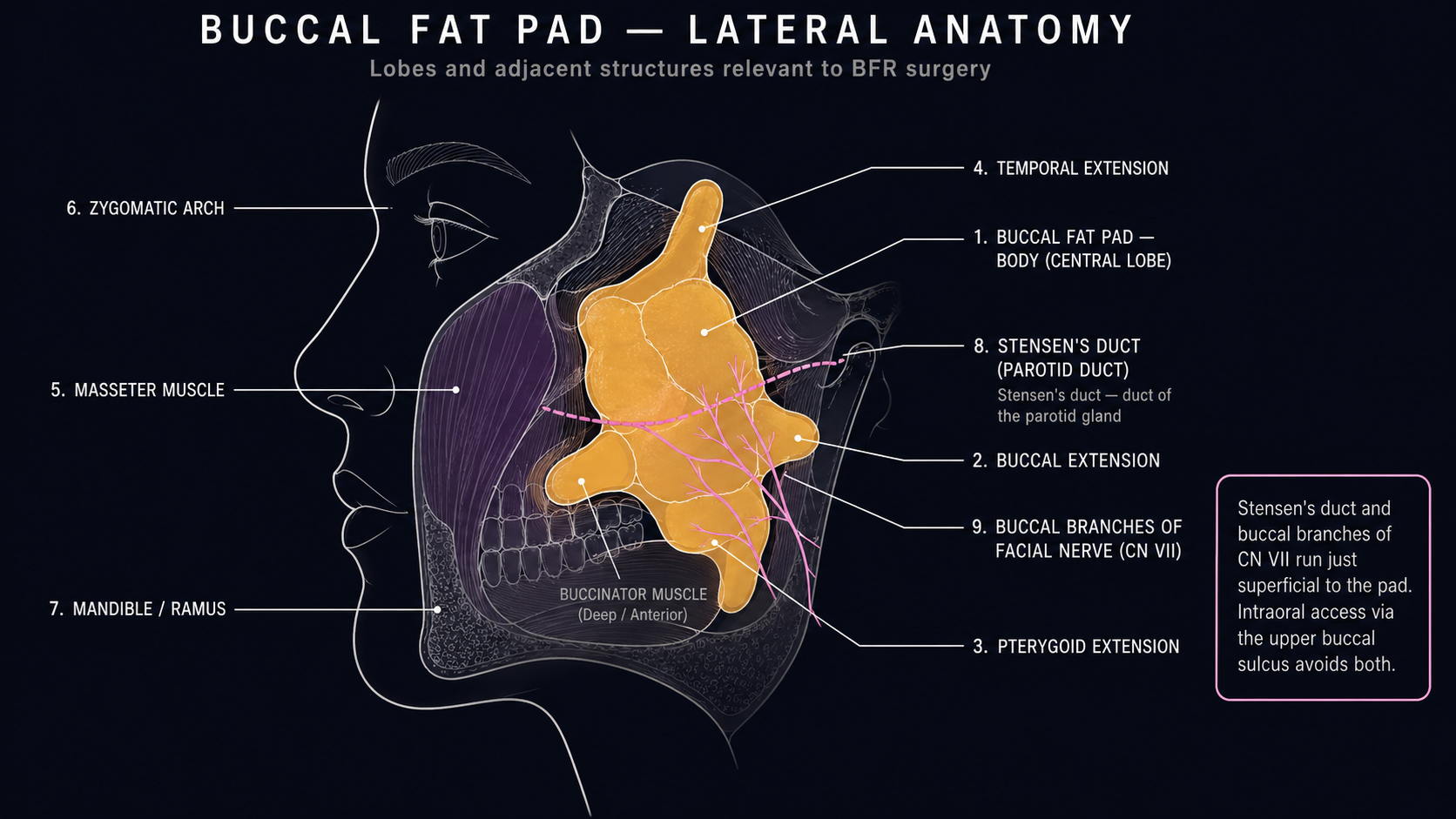
Anatomy of the buccal fat pad
The buccal fat pad (BFP), also called Bichat's fat pad or corpus adiposum buccae, is not ordinary subcutaneous fat. It's encapsulated, has its own fibrous fixation ligaments and segmental blood supply, and is largely hormonally insensitive — its volume does not track BMI in most studies the way subcutaneous fat does. Structural fat, more analogous to orbital or palmar fat pads than to cheek subcutaneous tissue.
The dominant modern model (Zhang et al., 2002) describes three lobes — anterior, intermediate, and posterior — with the posterior lobe further divided into four extensions:
- Buccal extension (most superficial, lying inferior to Stensen's duct) — the part removed in cosmetic BFR
- Pterygoid extension (deep)
- Pterygopalatine extension (deep)
- Temporal extension (deep)
The buccal extension plus posterior body together represent roughly half the total BFP volume — and this is the portion targeted in cosmetic buccal fat removal. The deeper extensions are not surgically accessed in standard bichectomy.
Quantitative anatomy
From Loukas et al. (2006), 80-cadaver study — the reference dataset:
| Parameter | Males | Females |
|---|---|---|
| Mean total BFP volume | 10.2 mL (range 7.8–11.2) | 8.9 mL (range 7.2–10.8) |
| Mean weight | 10.0 g | 9.4 g |
| Mean thickness | 6.1 mm | 5.8 mm |
The male–female difference is roughly 1.3 mL — about 13% — and was not statistically significant in Loukas's dataset. Critical for FFS reasoning: the BFP is not a strongly sexually dimorphic structure the way the frontal sinus, mandibular angle, or zygomatic arch are.
A 2025 CT study (Yardimci et al.) on Turkish patients actually found females had lower BFP volume than males in the 18–29 age range, but a Brazilian study the same year found no correlation with sex, BMI, or skin color — only age. The peer-reviewed evidence on sex dimorphism is genuinely conflicting, small-sample, and shows substantial overlap.
The BFP grows rapidly from ~4,000 mm³ at age 10 to ~8,000 mm³ by age 20, then declines gradually to ~7,000 mm³ by age 50, with continued atrophy in the elderly.
Surgical hazards immediately adjacent
| Structure | Why it matters |
|---|---|
| Stensen's (parotid) duct | Pierces the buccinator at the upper second molar; passes through or just superior to the anterior lobe. Identifying its papilla is the single most critical landmark in surgery. |
| Buccal branches of the facial nerve (CN VII) | Lie over or within the anterior lobe and the buccal extension — the at-risk structure for permanent smile asymmetry. |
| Facial artery and vein | Run along the anterior border |
| Transverse facial artery | Crosses the field |
| Sphenopalatine artery and pterygoid venous plexus | Lie deep, with rare reports of catastrophic bleeding requiring angiographic embolization |
The BFP is anatomically distinct from the malar fat pad (the superficial subcutaneous "apple of the cheek") and does not contribute to jowls. Confusing these compartments is one of the most common patient errors when researching the procedure.
How it ages — the case against BFR in young patients
This is where the controversy lives. The argument against routine BFR in patients under ~35 — especially FFS patients, often in their 20s with decades of facial change ahead — synthesizes four well-established lines of evidence with one weakly-evidenced extrapolation.
1. The compartmental theory of facial aging is robust
Rohrich and Pessa (2007–2009) established that subcutaneous facial fat is partitioned into discrete compartments separated by fascial septa, and that these compartments do not age uniformly:
- Deep compartments (deep medial cheek fat, sub-orbicularis oculi fat) atrophy preferentially
- Superficial compartments (nasolabial, jowl) descend and accumulate inferiorly
The youthful "inverted triangle of youth" inverts: by the 50s, fullness migrates from upper cheek to lower cheek and jowl, while the upper midface deflates.
2. Bone resorbs in predictable patterns
Mendelson and Wong (2012), Pessa (1998), and Shaw and Kahn (2007) used 3D-CT to document selective bone loss with age:
- Maxillary angle decreases by roughly 10° between under-30 and over-60
- Pyriform aperture, superomedial and inferolateral orbital rims, and prejowl mandible all resorb
The bony platform supporting the cheek soft tissues moves backward and downward with age, so any pre-existing soft-tissue volume deficit becomes more visible.
3. The buccal extension itself appears to deflate
Gierloff et al. (2012) demonstrated on cadaver CT that aging produces "an inferior migration of the midfacial fat compartments and an inferior volume shift within the compartments… Additional distinct compartment-specific changes (e.g., volume loss of the deep medial cheek fat and buccal extension of the buccal fat pad) contribute to the appearance of the aged face."
The sample was small (n=12) and findings on whole-BFP aging are contested — Yardimci 2025 actually found increased BFP volume with age — but the buccal-extension-specific deflation pattern is consistent with what facial-aging surgeons see clinically.
4. The remaining BFP cannot compensate
The pad's lobes are anatomically segregated by capsules and septa. Once the buccal extension is removed, the deeper extensions cannot migrate to fill the territory, and the fat does not regenerate. BFR is biologically irreversible.
5. The extrapolation: stacked deflation produces premature gauntness
This is the part that lacks direct longitudinal evidence. The argument: a patient who undergoes BFR at 25 enters the natural aging cascade — deep medial cheek fat atrophy, SOOF atrophy, buccal extension atrophy, maxillary retrusion, mandibular resorption — already missing ~3–5 cc of structural support per side. The surgical deficit and the natural deficit are additive, and at age 50 the cumulative hollowing is greater than it would have been without surgery.
The colloquial terms — "Joker face," "skeletal," "gaunt," "hollow cheek" — describe excessive submalar hollowing, visible shadowing of the buccal recess, and a harsh transition from cheekbone to jaw.
The most authoritative cautionary publication is Rohrich, Stuzin, Savetsky and colleagues, "The Role of the Buccal Fat Pad in Facial Aesthetic Surgery" (Plast Reconstr Surg 2021):
"Although this procedure is great for social media and seemingly beneficial for jawline aesthetics, the evidence remains limited as to whether or not this is an effective long-term solution. How much the buccal fat pad persists or diminishes as we age is an area of debate. However, the possibility of causing premature aging and midface distortion in the long run is disconcerting."
Weniger and Weidman's 2019 systematic review concluded that of 121 candidate citations, only 11 met inclusion criteria, and none had long-term patient follow-up.
Honest framing: the "BFR ages you 20 years later" claim is biologically plausible, consistent with the science of fat-compartment and bone aging, and the consensus opinion of leading facial aesthetic surgeons. But it has not been demonstrated in a longitudinal cohort study. The strongest evidence is indirect, and a serious patient should weigh expert consensus accordingly.
Why FFS surgeons split — by name
The FFS field is genuinely split, and the split runs along clear lines. The most published, academically-engaged FFS specialists tend toward refusing or de-emphasizing BFR; a smaller cohort centered on Spiegel performs it selectively.
| Surgeon / Group | Position |
|---|---|
| Deschamps-Braly (San Francisco) | Does not list BFR among FFS procedures. Practice philosophy is the opposite — adding volume via fat grafting. "We find many patients ask for cheek implants when, in fact, their issue is age-related deflation… we most often recommend lipo filling of the cheeks." |
| FACIALTEAM (Capitán & Simon, Marbella) | Effectively does not include BFR. Capitán-Simon textbook: "Prominent, round cheeks in the middle third of the face are compatible with femininity because women have a greater concentration of fat in this area." In their model, soft-tissue cheek fullness is itself feminine. |
| van de Ven (2pass Clinic, Antwerp) | Does not list BFR among middle-face procedures. Cheek treatment is augmentation (PEEK implants and lipofilling). |
| Toby Mayer (Beverly Hills) | Most direct anti-BFR stance. "Cheek implants will give you more feminine facial balance. I do not think that buccal fat removal will give you a more feminine face and you will need that as you age!" |
| Spiegel (Boston) | Most prominent FFS surgeon who does perform BFR; selective and explicitly age-cautious. "Something that may look good at 18 years old may not look good at 40." Recommends BFR only for "select patients." |
| Mardirossian (Florida/VA) | Performs routinely, often with cheekbone reduction |
| Harrison Lee (Beverly Hills) | Selective; often in revision FFS |
| Keojampa (Spiegel-trained) | Does not feature it |
| Zukowski (NJ) | Does not feature it |
| Weinfeld (Austin) | Includes it |
| IM Gender (Spain) | Conditional with explicit contraindications: "Not recommended for patients with very thin faces, as natural fat loss over time may accentuate a hollowed or aged appearance." |
Broader plastic surgery commentary:
- Hussain (ASPS): "If you trade a full cheek with a mid-cheek furrow, you've advanced your perceived age by a decade or more."
- Matarasso: "Removing buccal fat from someone who does not need the operation could potentially leave the face looking too boney in old age."
Neither ASPS, ISAPS, nor WPATH SOC-8 has issued a formal position on BFR in FFS specifically — the procedure sits in surgeon-and-patient-discretion territory.
The 2024–2026 consensus, as best one can read it, is measured retreat from BFR enthusiasm in both general cosmetic surgery and within FFS. The post-TikTok backlash has reinforced the volume-preservation philosophy that the leading FFS surgeons already held.
Patient selection — who is actually a good candidate
The honest answer is a minority of FFS candidates.
| Favoring BFR | Arguing against |
|---|---|
| Genuinely full or "round" lower midface that persists at stable healthy weight | Low BMI |
| Age over 30 (ideally over 35) | Age under 30 |
| Normal-range BMI (18.5–24.9) | Lean or angular baseline facial structure |
| Good skin elasticity | Thin or aged skin |
| Family history of retained facial fullness into 50s–60s | Already-defined cheekbone with submalar concavity |
| Pinch test confirms fullness is in buccal compartment (not masseter or generalized SC fat) | Family history of thin or sunken aging |
| HRT duration ≥1–2 years to allow estrogen-driven redistribution to stabilize | Planned aggressive skeletal feminization in the same operative session — mandible and chin work often eliminates the rationale for soft-tissue subtraction |
The most important practical point experienced FFS surgeons make: fix the bone first, then look at the soft tissue. Skeletal narrowing (mandibular angle reduction, jaw tapering, genioplasty) often substitutes entirely for BFR by shrinking the lower-face silhouette directly. See Mandible Contouring and Genioplasty.
HRT effects matter
The Moghadam et al. 2024 UCLA study used CT volumetrics in 45 transfeminine patients and found that ≥2 years of feminizing HRT increased malar fat by 1.6× (3.4 → 5.5 cm³) and temporal fat by 1.4× (2.0 → 2.8 cm³) versus <2 years (p<0.001 and p=0.01 respectively). The buccal fat pad itself was not measured — a notable gap — but the broader principle that estrogen drives subcutaneous facial fat accumulation argues for waiting at least 1–2 years on HRT, possibly the 2–5 year window cited by UCSF Transcare for facial fat to "finish redistributing."
Demographic skew matters
FFS patients trend younger, have decades more facial aging ahead, will continue gaining malar and temporal fat from HRT for years post- surgery, and are seeking long-term gender perception rather than a trend look. All of this argues for conservatism.
Is a slimmer lower face actually feminine?
Honest answer: weakly, and not via the BFP specifically. The Loukas 2006 sex difference is small and statistically non-significant. Cross-cultural research on facial sexual dimorphism (Perrett 1998, Kleisner 2021, Fiala 2023) consistently identifies upper-face features — forehead, brow ridge, malar projection — and overall lower-face length and width as the dominant cues, not buccal fullness.
The "heart-shape" or "inverted triangle" feminine ideal articulated in the FFS technique literature describes the combination of malar prominence above and tapered jaw below; the buccal hollow is a secondary contributor, and is more youth-coded than sex-coded.
The argument that BFR is feminizing per se is weaker than commonly assumed; the argument that aggressive BFR is masculinizing — by producing harsh, angular, hollow cheeks — has more support.
Surgical technique
The intraoral approach is now standard. Under general anesthesia in the FFS context (because BFR is combined with much larger procedures); standalone cosmetic BFR is often performed under local with sedation in 30–45 minutes per side.
Sequence:
- Identify the papilla of Stensen's duct at the level of the second maxillary molar.
- Make a horizontal 1–1.5 cm incision in the buccal mucosa about 1 cm inferior and posterior to the duct, through mucosa and the buccinator muscle.
- Use a closed hemostat to spread (not cut) the buccinator fibers in the direction of the facial nerve.
- Apply gentle external pressure on the cheek with the non-dominant hand to deliver the yellow BFP into the surgical field.
- Open the thin capsule and passively tease fat out, not pull aggressively — the Matarasso doctrine: only fat that protrudes easily with gentle pressure should be excised.
- Excise the base, confirm hemostasis.
- Close with one or two 4-0 resorbable sutures.
Conservative versus aggressive resection
The most consequential technique decision.
| Source | Volume excised per side |
|---|---|
| Traboulsi-Garet et al. systematic review | Mean 2.74 ± 0.69 mL (range 1.8–4.9 mL) |
| StatPearls reference | 3–5 cc — roughly 30–50% of the buccal extension |
Conservative FFS surgeons (Spiegel and trainees) take less. Aggressive resection is strongly correlated with over-resection, hollow appearance, and parotid or facial nerve injury.
Liposuction is not used in standard technique — the fat is passively delivered, not vacuumed. The few sources describing suction-assisted extraction are outliers.
In FFS, BFR is almost never standalone — it's one component of a multi-procedure session. OR-time addition is modest (under an hour). FFS surgeons also tend to be more conservative because trans women on long-term HRT already have fuller malar and temporal fat — overcorrection risk is higher than in general cosmetic patients.
Combination with other midface procedures
The defining FFS midface paradox: surgeons frequently add fat (or implants) to the upper midface while removing it from the lower midface in the same session. Hu et al. 2023 articulates this as deliberate strategy — cheek augmentation creates the upper vertex of the heart shape (malar prominence) while selective BFR creates the concavity of the ogee curve below.
Three combination patterns:
| Pattern | When it's used |
|---|---|
| Cheek implants + BFR | Patients wanting durable, defined upper-cheek projection (silicone or PEEK) |
| Lipofilling + BFR | Soft, natural projection without implant-related risks; the Deschamps-Braly preference |
| Skeletal narrowing alone (mandibular contouring + genioplasty) | Often substitutes entirely for BFR by shrinking the lower-face silhouette directly |
The sequencing question — skeletal first, soft-tissue second — is the single most important decision an FFS patient should discuss in consultation. See Procedure Staging.
In the East Asian aesthetic context, BFR is often paired with zygomatic reduction and V-line jaw surgery to achieve the "small face" or "egg shape" — a culturally specific paradigm distinct from the Western inverted-triangle FFS ideal.
Recovery
One feature surprises nearly every patient: swelling makes the cheeks look fuller, not slimmer, for the first several weeks. Universally described by surgeons but not formally quantified. Real, alarming if you're not warned, and resolves.
| Phase | What to expect |
|---|---|
| Days 0–3 | Mild-to-moderate cheek and jaw discomfort, comparable to wisdom-tooth extraction. Liquid/soft diet only — smoothies, yogurt, broth, scrambled eggs. No straws (suction can disrupt incisions). No spicy/acidic/hot foods. Cold compresses externally; head elevated for sleep; salt-water rinses several times daily. Most surgeons prescribe a 5-day antibiotic course and chlorhexidine mouthwash. Pain typically mild — many surgeons report acetaminophen alone is sufficient. |
| Days 5–7 | Swelling peaks. |
| Weeks 1–3 | Cheeks may genuinely look fuller than baseline, sometimes asymmetrically as edema resolves unevenly. Trismus (jaw stiffness, ~30% incidence) is common during this phase and resolves within ~15 days. Standalone BFR: return to desk work in 3–5 days. Combined FFS: dominated by the larger procedures (forehead, jaw); 2–3 weeks return to work, 4–6 weeks for exercise. |
| Months 2–3 | Visible slimming begins. |
| Months 3–6 | Slimming becomes pronounced. |
| Months 6–12 | Final result settles. When BFR is combined with major FFS, the full final aesthetic typically takes ~1 year to express. |
Combining BFR with other FFS procedures does not significantly extend overall recovery — major bony work dominates the timeline regardless, and buccal swelling is somewhat masked by overall facial swelling.
Risks and complications
Reported overall rates span 8.45% to 25%, depending on what is counted. The 2025 Pimentel et al. systematic review (n=308) found a 25% headline rate, but this includes transient edema (38.4%), trismus (30.1%), and minor pain (19.4%). "Serious" complications — those involving nerve, duct, artery, infection, or asymmetry requiring revision — cluster around 5%.
| Complication | Rate / detail |
|---|---|
| Parotid (Stensen's) duct injury | The signature anatomic risk. Cadaveric: duct crosses superficial to buccal extension in 42% of cases, deep in 26%, along superior border in 32%. Clinical injury rare (probably <1–2%) but underreported. Sequelae: sialocele, salivary fistula, infection. Management escalates from aspiration + antibiotics through botulinum toxin → pressure dressings → duct repair/stenting → rare parotidectomy. |
| Facial nerve buccal-branch injury | Smile asymmetry. Most cases are transient neuropraxia from retraction. Permanent paralysis ~0.97% in meta-analysis. Higher with external (facelift) approach than intraoral. |
| Asymmetry | ~11.65% — partly transient, partly permanent. Surgeons routinely weigh both fat specimens to mitigate. |
| Bleeding / hematoma | Rare |
| Infection | ~0.48% — low given oral environment, mitigated by chlorhexidine prep and antibiotics |
| Numbness | Common transiently; almost always resolves |
| Over-resection | The long-term concern that dominates everything else, because it is irreversible |
Over-resection is the dominant long-term concern. The BFP does not regenerate, and even fat grafting cannot replicate the original buccal architecture. Over-resection produces the gaunt or skeletal appearance that ages poorly. As one Beverly Hills surgeon put it bluntly: the procedure "ages you." The Spiegel Center concedes: "Something that may look good at 18 may not look good at 40."
Regret rates specific to BFR in FFS have not been published. Anecdotally, FFS patients tend to report greater satisfaction with conservative resection than aggressive resection, and FFS surgeons report more revision-restoration requests over time. One Beverly Hills practice (Rezzadeh) estimates ~15% of BFR patients seek corrective procedures within 5 years — a practice-level figure, not population data.
Reversal and revision options
There is no true reversal. The buccal fat pad cannot be regenerated; "reversal" in practice means volume restoration to soften the hollow appearance.
| Option | Detail |
|---|---|
| Hyaluronic acid fillers (Juvéderm Voluma, Restylane Lyft) | Earliest and most reversible. 6–18 months. Useful for testing whether volume restoration would actually improve appearance before committing to a more permanent procedure. |
| Sculptra (poly-L-lactic acid) | Stimulates collagen; lasts ~2 years; multiple sessions required. |
| Autologous fat grafting | Most durable. Fat harvested from abdomen or thigh, processed, injected into the cheek hollow. Retention 50–70%; multiple sessions often needed. Dr. Steven R. Cohen at FACES+ in San Diego has developed a dedicated buccal fat restoration technique. |
| Cheek/malar implants | Address adjacent volume loss but rarely directly substitute for buccal volume. |
Multiple surgeons emphasize that revision is partial, not perfect. "All of our surgeons agree that it requires great skill and experience to fat graft the buccal hollow to undetectable effect, particularly on the lean, thin-skinned patients." (Avance Plastic Surgery: "Correction options are limited and often provide only partial improvement.")
Cost in the FFS context
Standalone cosmetic BFR:
- Mid-range US markets: \(2,000–\)5,000
- Premium Beverly Hills / NYC: \(5,000–\)20,000
- ASPS national-average estimate: \(2,883–\)3,142
In bundled FFS pricing, BFR is typically a \(1,500–\)5,000 line item within a larger quote because the OR-time addition is small.
Insurance coverage is the painful part. Gorbea et al. 2021 reviewed 49 commercial insurers and found 93% had FFS policies but 51% considered FFS cosmetic. Tracheal shave was the most commonly covered FFS procedure (20%); mandibular contouring, frontal cranioplasty, rhinoplasty, blepharoplasty, and rhytidectomy each covered by only 13%. BFR is rarely explicitly listed as a covered FFS procedure even when broader FFS is covered — it usually falls under exclusions like "body contouring (e.g., fat transfer, lipoplasty)."
Only 3 of 50 state Medicaid programs explicitly cover any FFS, 13 prohibit it entirely, 19 have no published policy. California Medi-Cal and a few state-marketplace plans have meaningful FFS coverage with WPATH-style criteria, but buccal fat is often denied as cosmetic even within otherwise-covered FFS. Appeals matter: California DMHC data shows roughly 72% of denials are reversed on appeal.
The TikTok trend and its aftermath
BFR had a genuine cultural moment between roughly September 2021 and early 2023. Chrissy Teigen confirmed the procedure on Instagram in September 2021 (Dr. Jason Diamond, Beverly Hills). Lea Michele's December 2022 viral selfie catalyzed mass speculation, and within weeks Google Trends interest peaked, the TikTok hashtag #BuccalFatRemoval crossed 135 million views, and major outlets published explainer pieces.
ASPS first tracked BFR in 2022, recording 4,543 procedures by ASPS member surgeons — the least common facial procedure they tracked, suggesting the cultural footprint vastly exceeded the actual surgical volume.
Plastic surgery community pushback was sharp and unusually direct. Dr. Marina Gendler (CNN): "The latest trend of buccal fat removal is probably the dumbest trend I've seen in a long time." Even Dr. Jason Diamond, who performed Teigen's procedure, conceded the procedure had been over-marketed.
By 2024–2025, multiple Beverly Hills practices reported a roughly 35% decline in BFR requests from the 2023 peak, with average patient age rising from 23 to 28 — older, better-selected candidates predominating.
For FFS specifically, the trend reinforced an already-existing skepticism. Major FFS practices did not pivot toward marketing BFR during the trend. The trend's main effect on the FFS conversation was probably to increase patient awareness of long-term risks, which has shifted the typical consultation from "do I get this?" toward "do I really need this?"
FFS surgeons vs general cosmetic surgeons
The two surgeon populations think differently about this procedure, and it matters.
FFS-trained surgeons:
- Approach the lower midface skeletally first
- Ask whether mandibular angle reduction, jaw tapering, and genioplasty have already produced sufficient narrowing
- Prefer adding volume (lipofilling, malar implants) over removing it
- Think in 30–50-year horizons because their patients are typically in their 20s–30s
- Are comfortable refusing the procedure or deferring it
- Often perform it conservatively when they do
General cosmetic surgeons:
- More often offer BFR as a standalone, in-office procedure
- During the 2022–2024 trend window, more willing to perform it on younger and lower-BMI patients than FFS-trained surgeons would have been
- Do not typically apply the "skeletal-first" filter
- Treated the procedure as a high-volume, high-margin offering during the trend
For an FFS patient, the practical implication: BFR performed by an experienced FFS surgeon as part of a properly sequenced FFS plan is a meaningfully different procedure — in selection, technique, and aesthetic intent — than the same procedure performed by a general cosmetic surgeon as a standalone trend procedure.
What to ask in consult
| Question | What a good answer sounds like |
|---|---|
| Do I actually need BFR, or is my skeletal plan sufficient? | Surgeon should be willing to argue against the procedure if your jaw/chin work will narrow the lower face directly. |
| Have I been on HRT long enough for malar/temporal fat to stabilize? | ≥1–2 years preferred; possibly 2–5 for full redistribution. |
| How much fat will you remove? | Conservative: under 3 cc per side. Aggressive (>4 cc) is a flag in FFS context. |
| What's your protocol for protecting Stensen's duct and the buccal branches of the facial nerve? | Should reference papilla landmark and spreading (not cutting) the buccinator. |
| What's your over-resection rate, and how do you handle revisions? | Should know their own number; should have a fat-grafting restoration protocol. |
| What does my face look like at 50? | A surgeon comfortable refusing BFR on aging grounds is more trustworthy than one who waves it off. |
| Are you sequencing skeletal feminization before deciding on BFR? | Skeletal first, soft tissue second. Default. |
Bottom line
Buccal fat removal is the FFS procedure where surgeon selection matters most and the long-term stakes are highest. The anatomy is well-understood, the technique is standardized, and short-term complications are low — but the procedure is permanent, the long-term aging risk is biologically plausible if not directly proven, and the feminizing contribution is weaker than commonly assumed.
The buccal fat pad is not strongly sexually dimorphic; HRT actively increases malar and temporal fat over years; skeletal feminization of the jaw and chin often eliminates the rationale for soft-tissue subtraction; and the leading FFS surgeons are split, with Deschamps-Braly, FACIALTEAM, van de Ven, and Mayer effectively declining the procedure, and Spiegel and trainees performing it conservatively in selected patients.
If pursued at all, BFR should be:
- After skeletal feminization
- After at least 1–2 years on HRT
- Conservatively (probably under 3 cc per side)
- In a patient over 30 with normal BMI and good skin elasticity
- By a surgeon who specializes in FFS and is comfortable refusing the procedure when indicated
The strongest case against routine BFR in FFS is not that it cannot be done well — it is that for most candidates, it cannot be undone if it is done badly, and the aging cascade is unforgiving.
A reasonable patient default in 2026: assume you do not need it unless an experienced FFS surgeon, after seeing your skeletal plan and your HRT history, specifically argues that you do.
Sources
Anatomy
- Zhang HM et al. (2002) — Anatomical structure of the buccal fat pad and its clinical adaptations (Plast Reconstr Surg) — three-lobe model with four extensions of the posterior lobe.
- Loukas M et al. (2006) — 80-cadaver study; reference dataset for BFP volume, weight, thickness; sex difference ~1.3 mL (not statistically significant).
- Yardimci SH et al. (2025) — Turkish CT study; conflicting sex dimorphism findings.
- Jackson IT (1999) — BFP age trajectory.
The case against BFR in young patients
- Rohrich RJ, Stuzin JM, Savetsky IL et al. (2021) — The Role of the Buccal Fat Pad in Facial Aesthetic Surgery (Plast Reconstr Surg) — most authoritative cautionary publication.
- Rohrich RJ, Pessa JE (2007–2009) — compartmental theory of facial aging; deep vs superficial compartment differential atrophy.
- Mendelson B, Wong CH (2012) — bone resorption with age (Aesthet Plast Surg).
- Pessa JE (1998) — selective bone loss patterns.
- Shaw RB, Kahn DM (2007) — 3D-CT documentation of facial bone aging.
- Gierloff M et al. (2012) — cadaver CT showing buccal-extension volume loss with age.
- Weniger FG, Weidman AA (2019) — systematic review, 11/121 citations met inclusion criteria; no long-term patient follow-up.
Technique and outcomes
- Hu LE et al. (2023) — FFS midface technique paper articulating the heart-shape / inverted-triangle ideal.
- Pimentel et al. (2025) — J Cranio-Maxillofac Surg; systematic review of 308 patients, 25% headline complication rate including transient edema and trismus.
- Traboulsi-Garet B et al. — systematic review; mean excised volume 2.74 ± 0.69 mL/side.
- Hwang K et al. — cadaveric study of Stensen's duct relationship to buccal extension.
- Weissler EH et al. (2022) — Aesthet Surg J Open Forum; parotid duct injury management algorithm.
- Capitán L et al. (2024) — J Craniomaxillofac Surg; soft-tissue complications after FFS, emphasizing re-suspension and readaptation over subtraction.
HRT effects on facial fat
- Moghadam et al. (2024) — UCLA CT volumetric study (n=45); ≥2 years of HRT increased malar fat 1.6× and temporal fat 1.4× versus <2 years. PMID 39480648.
Sex dimorphism and aesthetics
- Perrett DI et al. (1998) — facial sexual dimorphism research.
- Kleisner K et al. (2021) — cross-cultural facial dimorphism.
- Fiala V et al. (2023) — facial sex perception cues.
Insurance and policy
- Gorbea E et al. (2021) — Otolaryngol Head Neck Surg; 49-insurer FFS coverage analysis.
- Coleman et al. (2022) — WPATH Standards of Care v8 — facial gender surgery medical necessity criteria; no specific position on BFR.