Wendler's Glottoplasty
The dominant modern voice-feminization surgery. Wendler's glottoplasty de-epithelializes a strip along the medial edge of the anterior portion of both true vocal folds and sutures the raw surfaces together, creating a permanent anterior web (synechia). The web shortens the vibrating segment of the folds, which raises fundamental frequency. The whole operation is performed endoscopically through a suspension micro-laryngoscope — no neck incision, no cartilage manipulation.
Originally described by Jürgen Wendler in 1990 and refined by Gross (1999) and others, the technique has displaced earlier external approaches — most notably Cricothyroid Approximation as a standalone — for most candidates seeking durable pitch elevation without external scarring. For laser-based endoscopic alternatives see LAVA & Other Techniques; for the more aggressive open approach see Feminization Laryngoplasty. For who should and shouldn't be on the table at all, see Candidacy & Timing.
Surgery raises the floor, not the ceiling
Wendler's reliably lifts habitual speaking pitch by 30–50 Hz in most series. It does not address resonance, intonation, prosody, or breath support — the things that make a voice read as feminine in conversation. Patients who skip voice therapy and bet entirely on surgery routinely report disappointing perceived results despite a measurably higher F0. Plan on therapy before and after the operation; see Recovery & Voice Training.
Mechanics: how pitch is raised
Fundamental frequency (F0) of phonation is governed by three variables:
- Vibrating length of the vocal folds — shorter is higher
- Tension along the folds — greater is higher
- Mass per unit length — less is higher
Wendler's targets length. Fusing the anterior 1/3 to 1/2 of the membranous fold edges leaves only the posterior remnant free to vibrate. The acoustic effect is the same as capoing a guitar string higher on the neck — same tension, shorter length, higher pitch.
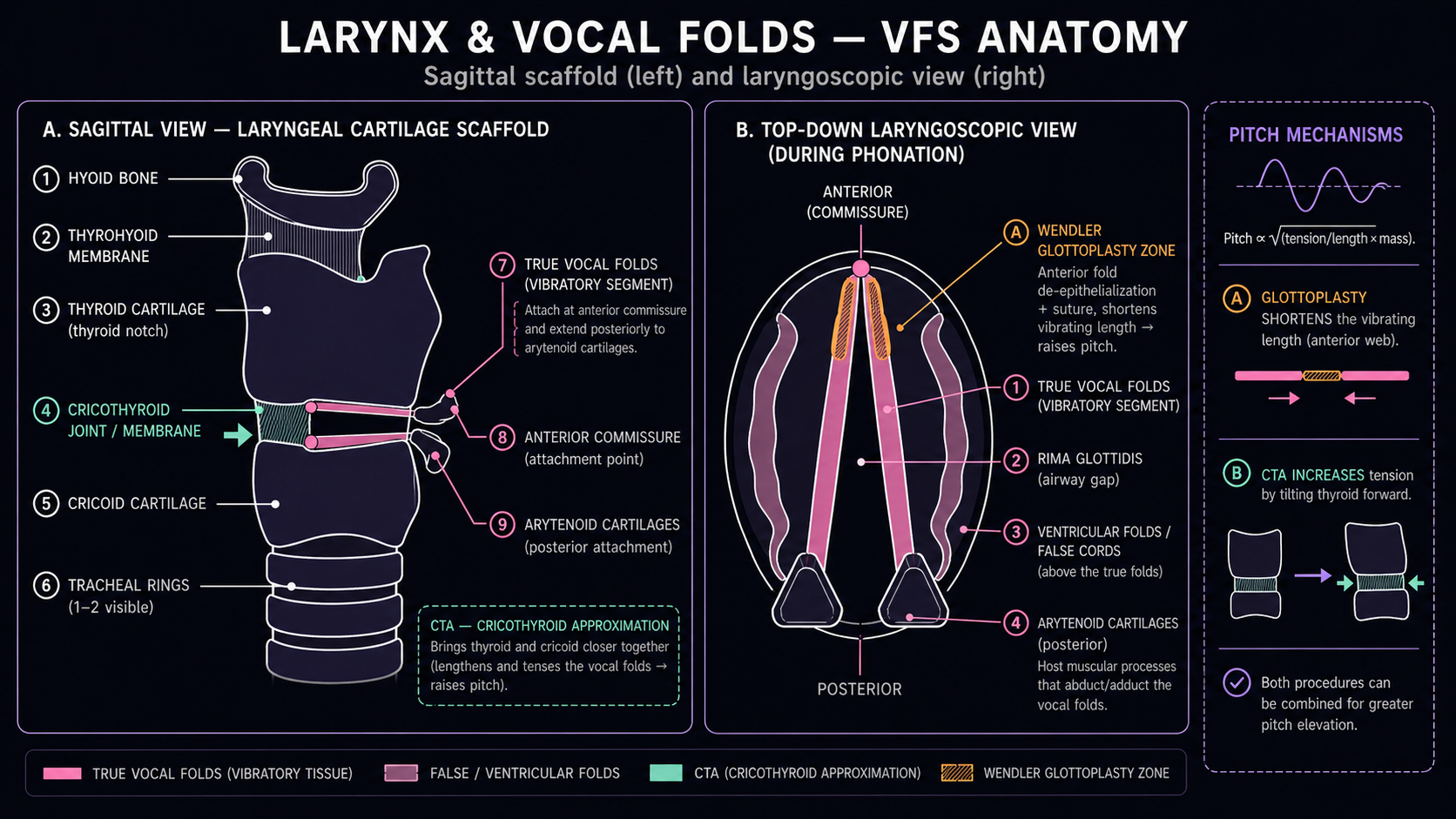
The three families of pitch-raising surgery target different variables, which explains why their outcome profiles, reversibility, and risk patterns differ:
| Procedure | Target variable | Approach | Reversibility |
|---|---|---|---|
| Wendler's glottoplasty | Length (shorten) | Endoscopic, suture anterior web | Limited; web release possible |
| CTA (Isshiki IV) | Tension (increase) | External, suture cricoid to thyroid | Sutures can loosen or be removed |
| LAVA / FemLar (laser) | Length + mass | Endoscopic CO2 laser ablation of mucosa | Heals as scar; not easily reversed |
CTA is commonly stacked on top of Wendler's in combined protocols (see Yeson below). LAVA and FemLar are alternative endoscopic approaches with their own trade-offs and are covered on separate pages.
The de-epithelialization step
This is the maneuver that distinguishes Wendler's from earlier anterior-web attempts. Pre-Wendler techniques tried to suture mucosa directly to mucosa. They failed predictably — the epithelium prevents true tissue union, so the suture either cheese-wires through the mucosa during phonation or the web breaks down within weeks and pitch returns to baseline.
Wendler's contribution was to strip a strip of epithelium from the medial edge of each fold (typically with cold microscissors or a low-power CO2 laser) before suturing. The exposed lamina propria on each side fuses to its mirror surface during healing, producing a true scar union rather than a transient mucosal apposition.
Practical consequences flow from that detail:
- Pitch gain is durable on the order of years, not weeks.
- Voice rest is mandatory while the union forms (1–2 weeks of strict silence).
- The risk profile shifts toward scar-related issues — granuloma, web extension, vocal-fold stiffness — rather than early dehiscence.
Whispering is not voice rest
Whispering generates substantial vocal-fold contact stress and is explicitly forbidden during the strict-rest period. Patients who whisper through the first two weeks have higher early dehiscence rates. Communicate by writing or typing until the surgeon clears phonation.
Pitch gain — typical range and published series
Mean F0 gain from a standalone Wendler's procedure clusters in the 30–50 Hz range across published cohorts (measured on sustained /a/ or connected-speech average). Individual results vary widely with anatomy, surgeon technique, how much fold length is sutured, and whether CTA is added.
Mapping to a transfeminine baseline near 120 Hz:
- 30 Hz gain → ~150 Hz (low end of cisgender female range)
- 50 Hz gain → ~170 Hz (comfortably in cisgender female range)
- Combined Wendler's + CTA → 60–90 Hz gain reported in some Korean series
| Series (lead author, country) | n | F0 pre | F0 post | Δ Hz | Follow-up |
|---|---|---|---|---|---|
| Nuyens et al. (Ghent, Belgium) | ~30 | ~125 Hz | ~175 Hz | ~50 | 6–12 mo |
| Mañas et al. (Barcelona, Spain) | ~25 | ~120 Hz | ~165 Hz | ~45 | 6 mo |
| Casado / Rinaldi (Florence, Italy) | ~40 | ~118 Hz | ~155 Hz | ~37 | 12 mo |
| Yeson Voice Center (Seoul, glottoplasty + CTA) | 100s | ~110–120 Hz | ~190–210 Hz | ~70–90 | 6–12 mo |
| Anderson (US, Wendler-style + injection) | ~20 | ~120 Hz | ~155 Hz | ~35 | 6 mo |
| Kim (Korea, glottoplasty + ACA) | ~30 | ~115 Hz | ~180 Hz | ~65 | 12 mo |
Numbers are approximate ranges across published reports; individual papers report sub-cohorts and different acoustic measurements (mean F0 on /a/, F0 in connected speech, fundamental frequency at habitual pitch). See Sources for primary citations.
Edema masks the real result for months
Pitch is typically higher than its eventual settled value in the first weeks because of laryngeal edema and tight scar — and then drops as swelling resolves. Final F0 stabilizes around 6 months. Do not judge the result before 3 months and ideally 6.
One-stage vs two-stage protocols
One-stage is the default. The full de-epithelialization and suturing happens in a single operative session, typically 60–120 minutes. Most published high-volume series — Nuyens, Mañas, Casado — use one-stage protocols.
Two-stage protocols are used by some surgeons (parts of the Yeson program, revision contexts):
- Stage 1: de-epithelialization with placement of holding sutures.
- Stage 2 (weeks later): inspection, additional suturing, and/or addition of CTA via an external approach.
The rationale for staging is calibration — the surgeon assesses pitch and union before committing to a longer web, and CTA tension can be tuned as a separate step. The cost is a second anesthetic, a second voice-rest period, and correspondingly higher financial and recovery burden. Two-stage is not inherently better; it is a different trade.
Variants and modifications
Anterior commissure advancement (ACA)
ACA augments the anterior web by also advancing the anterior commissure itself — a small wedge of thyroid cartilage is repositioned anteriorly, further shortening the vibrating segment and increasing tension. Reported to add ~10–20 Hz over standalone Wendler's. Trades a higher complication rate (cartilage manipulation, possible airway implications) for greater pitch gain. Largely confined to specific Korean centers.
Mañas modification (Spain)
Refinements published by Mañas and colleagues at Hospital Clínic de Barcelona:
- More extensive de-epithelialization along a longer anterior segment.
- Continuous suture pattern rather than interrupted sutures.
- Specific knot placement that avoids suture extrusion into the airway.
Reported to reduce early dehiscence rates and produce more uniform anterior webs. Pitch gains are comparable to standard Wendler's (~40–50 Hz) — the modification targets reliability of the result, not magnitude.
Yeson Voice Center combined approach (Korea)
Yeson (Dr. Hyung-Tae Kim and colleagues, Seoul) is best known for routinely combining three procedures in one session:
- Glottoplasty (Wendler-style anterior web)
- CTA via small external incision
- Optional tracheal shave (chondrolaryngoplasty)
This combined approach produces the largest pitch gains in the published literature — often 70–90 Hz — at the cost of longer operative time (~3–4 hours total), external scarring from CTA and shave, and the stacked risk profile of three procedures rather than one. Yeson's high-volume case series form the largest single body of VFS outcome data.
Other modifications
- Laser-assisted de-epithelialization. CO2 laser instead of cold microscissors for the epithelial strip. Faster and less bleeding, but risks deeper thermal damage to the lamina propria with long-term stiffness implications. Some surgeons treat this as a hybrid with FemLar/LAVA — see LAVA & Other Techniques.
- Knotless / barbed sutures. Experimental; published evidence is thin.
- Combined with vocal-fold injection. Rare; an attempt to add bulk reduction to the length-shortening effect (Anderson's protocol uses a temporary injection to assist web maturation).
Operative time and anesthesia
- Standalone Wendler's: 60–120 minutes operative time.
- Combined Wendler's + CTA: 2.5–4 hours.
- General anesthesia, endotracheal intubation with a small-diameter tube to leave room for the laryngoscope and instruments.
- Suspension micro-laryngoscopy throughout — the laryngoscope braces against a chest plate to stabilize the airway view and free both of the surgeon's hands.
- Same-day discharge is common for standalone Wendler's; combined approaches often involve one overnight observation.
Recovery timeline
| Phase | Duration | Notes |
|---|---|---|
| Strict voice rest | 7–14 days | No phonation. Whispering also forbidden. Communicate by writing or typing. |
| Light voice use | Weeks 2–4 | Short, soft phonation. No singing, shouting, or sustained talking. |
| Gradual return | Weeks 4–8 | Normal conversational use. No vocal exertion. |
| Voice therapy | Starts ~4–6 weeks post-op | Critical for consolidating feminine voice patterns. |
| Final pitch settling | 3–6 months | Mucosal edema resolves; scar matures. F0 may rise initially, then settle. |
| Full scar maturation | 12 months | Long-term durability assessed at this point. |
Detailed protocols, voice-therapy sequencing, and singer-specific considerations live on Recovery & Voice Training.
Patient-reported outcomes
Common instruments in the VFS literature:
| Instrument | What it measures | Typical post-op direction |
|---|---|---|
| VHI-10 (Voice Handicap Index, 10-item) | Self-perceived voice handicap | Drops (improves) post-op |
| TVQ-MtF (Transsexual Voice Questionnaire) | Voice-related dysphoria, congruence | Drops (improves) post-op |
| GRBAS | Clinician-rated voice quality (Grade, Roughness, Breathiness, Asthenia, Strain) | Slight worsening early, returns toward baseline |
| Acoustic measures (F0, jitter, shimmer, HNR) | Objective voice signal | F0 rises; jitter/shimmer transiently worsen |
TVQ-MtF improvements are robust and large (effect sizes typically ≥1.0 SD). VHI-10 improvements are more variable — some patients trade lower perceived handicap (less dysphoric voice) for new vocal-quality complaints (roughness, vocal fatigue). That tradeoff is real and should be discussed pre-op.
Failure rates and revision
Reported failure or suboptimal-outcome rates: ~5–15% across published series. "Failure" is defined inconsistently and usually means one of:
- Anterior web dehiscence — suture line breaks down, pitch returns near baseline.
- Insufficient pitch gain despite an intact web.
- Excessive web — airway or breathing complaints, vocal fatigue, dysphonia.
- Unacceptable voice quality — severe roughness, breathiness, diplophonia.
Revision options:
- Re-do glottoplasty extending the web for insufficient gain or partial dehiscence.
- Web release (cutting back the web) for excessive web or airway issues.
- Adding CTA externally for additional pitch without further endoscopic web extension.
- LAVA or FemLar as salvage or augmentation — see LAVA & Other Techniques.
Revision rates run higher in any surgeon's first cohort (learning curve) and lower at high-volume centers. Detailed complication management lives on Risks & Complications.
Risks and complications
| Complication | Notes |
|---|---|
| Granuloma at suture site | Most common minor complication; usually self-limiting or steroid-responsive |
| Web dehiscence | Early, before scar union forms; correlates with vocal use during voice rest |
| Excessive web extension | Causes breathiness, vocal fatigue; may need web-release revision |
| Vocal-fold stiffness | From over-aggressive de-epithelialization or thermal injury with laser |
| Loss of vocal range | 3–6 semitones of upper range typical; lower range often more; singers beware |
| Dental injury from laryngoscope | Standard micro-laryngoscopy risk; mouthguard used |
| Standard anesthesia risks | General anesthesia, endotracheal intubation |
Singers should think hard before signing
Vocal-range loss is largely unavoidable. A web that shortens vibrating length raises the floor and lowers the ceiling — the upper range loses less in absolute terms but the lower range often loses more, and singers describe the change as bigger than the F0 numbers suggest. If singing is part of your livelihood or identity, get a second consult before committing.
Distinguishing Wendler's from CTA and FemLar
A side-by-side that maps directly onto the candidacy decision:
| Question | Wendler's | CTA | FemLar / LAVA |
|---|---|---|---|
| External scar? | No | Yes (small neck incision) | No |
| Targets length? | Yes (anterior web) | No | Yes (mucosal ablation) |
| Targets tension? | No | Yes (cricoid-thyroid suture) | Indirect |
| Reversibility | Limited (web release possible) | Sutures removable | Not reversible |
| Pitch gain (typical) | 30–50 Hz | 20–40 Hz | 30–50 Hz |
| Voice-quality risk | Roughness, breathiness | Fatigue, lower-range loss | Stiffness, scar quality |
| Stackable with others? | Yes — CTA commonly added | Yes — base for combined | Sometimes used as revision |
Wendler's is the right primary operation for the median candidate: an adult who has done some voice therapy, wants durable pitch elevation, can afford 1–2 weeks of strict voice rest, and is not a professional singer. The candidacy details that nuance this default — hormone status, GERD, anticoagulation, body habitus — live on Candidacy & Timing.
Sources
- Wendler J. Vocal pitch elevation after transsexualism male-to-female. Proceedings of the Union of European Phoniatricians, Salsomaggiore, 1990.
- Gross M. Pitch-raising surgery in male-to-female transsexuals. Journal of Voice, 1999.
- Anderson JA. Pitch elevation in transgendered patients: anterior glottic web formation assisted by temporary vocal fold injection. Journal of Voice, 2014.
- Nuyens M, Bachmann M, et al. (Ghent / Bern groups). Outcome reports on endoscopic glottoplasty in transgender women. European Archives of Oto-Rhino-Laryngology, 2010s–2020s.
- Mañas R, et al. Modified Wendler glottoplasty: technique and results in transgender women. Acta Otorrinolaringológica Española, late 2010s.
- Casado JC, Rinaldi V, et al. Wendler glottoplasty in male-to-female transsexual patients: outcomes and patient-reported voice femininity. Casado / Rinaldi, 2010s–2020s, European Archives of Oto-Rhino-Laryngology / Journal of Voice.
- Kim HT. (Yeson Voice Center, Seoul). Multiple publications on combined glottoplasty + CTA outcomes; large case-series papers in Journal of Voice and Korean ENT journals.
- Thomas JP, Macmillan C. Feminization laryngoplasty: assessment of surgical pitch elevation. European Archives of Oto-Rhino-Laryngology, 2013.
- Song TE, Jiang N, 2017, Otolaryngology — Head and Neck Surgery. Transgender phonosurgery systematic review and meta-analysis.
- Van Damme S, et al., 2020s, Journal of Voice. Voice-related quality of life after Wendler's glottoplasty: systematic review.
- Dacakis G, Davies S, Oates JM, Douglas JM, Johnston JR. Development and preliminary evaluation of the Transsexual Voice Questionnaire for male-to-female transsexuals. Journal of Voice, 2013.
- Rosen CA, Lee AS, Osborne J, Zullo T, Murry T. Development and validation of the Voice Handicap Index-10. Laryngoscope, 2004.