Facelift (Rhytidectomy)
A soft-tissue lift that repositions the cheek, jowl, and neck skin and underlying SMAS (the fibrous layer beneath the skin) to reduce sagging and sharpen the jawline-to-neck transition.
Facelift is not a feminizing procedure on its own — it doesn't change bony anatomy or address sex-dimorphic features directly. In the FFS context it has a specific role: managing the soft-tissue consequences of mandible reduction when the skin envelope no longer matches the smaller skeleton beneath.
Facelift is the procedure most clearly staged after FFS bone work
Of all FFS-adjacent procedures, facelift has the strongest staging argument. Skin retraction after mandibular contouring continues for 9–12 months; performing the lift in the same session commits skin redraping vectors before you know what the underlying skeleton will support. The published consensus interval is 6–12 months between FFS bone work and facelift, with 1 year being the most commonly cited optimum. See Procedure Staging for the full rationale.
Why FFS patients consider facelift
Two distinct populations:
- Patients with iatrogenic jowling after mandibular reduction. This is the FFS-specific case. The 2022 paper by Rochlin, Morrison, Rohrich, and Satterwhite on post-FFS facelift describes iatrogenic jowling as a predictable consequence of mandibular reduction — the soft-tissue envelope is suddenly draped over a smaller skeleton, and the tissue doesn't always shrink-wrap to fit. Patients with mandibular contouring were 9× more likely to want a facelift than non-mandible-contoured FFS patients (90% vs 10%). Risk factors: older age at FFS, sun-damaged skin, smoking exposure, prior major weight loss, significant pre-existing facial laxity.
- Patients seeking aging-related facial rejuvenation. Standard cosmetic indication — applies to trans and cis patients alike. Often combined with other cosmetic refinements (neck lift, blepharoplasty, fat grafting) rather than with FFS bone work.
For population 1, the trans-specific question is timing relative to the FFS bone work, not whether to do the lift at all. For population 2, it's a standard cosmetic conversation that doesn't require special FFS-specific framing.
Why timing matters
A facelift performed during the same session as mandibular contouring has three problems:
- Skin redraping vectors are committed before the skeleton stabilizes. The skin shrinks and conforms to the new bone over 9–12 months; facelift surgery during this window lifts to a soft-tissue position that may not match the final skeletal target.
- Overlapping incisions and dissection planes can compromise blood supply. Coronal/temporal forehead-flap incisions used for forehead contouring cross territory with facelift dissection in the pre-auricular and temporal regions.
- Cumulative complication risk. Spiegel's Boston group (Gupta et al., 2019) demonstrated that 25 patients could safely undergo facelift in the same setting as forehead, cheek, rhinoplasty, and mandibular work, but reported a 16% infection rate (driven by cheek implants and a facelift hematoma) — meaningfully higher than the same group's staged-facelift outcomes.
The published consensus is 6–12 months delay, with 1 year as the most commonly cited optimum. Many surgeons who routinely perform FFS prefer to defer facelift until they can see exactly how a patient's skin retracts.
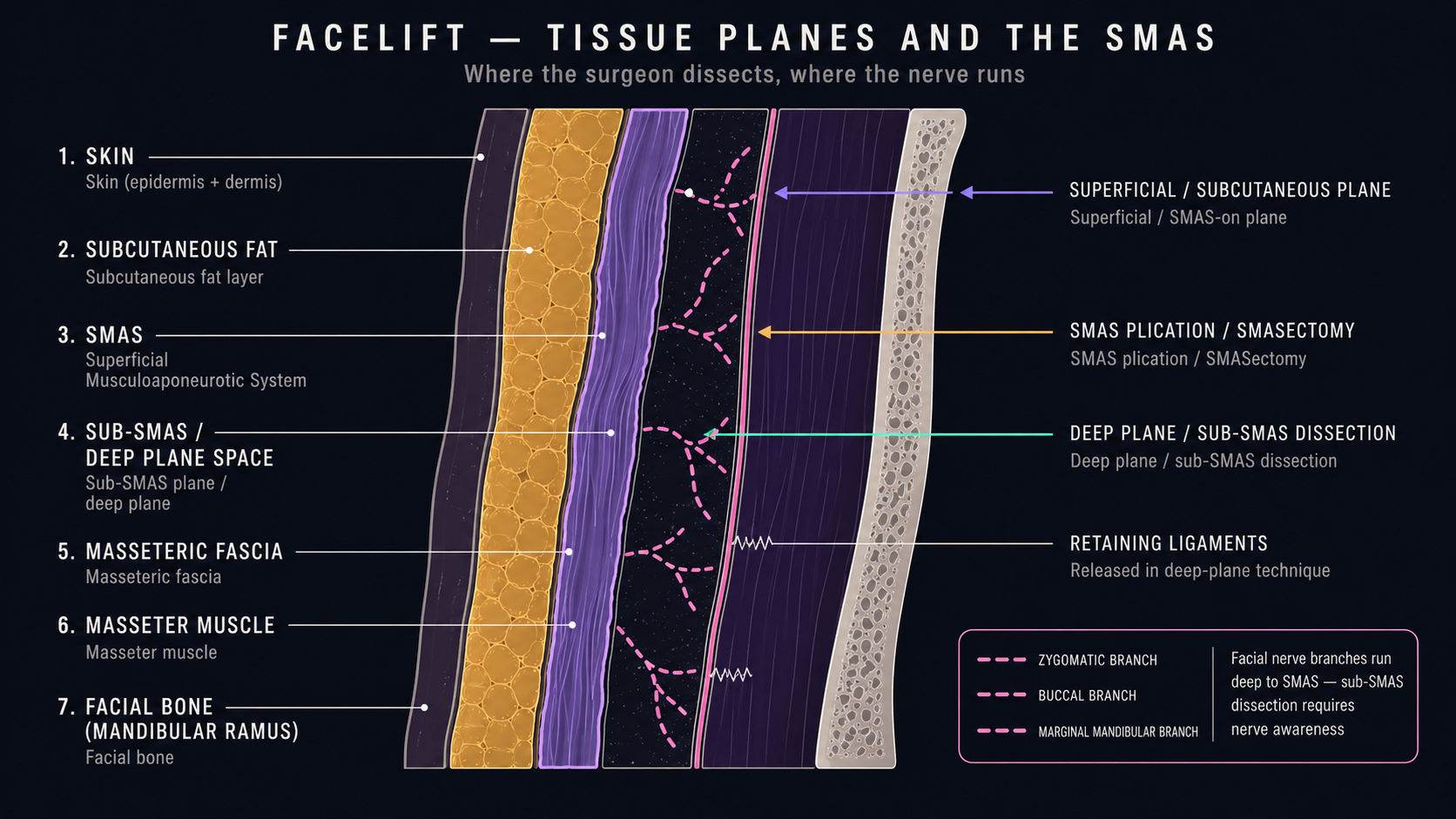
Facelift techniques (briefly)
This page covers facelift only at the level relevant to FFS planning; detailed cosmetic-rhytidectomy literature is outside scope.
| Technique | Plane of dissection | Strengths | Weaknesses |
|---|---|---|---|
| Skin-only / "mini" facelift | Subcutaneous skin only | Short recovery; minimal scar | Limited durability; primarily marketing |
| SMAS plication / imbrication | Skin + folding/suturing of SMAS | Moderate durability; modest invasiveness | Less aggressive lift; less effective for severe jowling |
| Extended SMAS / SMAS-ectomy | Skin + dissection beneath SMAS with strip removal or repositioning | Strong durable lift; standard for moderate-severe laxity | Longer recovery; nerve risk |
| Deep-plane facelift | Below the SMAS, with release of facial retaining ligaments | Best long-term durability; strongest jawline definition | Technically demanding; longer operative time; specific surgeon experience required |
For post-FFS jowling specifically, deep-plane or extended SMAS facelift are the options most likely to address the redundant lower face appropriately. Skin-only or "mini" lifts are usually inadequate for the kind of redraping post-mandibular-reduction skin needs.
A neck lift (platysmaplasty + cervicoplasty) is commonly bundled with facelift to address concurrent submental laxity. Many FFS patients who develop jowling also have submental fullness or "tech-neck" that benefits from neck lift in the same operation.
Recovery
| Phase | What to expect |
|---|---|
| Days 0–7 | Significant bruising, swelling, and tightness. Drains commonly placed for 24–48h. Head elevation; gentle hair washing after 48h. Stitches around the ears and hairline removed at 5–10 days. |
| Weeks 1–2 | Bruising fades; tightness persists. Most patients comfortable in public around 10–14 days. Heavy lifting, bending, and strenuous exercise restricted ~3 weeks. |
| Weeks 2–6 | Numbness and altered sensation common — peripheral cervicofacial nerve fibers are stretched. Most resolves over 2–6 months. |
| Months 2–3 | Most external swelling resolved. Scar redness in the maturation phase. |
| Months 6–12 | Final scar maturation; residual numbness usually resolves; final result. |
Hair-bearing scalp incisions (above the ears, into the temporal hairline, behind the ears) are common in extended facelifts. Hair typically grows through trichophytic incisions over 8–12 weeks; visible hairline shifts are designed-out by experienced surgeons but worth asking about in consult.
Risks and complications
| Risk | Detail |
|---|---|
| Hematoma | The most common serious complication of facelift; rates 1–8% depending on technique and population; higher in male patients due to thicker skin and richer vascularity; smoking and hypertension elevate risk |
| Skin necrosis | Rare with proper flap design; markedly elevated in smokers |
| Facial nerve injury | Frontal branch most at risk in temporal dissection; marginal mandibular branch most at risk in mandibular angle dissection; most cases are neuropraxia and resolve over weeks to months; permanent injury is rare |
| Scarring | Usually inconspicuous in pre/post-auricular and hairline locations; hypertrophic in some skin types | | Hair loss | Along incision lines or temporal scalp from tension; trichophytic closure mitigates | | Asymmetry | Low rates with experienced surgeons | | Earlobe deformity ("pixie ear") | Caused by excessive tension at the lobule; preventable with careful inset |
Smoking is the strongest modifiable risk factor for skin necrosis, delayed healing, and hematoma. Most facelift surgeons require complete nicotine cessation for 4–6 weeks pre- and post-op.
Who shouldn't get a facelift in the FFS context
- Patients still within 9–12 months of major mandibular contouring (skin retraction not yet complete)
- Patients still within 6–12 months of major forehead/coronal work (overlapping flap territory)
- Active smokers or vapers who won't quit
- Patients with significant uncontrolled hypertension or coagulopathy
- Patients seeking a feminizing change rather than a soft-tissue rejuvenation — facelift doesn't feminize features; it tightens skin
What to ask in consult
| Question | Why it matters |
|---|---|
| Why facelift now, instead of waiting longer? | If you're under 9–12 months from mandible work, the answer should be specific. |
| What technique — SMAS plication, extended SMAS, deep-plane? | Should match your specific laxity pattern; "mini" facelift is rarely the right answer for post-FFS jowling. |
| Are you including a neck lift? | Often paired; ask why or why not. |
| Smoking / nicotine policy? | If they don't have one, that's a flag. |
| What's your hematoma rate? | Should know their own number. |
| What's the scar plan, especially around my hairline and earlobe? | Trichophytic closure, no tension at the lobule. |
Sources
- Rochlin DH, Morrison SD, Rohrich RJ, Satterwhite T. (2022) — Post-FFS facelift cohort describing iatrogenic jowling as a predictable consequence of mandibular reduction; 9× higher rate of facelift request after mandibular contouring.
- Gupta et al. (2019) — Spiegel Boston group; 25-patient series of facelift combined with forehead, cheek, rhinoplasty, and mandibular work in single setting; 16% infection rate.
- See Procedure Staging for the full rationale on facelift timing relative to FFS bone work.
- Coleman et al. (2022) — WPATH Standards of Care v8 — facial gender surgery medical necessity criteria.
- American Society of Plastic Surgeons — Facelift — general (non-FFS-specific) procedure overview and recovery guidance.