Candidacy & Timing
A hair transplant is only as durable as the hair around it. The grafts themselves come from the occipital "permanent" zone and are largely androgen-resistant by donor dominance — but the recipient field is not. Native frontal and mid-scalp follicles keep miniaturizing on whatever androgenetic trajectory existed before surgery unless that trajectory is medically arrested. Transplant a patient with active, unstabilized androgenetic alopecia (AGA) and five to ten years later you have a halo of transplanted hair inside a ring of progressing native loss — an iatrogenically unnatural pattern that can only be patched with more grafts indefinitely.
For transfeminine patients this picture shifts in two ways. In your favor: feminizing HRT — testosterone suppression plus AR blockade — is more potent at scalp DHT control than 1 mg finasteride, the cisgender-male standard. Against you: most people who want a transplant want one because HRT did not fully restore the frontotemporal hairline, and the transfeminine-specific transplant literature is sparse, retrospective, and almost entirely FFS-adjacent.
The candidacy question reduces to four serial filters:
- Is the AGA medically stabilized, or stabilizable?
- Is the donor area dense and miniaturization-free?
- Are systemic risk factors (smoking, scarring alopecia, unstable HRT) controlled?
- Does the timing line up with planned Hairline Advancement?
Fail filter (1) or (2) and you are not a candidate, regardless of motivation.
This page is candidacy and timing only
Harvest method (FUE vs FUT), aesthetic hairline design, surgeon selection, and recovery are covered separately under FUE vs FUT, Hairline Design, Surgeons & Cost, and Recovery. Sequencing relative to a full FFS plan is covered in Procedure Staging and Combining with FFS.
What HRT does — and doesn't — do to the hairline
AGA is DHT-driven. Type II 5α-reductase converts testosterone to DHT in the dermal papilla; DHT binds the androgen receptor and shortens anagen, miniaturizing terminal follicles into vellus over successive cycles. Anything that lowers DHT exposure at the follicle slows or halts the process.
Feminizing HRT does this through three layered mechanisms:
- Testosterone suppression. Target serum total T <50 ng/dL is the WPATH SoC v8 / Endocrine Society standard. Cyproterone acetate hits this in roughly 90% of users; spironolactone in only ~19–25% per the Burinkul 2021 RCT. GnRH agonists and orchiectomy produce castrate-level suppression.
- Androgen-receptor blockade. Spironolactone and bicalutamide block AR peripherally, including at the dermal papilla. Spironolactone has been used at 100–200 mg/day for AGA in cis women for decades.
- Estrogen tone. Estradiol prolongs anagen and may directly antagonize DHT effects in the follicle; the effect on scalp follicles specifically is less established than in skin generally.
The most cited transfeminine-specific data point is Gao et al. 2018: a 50-patient retrospective series in which density (by phototrichogram) improved or stabilized in most patients with pre-HRT frontal/vertex AGA over 12+ months. Effect was strongest in younger patients with shorter pre-HRT loss and weakest in established Norwood IV–V. Stevenson et al. 2019 reports similar directional findings on patient-reported outcomes.
What HRT does not reliably do:
- Reverse established miniaturization. Once a follicle has cycled through several rounds of miniaturization, regrowth to terminal-quality hair is uncertain even with full DHT suppression. Vertex thinning improves more reliably than frontotemporal recession.
- Restore the temple points / M-shape. Frontotemporal recession established during male puberty is a structural change to the hairline shape, not just density. Capitán et al. 2017 reported lateral recession in ~79% of FFS-seeking transfeminine patients — this is the residual problem most transplants are asked to solve.
- Work on a transplant timescale. Maximal hairline benefit from HRT alone takes 2–5 years. Clinician and community consensus is to wait at least 18–24 months on stable HRT before deciding on a transplant, both to let HRT do its work and to characterize what's actually left.
A 171-patient transfeminine FFS cohort (Nguyen et al. 2025, referenced via the Hairline Advancement data) found longer estrogen exposure was associated with less lateral forehead length, plausibly through partial regrowth at the frontotemporal margins. No published data quantify how often previously-recessed temple points fill in to a transplant-unnecessary degree. Anecdotal range from clinician reports is roughly 10–30% partial fill; near-complete fill is uncommon.
Stabilize the loss medically before you transplant
This is the single most important rule in hair restoration, and it applies to transfeminine patients with the same force as to cis men, with caveats below.
The cisgender-male standard regimen, used as the baseline:
| Drug | Dose | Mechanism | Notes |
|---|---|---|---|
| Finasteride | 1 mg/day oral | Type II 5α-reductase inhibitor; lowers serum DHT ~70% | Kaufman 1998 RCT; durable in long-term extension data |
| Dutasteride | 0.5 mg/day oral | Type I + II 5-ARI; lowers DHT >90% | Gubelin Harcha 2014 — superior to finasteride for vertex |
| Topical minoxidil 5% | 1 mL twice daily | K-ATP opener; prolongs anagen | Olsen 2002 RCT |
| Oral minoxidil | 0.25–5 mg/day | Same MOA, systemic | Randolph & Tosti 2021 review; growing pre-transplant use |
ISHRS practice consensus is that any patient with Norwood ≥III planning transplantation should be on at least one stabilizing agent for 6–12 months prior to surgery, both to confirm the trajectory is arrested and to mature any reversible miniaturization so recipient density can be assessed honestly.
Where transfeminine patients differ:
- Most are already on systemic anti-androgen therapy that is more potent than finasteride. Spironolactone, CPA, bicalutamide, and orchiectomy all suppress androgen signaling more aggressively than 1 mg finasteride. Finasteride is therefore often redundant in this population, though some surgeons add it for its scalp-localized DHT effect. No high-quality comparative data exist on whether adding finasteride to standard feminizing HRT improves transplant outcomes.
- Dutasteride is sometimes used in transfeminine patients seeking maximal scalp protection (Iwamoto 2019 discusses 5-ARI use in this population), though the marginal benefit over already-suppressed androgen tone is not quantified.
- Minoxidil (topical or low-dose oral) is uncomplicated and frequently added pre-transplant; no transfeminine-specific contraindications.
See Anti-androgens and Hair for the medical management side.
The practical filter: if a transfeminine patient has stable density and shape on HRT for ≥12 months, with no progressive miniaturization on dermoscopy, they are "stabilized" by the standards used in cisgender-male transplantation. If hair is still visibly receding or thinning on HRT, the AGA is not adequately controlled and you need to investigate:
- Testosterone is not adequately suppressed — check labs.
- The patient has unusually androgen-sensitive follicles — consider adding a 5-ARI.
- A non-androgenic process is at work — telogen effluvium, scarring alopecia, thyroid disease, nutritional deficiency.
Don't transplant into active loss
The single most common avoidable bad outcome in trans hair transplant is grafting into a field that is still miniaturizing. Five years later the surrounding native hair has thinned, and the transplanted zone stands out as an island. Get density-tracked on HRT for at least a year before scheduling.
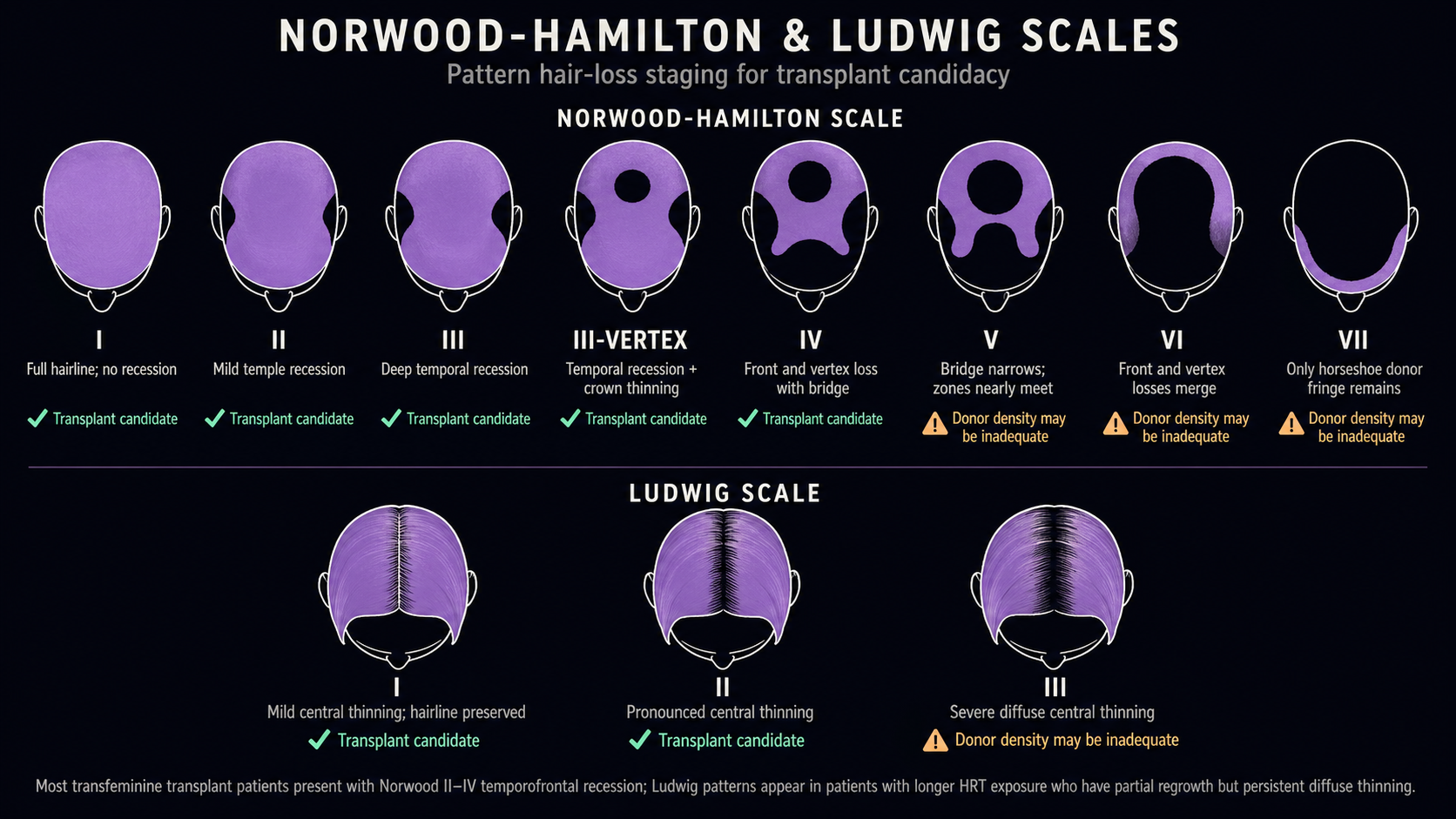
Norwood/Ludwig pattern and what it predicts
The Norwood-Hamilton scale stages male-pattern AGA; the Ludwig scale stages diffuse central female-pattern thinning. Transfeminine patients almost always present with a Norwood-pattern history (puberty was androgenic) but may, after years of HRT, have evolved toward a Ludwig-style diffuse pattern overlaid on residual frontotemporal recession.
| Pattern | Typical transfem context | Transplant candidacy on HRT |
|---|---|---|
| Norwood I–II | Pre-HRT or early HRT; minor temple recession | Often best served by continued HRT + monitoring; transplant only for shape, modest grafts |
| Norwood III | Established temple recession ± mild crown | Classic candidate; medical stabilization confirmed before surgery |
| Norwood III vertex / IV | Temple recession + clear crown thinning | Candidate if donor density adequate; realistic graft-supply discussion needed |
| Norwood V | Extensive frontal + vertex loss | Borderline; donor supply usually limiting; staged plan or scalp micropigmentation supplement |
| Norwood VI–VII | Only horseshoe remaining | Usually not a candidate for satisfying frontal restoration; donor inadequate to cover demand |
| Ludwig I–II (post-HRT diffuse) | Years on HRT with diffuse thinning, less recession | Often not transplanted — diffuse thinning means donor area is also miniaturizing |
| Ludwig III | Severe diffuse | Generally not a candidate |
The Norwood VI/VII cutoff is the hardest candidacy line in the field. A typical lifetime donor yield is roughly 5,000–8,000 follicular units, and a complete frontal-plus-mid-scalp restoration at conservative density needs about 4,000–6,000. A Norwood VI patient cannot be made to look like a Norwood II without exhausting donor capacity — and the result will look thin under any close inspection.
In transfeminine patients this cutoff softens partially, because:
- HRT may partially restore vertex/mid density, reducing the deficit the transplant has to cover.
- The aesthetic target is a feminine hairline shape — rounded, full temples, low mid-frontal point — not a dense young-male hairline. Graft demand for feminine framing can be lower than for male restoration.
- Eyebrow, lash, and frontotemporal hairlines are often the actual priority, and these are smaller graft demands.
But the donor-supply ceiling is hard physiology and does not move. A patient with Norwood VI underlying loss, partially rescued by HRT to a visible Norwood IV–V, may still have only Norwood-VI donor reserves.
Donor-area assessment
The donor area is the occipital and posterior parietal scalp where follicles express low or no AR sensitivity. In cisgender-male AGA this region is the only reliable graft source. Assessment includes:
- Density. Normal Caucasian density is roughly 70–100 FU/cm²; African 50–70; East Asian 65–85. Below ~40 FU/cm² is generally insufficient.
- Miniaturization rate. Dermoscopy at 20× quantifies the percentage of vellus/intermediate hairs in the donor zone. >20% miniaturization is a relative contraindication because it signals diffuse unpatterned alopecia (DUPA) — the donor will continue to thin after harvest, leaving visible donor-site loss (Bernstein 1995).
- Hair caliber. Coarse hair gives more visual coverage per graft; fine hair requires more grafts for equivalent density.
- Color contrast. High contrast (dark hair, light scalp) makes thin areas more visible and raises the density bar.
- Scarring. Prior occipital surgery, traction injury, or scarring alopecia in the donor zone reduces yield.
- Scalp laxity. Relevant for FUT/strip harvest; less so for FUE. Tight scalps limit strip width and elevate scar-widening risk.
In transfeminine patients the donor zone usually behaves like a cis-male donor zone, because follicular androgen-resistance is established embryologically and is not reversed by HRT. There are no published data suggesting estrogen expands the donor zone or rescues miniaturized donor follicles, and conversely none suggesting the donor zone is worse in transfeminine patients than it would have been in the same person pre-transition.
Body-hair transplantation as fallback. Beard, chest, or thigh hair can extend graft supply (Umar 2012). Beard gives the best caliber match to scalp but a coarser texture; body hair has shorter anagen (limiting maximum length) and lower take rates (~60–80% vs. ~85–95% for scalp). For transfeminine patients, body and beard hair are often already reduced by HRT and laser treatment by the time transplant is considered, which limits BHT availability. Quantitative data on BHT yield in HRT-suppressed body hair are essentially absent.
Comorbidities, age, and red flags
Standard hair-transplant exclusions are well established and apply to transfeminine patients equivalently:
- Active scarring alopecia — lichen planopilaris, frontal fibrosing alopecia (FFA), central centrifugal cicatricial alopecia, discoid lupus. Transplanted grafts are destroyed by the same inflammatory process that caused the original loss. Disease must be quiescent for ≥1–2 years with biopsy confirmation before transplant is considered (Donovan 2012). FFA has a strong female predominance and is rising in incidence — no published evidence of elevated FFA risk in transfeminine patients specifically, but the question is biologically plausible and unstudied.
- Active alopecia areata. Same logic; quiescence required.
- Uncontrolled diabetes, immunosuppression, bleeding disorders. Standard surgical exclusions; affect graft survival and infection risk.
- Smoking. Nicotine vasoconstriction reduces graft survival and increases donor scarring. Pooled odds ratios for surgical wound complications generally are 1.79–2.07 (Sørensen 2012). Most transplant practices require cessation 2–4 weeks pre- and post-op; some refuse to operate on active smokers entirely.
- Body dysmorphic disorder / unrealistic expectations. Standard pre-op screen.
- Recent hormonal changes / unstable HRT. Active telogen effluvium — triggered by HRT initiation, dose changes, surgery, or stress — confounds recipient assessment. Standard wait is ≥6 months post-HRT-initiation or post-major-stressor before transplant evaluation.
Age. Transplants in patients <25 are controversial in cisgender-male literature because future AGA progression cannot be predicted. In transfeminine patients the rationale is partially different: HRT may still be evolving the hairline, and you should have at least 18–24 months of stable HRT before transplant.
| Flag | Action |
|---|---|
| Norwood ≥VI underlying | Donor-capacity assessment; expect staged or limited result |
| Donor miniaturization >20% | Defer; rule out DUPA |
| Active scarring alopecia | Defer until quiescent ≥1–2 yr with biopsy |
| <18–24 mo on stable HRT | Defer; let HRT do its work |
| Active progressive AGA on HRT | Investigate undertreatment vs. add 5-ARI; defer |
| Active smoker | Cessation 2–4 wk minimum, longer preferred |
| Unrealistic shape goals | Counsel; consider FFS-first if hairline lowering is the real goal |
| Prior FFS without proper hairline planning | Vascular caution; transplant feasible but yields lower; defer 6–12 mo from FFS |
Timing relative to FFS hairline advancement
This is the single most asked transfeminine-specific timing question, and the answer is: it depends on which problem dominates.
The decision tree:
- Central forehead is too tall and the hairline is dense and stable → scalp advancement (pretrichial) first, transplant later only if temple recession remains. Scalp advancement gives 1.8–2.2 cm of dense lowering immediately. Transplanting first wastes grafts on tissue that will be excised.
- Hairline shape is the dominant problem (M-shape, temple recession) and central height is acceptable → transplant only. Scalp advancement does not effectively round temples and may even emphasize residual recession.
- Both height and shape need correction and laxity is good → scalp advancement first, transplant second, typically 9–12 months later. The advancement establishes the central position; the transplant fills temples and softens the corners.
- Both need correction but laxity is poor or you want to avoid a frontal scar → transplant only, accepting that central lowering will be modest (~1 cm) and incremental over multiple sessions.
- Simultaneous advancement + transplant is practiced by a small number of high-volume FFS centers — the Capitán group most notably (Capitán 2017 describes 65 cases) — using a posterior coronal strip harvest. The technique is technically demanding and not the mainstream protocol; some surgeons argue simultaneous grafting risks compromising flap perfusion and graft survival, and prefer staging.
| Combination | Typical interval |
|---|---|
| Scalp advancement → transplant | 9–12 months |
| Transplant → scalp advancement | Generally avoided (graft loss in advancement zone); if done, 12+ months |
| Forehead contouring (no advancement) → transplant | 6–9 months |
| Transplant → forehead contouring (no advancement) | 6–9 months |
| Simultaneous advancement + transplant | Single stage, center-specific protocol |
Don't transplant before scalp advancement
Grafts placed in skin that will later be excised or significantly displaced are wasted. If you might want hairline lowering, get the staging conversation done before booking transplant grafts at the planned excision zone. See Procedure Staging and Combining with FFS for the full sequencing logic.
Where the literature is thin
A few places to keep in mind that the evidence here is indirect or sparse:
- Quantified HRT effect on hairline geometry over time. Nguyen 2025 is the strongest single dataset, but it measures forehead length, not graded hairline shape change. No large-cohort study with serial standardized photography has quantified how much frontotemporal recession recovers on HRT.
- Comparative outcomes, transfeminine vs. cisgender-male transplant cohorts. Graft survival, density achieved, and revision rates are reported in cisgender-male series; equivalent transfeminine cohorts are small, retrospective, and rarely compare directly. The assumption that outcomes are equivalent is reasonable but not formally validated.
- Adding 5-ARI to standard HRT pre-transplant. No controlled data. Practice varies.
- Body-hair transplant yield in HRT-suppressed body hair. Essentially no published data.
- FFA incidence in transfeminine patients. Biologically plausible given long-term estrogen exposure, but not studied.
- 10+ year transplant durability in transfeminine patients. Cisgender-male long-term data exist; equivalent transfeminine follow-up is missing.
Where cisgender-male data are used as a proxy — donor density norms, miniaturization thresholds, smoking ORs, finasteride mechanism, the Norwood-VI ceiling — the underlying biology is shared and the proxy is reasonable.
Sources
Foundational technique
- Orentreich N. (1959) — The Concept of Donor Dominance (Annals of the New York Academy of Sciences) — foundational basis for follicular harvest from the occipital permanent zone.
- Bernstein RM, Rassman WR. (1997) — Follicular Transplantation: Patient Evaluation and Surgical Planning (Dermatologic Surgery) — the principle that native recipient hair continues its AGA trajectory after grafting.
- Bernstein RM. (1995) — Diffuse Unpatterned Alopecia (DUPA) (Dermatologic Surgery) — donor miniaturization as a contraindication.
- Hamilton JB. (1951); Norwood OT. (1975) — Norwood-Hamilton classification.
- Ludwig E. (1977) — Classification of the Types of Androgenetic Alopecia (Common Baldness) Occurring in the Female Sex (British Journal of Dermatology).
- Unger WP, Shapiro R, eds. — Hair Transplantation, 5th ed. (CRC Press) — standard reference textbook.
Medical stabilization
- Kaufman KD et al. (1998) — Finasteride in the Treatment of Men with Androgenetic Alopecia (Journal of the American Academy of Dermatology) — the foundational finasteride RCT.
- Olsen EA et al. (2002) — A Randomized Clinical Trial of 5% Topical Minoxidil (Journal of the American Academy of Dermatology).
- Gubelin Harcha W et al. (2014) — A Randomized, Active- and Placebo-Controlled Study of the Efficacy and Safety of Different Doses of Dutasteride versus Placebo and Finasteride (Journal of the American Academy of Dermatology) — dutasteride superior to finasteride for vertex AGA.
- Randolph M, Tosti A. (2021) — Oral Minoxidil Treatment for Hair Loss: A Review of Efficacy and Safety (Journal of the American Academy of Dermatology).
- Sinclair RD et al. (2005) — Spironolactone for AGA in cis women.
- Conrad F et al. (2004) — Estrogens and the Hair Follicle (Journal of Investigative Dermatology Symposium Proceedings).
Donor area and operative principles
- Jimenez F, Ruifernández JM. (1999) — Distribution of Human Hair in Follicular Units (Dermatologic Surgery) — population density norms.
- Cole JP. (2013) — donor capacity and lifetime graft yield estimates.
- Umar S. (2012) — Use of Body Hair and Beard Hair in Hair Restoration (Aesthetic Surgery Journal).
- Donovan JC et al. (2012) — Scarring alopecia and hair transplantation (Journal of the American Academy of Dermatology).
Transfeminine-specific
- Coleman E et al. (2022) — WPATH Standards of Care v8 — gender-affirming hair-restoration framing.
- Hembree WC et al. (2017) — Endocrine Treatment of Gender-Dysphoric/Gender-Incongruent Persons (Journal of Clinical Endocrinology & Metabolism) — Endocrine Society guideline; <50 ng/dL testosterone target.
- Gao Y et al. (2018) — Hair Growth in Trans Patients on Combined Estrogen and Antiandrogen Therapy (Journal of Cosmetic Dermatology) — 50-patient retrospective series.
- Stevenson MO et al. (2019) — Transfeminine hair outcomes on HRT (Endocrine Practice).
- Iwamoto SJ et al. (2019) — 5α-reductase inhibitor use in transfeminine patients (Endocrine Practice).
- Burinkul S et al. (2021) — Spironolactone vs. cyproterone acetate RCT; testosterone suppression rates by agent.
- Capitán L et al. (2017) — Facial Feminization Surgery: Simultaneous Hair Transplant during Forehead Reconstruction (Plastic and Reconstructive Surgery) — 65-patient simultaneous advancement-plus-transplant cohort; 79% lateral recession prevalence.
- Nguyen et al. (2025) — Estrogen Hormone Therapy Stabilizes Lateral Hairline in Transfeminine Patients (Journal of Plastic, Reconstructive & Aesthetic Surgery) — 171-patient cohort linking hormone duration to lateral forehead length.
General surgical risk
- Sørensen LT. (2012) — Wound Healing and Infection in Surgery: The Clinical Impact of Smoking and Smoking Cessation (Archives of Surgery) — OR 2.07 dehiscence, 1.79 surgical-site infection in active smokers.