Exercises
A drill library organized by purpose. Use these in combination during practice sessions — most sessions should include a brief warm-up, the day's focus drills, and a cool-down.
The 8-Week Plan sequences these into a structured progression; you can also dip in here directly when you want to look up a specific drill.
Warm-up
Always start with these. Cold practice is how vocal strain happens.
Deep breathing
- Stand tall, hand on belly
- Inhale through nose (belly rises)
- Exhale through mouth (belly falls)
- Stretch neck/shoulders, massage jaw
- 5–10 cycles
Open-throat humming
- Hum "mmm" at comfortable pitch
- Keep throat relaxed
- Feel buzz in lips/face (not chest)
- Glide pitch up and down like a siren
Lip trills / straw phonation
- Loosely close lips, blow air ("brrr")
- Or hum through a drinking straw
- Keeps strain low, aligns resonance forward
Vowel glides
- Hum "mmm" then open to "oo" or "ah"
- Single breath, carry the buzz forward
- Start soft, increase volume gradually
Foundation drills
The bedrock skills. Master these in Week 1, return to them as warm-up forever.
Diaphragmatic breathing
Why: Core breath support for stable, healthy phonation. How: Stand or sit tall. One hand on chest, one on belly. Inhale through nose so belly rises; exhale through mouth so belly falls. 5–10 cycles.
Sustained vowels
Why: Builds stamina and control. How: Take a diaphragmatic breath, sustain "ee / aa / oo" at a comfortable pitch as long as possible. Keep tone even. Repeat ×5.
Sirens
Why: Expands range and smooths pitch transitions. How: Glide from lowest to highest comfortable pitch and back in one smooth "oooo" sound. Repeat ×5.
Pitch matching
Why: Targets feminine pitch band (~180–220 Hz). How: Play a note on keyboard or app, match it, sustain 3–5 s. Use a pitch tracker if possible. Vary notes in target range.
Target notes reference:
| Note | Pitch (Hz) |
|---|---|
| G3 (low edge) | 196 Hz |
| A3 (core target) | 220 Hz |
| A♯3 / B♭3 (mid-core) | 233 Hz |
| B3 (upper core) | 247 Hz |
| C4 (bright edge) | 262 Hz |
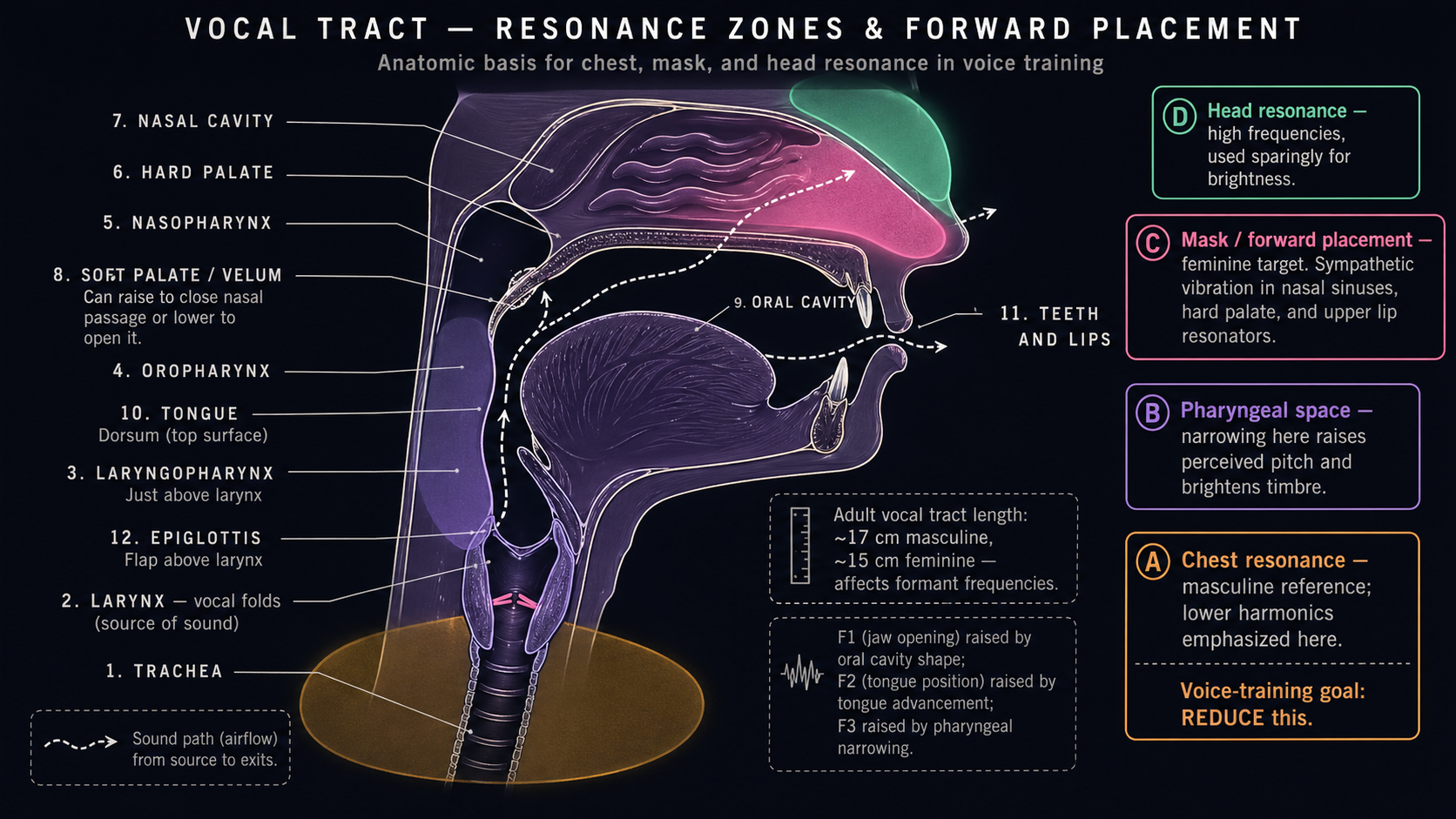
Resonance placement
The most important skill set after pitch. These move resonance forward (away from chest, toward face/mask), which is what makes a voice read as feminine more reliably than pitch alone.
Humming slide to mask
- Hum "M" at low pitch
- Slowly glide pitch upward
- Feel vibration move from chest → face
- Open to "ee" while keeping forward buzz
- Repeat with other vowels (may, moh, moo)
Vowel resonance drill
- Say "ee → oo → oh → ah" on one pitch
- Exaggerate tongue/lip positions
- Notice where vibrations shift
- Goal: keep resonance forward throughout
Chest vs. head awareness
- Sustain "ah" at low pitch
- Glide up to higher pitch and back
- Notice: low = chest vibration, high = face/head
- Practice minimizing chest vibration on higher notes
M / N forward resonance
- Sustain "mmm" or "nnn" for a few seconds
- Feel buzz in lips, cheeks, nose
- Smile slightly to lift resonance
- Speak M/N words: "moon," "maybe," "nice"
Key O exercise — lighten
- Say "Key" in speech range (not too high)
- Notice: tongue up, smaller oral space
- Hold Key mouth shape while saying "O"
- Practice: "Key O. Hi, how are you?"
- Try: "Key O, I'll have an iced coffee, please"
- Maintains lighter / brighter resonance
Key O exercise — darken
- Say "O" with open, yawning space
- Notice: large oral cavity, open jaw
- Hold O mouth shape while saying "Key"
- Practice: "O Key. Hi, how are you?"
- Try: "O Key, I'll have a nice coffee, please"
- Creates darker / fuller resonance
Resonance reminders
- Speak one word, with intention, at a time.
- Speak the same sentence repeatedly to allow focused exploration of the sounds.
- "Correct" feels like pulling the Adam's apple backward into the throat & up — not just up.
Strengthening
For deeper control once foundations and resonance are stable.
Whisper-scream (larynx control)
- Deep breath, mouth in "ah" shape
- Exhale in strong whisper (no voice)
- Start with low larynx (yawn feeling, dark tone)
- Raise larynx (brighter, whistling tone)
- Toggle between positions to build control
Breath sigh (soft palate lift)
- Inhale through nose like starting a yawn
- Feel soft palate lift, throat open
- Exhale silently through mouth (fog a mirror)
- Keep palate lifted, no air through nose
- Repeat 5–10× to reduce nasality
Meem-mah alternation
- Alternate "mmm" and "mah" smoothly
- "mmm": lips closed, vibrations in face
- "mah": soft palate relaxes, slight nasality
- Teaches fine control of soft palate height
Straw phonation
- Hum or speak through a drinking straw
- Feel lips tingle, resonance pushed forward
- Try syllables or short phrases
- Remove straw, repeat — keep the sensation
Resonant articulation
- Smile gently while speaking
- Exaggerate lip / tongue movement
- Use mirror: watch for throat tension
- Goal: relaxed throat, engaged face
Cool-down
Always end practice with these. Skipping the cool-down is how soreness accumulates.
Post-practice recovery
- Gentle humming at low pitch
- Light lip trills on descending glide
- Drink water
- Rest voice for a few minutes
Beyond the drills
These drills cover voice mechanics. The full skill set also includes:
- Intonation & melody — practiced via Practice Sentences and Week 3 of the 8-Week Plan
- Articulation — tongue twisters, over-enunciation; Week 4 of the plan
- Speech rate & inflection — Week 5
- Vocabulary & expressive language — Week 6
- Body language alignment — Week 7
- Voice modeling (shadowing / echoing a target speaker) — Week 8