GnRH agonists
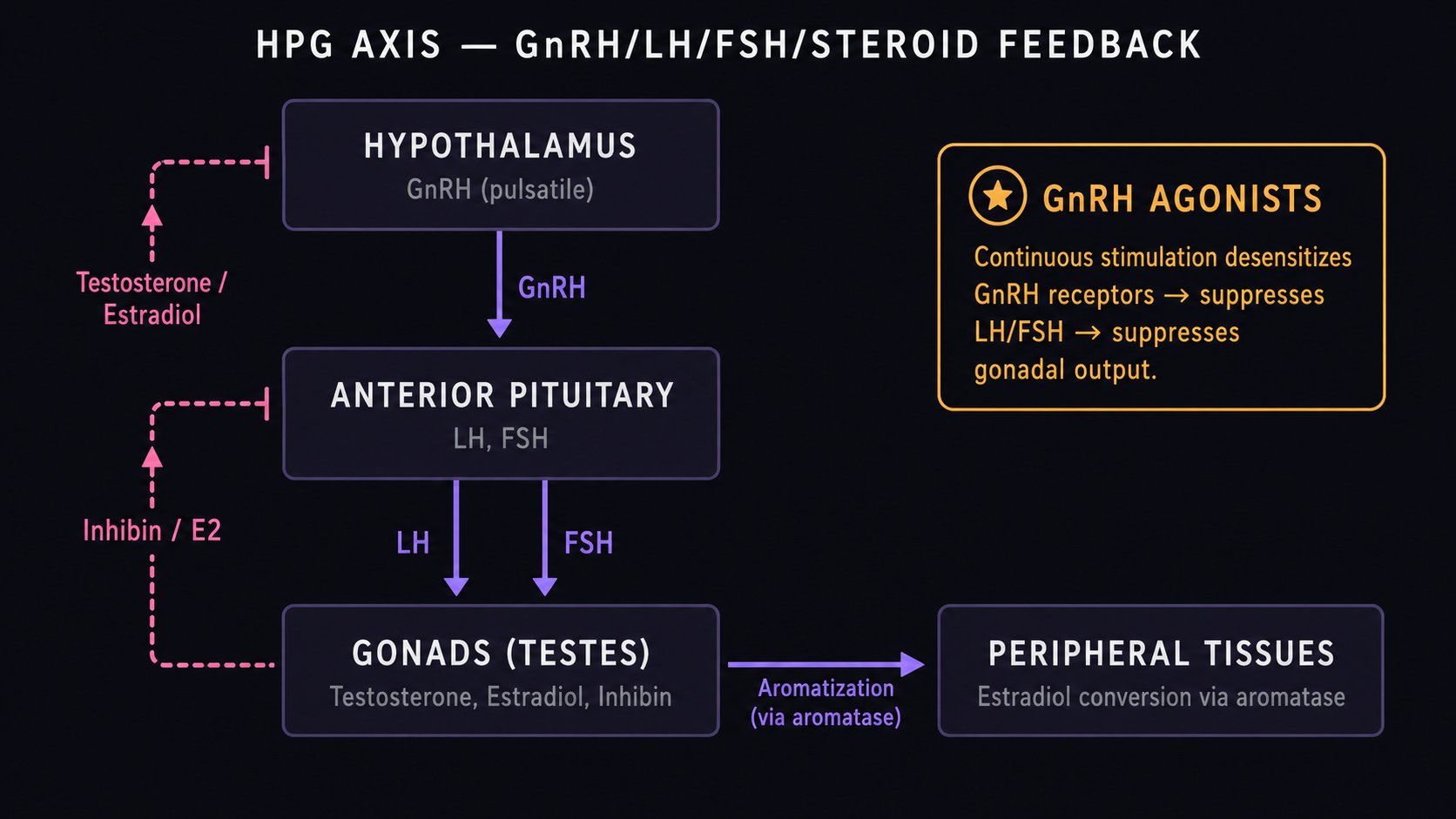
GnRH agonists shut down the gonads at the source. Normally the hypothalamus releases gonadotropin-releasing hormone (GnRH) in pulses, which the pituitary reads as the signal to release LH and FSH, which tell the gonads to make testosterone or estrogen. A GnRH agonist floods the system with continuous GnRH stimulation — the pituitary responds by desensitizing its receptors and stopping LH/FSH release entirely. Within ~2–4 weeks, gonadal hormone production drops to near-zero.
In feminizing HRT, GnRH agonists have two main use cases:
- Adolescent puberty blockers — pause endogenous puberty before the patient is ready to commit to cross-sex hormones. Lower-dose Lupron is the most common formulation.
- Adult anti-androgen alternative — when spironolactone, cyproterone acetate, or bicalutamide aren't suitable (intolerance, hyperkalemia, hepatotoxicity), or when complete gonadal suppression is needed (e.g. for patients with hormone-sensitive cancer).
The main practical barrier is cost: in the US a Lupron Depot injection runs hundreds to thousands of dollars per dose without insurance coverage. Most adult feminizing HRT regimens stick with cheaper oral anti-androgens unless there's a specific reason to escalate.
Initial T flare
GnRH agonists cause a brief but real rise in testosterone for ~1–2 weeks before suppression kicks in (the "flare" or "stimulating phase"). For patients with hormone-sensitive prostate cancer, this can briefly worsen symptoms. Some protocols co-administer an AR antagonist (bicalutamide, flutamide) for the first few weeks specifically to blunt the flare. Newer GnRH antagonists (relugolix / Orgovyx, oral) avoid the flare entirely — increasingly used in cis-male prostate cancer and being adopted by some informed-consent feminizing HRT protocols.
At a glance
| Drug | Brand | Route | Typical M2F dose | Notes |
|---|---|---|---|---|
| Leuprolide acetate | Lupron Depot | IM injection | 3.75–7.5 mg / month | Most common; pediatric form widely used as puberty blocker |
| Goserelin acetate | Zoladex | Subcutaneous implant | 3.6 mg / month or 10.8 mg / 3 months | Implant inserted under skin, less frequent dosing |
| Nafarelin acetate | Synarel | Nasal spray | 1600 µg / day (2 sprays each nostril, twice daily) | Rare in adult feminizing HRT; more common for endometriosis |
Leuprolide acetate (Lupron Depot)
The most widely-used GnRH agonist. Pediatric Lupron Depot (lower dose) is the standard puberty blocker. The adult-dose Lupron Depot is used in feminizing HRT only when oral AAs aren't viable. Cost is the gating factor for most patients.
Full detail (mechanism, side effects, source notes)
Mechanism: Synthetic GnRH agonist. After an initial 1–2 week flare, the pituitary desensitizes to GnRH stimulation and stops producing LH/FSH, which dramatically decreases gonadal hormone production within a month.
Delivery: Sustained-release IM injection. Standard adult doses 5, 7.5, 11.25, 15, 22.5 mg formulations (1-month, 3-month, 6-month depots).
Source dose: 3.75–7.5 mg/month pre-op for feminizing use.
Side effects relevant to M2F use: Hot flashes (very common), headache, insomnia, mood changes, decreased bone density (significant on long-term use without estrogen replacement), dry mouth, fatigue, possible elevated blood pressure. Liver effects monitored periodically.
Important: because GnRH agonists eliminate gonadal estrogen production too, adolescents on long-term puberty blockers without subsequent estrogen need bone-density monitoring. Adults on a GnRH agonist for feminizing HRT take estrogen alongside it (otherwise bone loss accelerates).
Source notes a FDA warning about misleading product information — worth reviewing if Lupron is on the table.
Goserelin acetate (Zoladex)
A subcutaneous implant inserted under the skin (typically abdominal). The 3.6 mg formulation lasts one month; the 10.8 mg formulation lasts three months. Less convenient than oral meds but less frequent than monthly injections.
Full detail (mechanism, side effects, source notes)
Mechanism: Same as leuprolide — GnRH agonist; pituitary desensitization within ~1 month.
Delivery: 3.6 mg or 10.8 mg sustained-release subcutaneous implant.
Source dose: 3.6 mg every month (1-month implant) or 10.8 mg every 3 months (3-month implant).
Side effects relevant to M2F use: Dizziness, insomnia, lethargy, hot flashes, sweating, fluid retention, mild allergic reactions, elevated calcium. Cardiovascular: rare reports of congestive heart failure or pulmonary effects.
Contraindications: Known hypersensitivity to GnRH or GnRH analogues.
Nafarelin acetate (Synarel)
Delivered as a nasal spray rather than injection or implant — appealing for needle-averse patients but requires four sprays per day, every day. Rarely used in adult feminizing HRT; most common indication is endometriosis or pediatric central precocious puberty.
Full detail (mechanism, side effects, source notes)
Mechanism: Same GnRH agonist mechanism as leuprolide and goserelin.
Delivery: Nasal spray (Synarel).
Source dose: 1600 µg/day — 2 sprays into each nostril, twice daily.
Side effects relevant to M2F use: Headache, insomnia, depression, hot flashes, acne, oily skin, body odor, increase in body/facial hair (during initial flare), nasal irritation, muscle pain, fluid retention. (Some side effects listed in the source — vaginal dryness, ovarian cysts, vaginal bleeding — apply only to the cis-female endometriosis indication and are not relevant to M2F use.)
See also: GnRH antagonists (newer)
GnRH antagonists like relugolix (Orgovyx) block the GnRH receptor directly without first stimulating it — so there's no flare phase, T drops within days rather than weeks, and recovery after stopping is faster. Relugolix is oral (single daily pill), FDA-approved in 2020 for advanced prostate cancer, and increasingly used in informed-consent feminizing HRT as a cleaner alternative to GnRH agonists. Not in the hemingways source pages because they predate this drug class.
Sources
- Hembree WC et al. Endocrine Treatment of Gender-Dysphoric/Gender-Incongruent Persons. Endocrine Society Clinical Practice Guideline. J Clin Endocrinol Metab. 2017;102(11):3869–3903. doi:10.1210/jc.2017-01658
- Per-drug brands, formulations, side-effect lists, and historical doses adapted from the hemingways.org GIDinfo drug pages.