Hairline Advancement
The masculine hairline tends to sit higher (often 6–8 cm of non-hair-bearing forehead) and shows lateral recession that creates an M-shape. The feminine hairline tends to sit lower (~7–9 cm from glabella to mid hairline), with rounder corners and less temple recession. Hairline advancement is the umbrella term for surgically narrowing that gap.
This is not one operation. It's a family of techniques. The two main strategies are very different in what they do, what they cost, and who they suit:
| Strategy | What it does | What it's good for | What it's bad at |
|---|---|---|---|
| Scalp advancement | The forehead skin is excised and the hair-bearing scalp is pulled forward and re-fixed | Immediate, dense central lowering (~1.8–2.2 cm typical; up to ~2.3 cm in larger series) | Doesn't fix temple recession; creates a frontal scar; needs scalp laxity |
| Hair transplantation | Individual follicles harvested from the back of the scalp and placed in the new hairline | Temple rounding; M-shape correction; building density; soft, natural-looking border | Limited central lowering (~1 cm max); requires multiple sessions over months |
Many patients need both, sequenced or simultaneously. Choosing the right primary procedure is the single biggest determinant of whether the hairline ends up looking elegant or compromised.
Hairline ≠ forehead height
These two are coupled but not the same. Forehead contouring reshapes the bone underneath. Hairline advancement reshapes the skin and follicle position above it. If you want both a smaller, smoother brow ridge AND a lower hairline, they're commonly done in one session through a single pretrichial (at-the-hairline) incision. If you only want bone work, a coronal incision hidden in the hair gives a better-hidden scar.
Picking the right primary operation
A clean candidacy framework, drawn from contemporary FFS literature:
Scalp advancement is the right primary operation when:
- The frontal hairline is stable (not actively receding) and not actively miniaturizing
- Frontal density is good — there's enough hair to conceal the scar
- The scalp is mobile / lax — the surgeon can advance it without excessive tension
- The main problem is central forehead height (vertical, not M-shape)
- You're willing to accept a frontal scar as a trade-off for immediate results
Hair transplantation is the right primary operation when:
- The hairline is M-shaped with significant temple recession
- Frontal density is low or shows miniaturization
- Scalp laxity is poor (limits achievable advancement)
- You want to avoid a visible frontal scar at all costs
- Hair loss has been ongoing — even if currently medicated/stabilized, another scar through a thinning area ages badly
In a 492-patient transfeminine FFS cohort, the explicit recommendation was transplant-first when the dominant problem was temple recession and when donor density was good without active androgenetic alopecia. Among that same population, lateral recession was present in 79% of cases — so for many trans women, transplant is the operation that does most of the actual work even when scalp advancement is also performed.
Wrong-incision-first is hard to undo
Modern revision-focused FFS literature is consistent on this: a posterior coronal incision in someone who actually needed pretrichial lowering is one of the harder mistakes to fix. A second pretrichial design in a previously operated scalp also has higher alopecia risk between the scars from compromised vascularity. Get the strategy right the first time.
What "feminine hairline" actually means
Lowering height alone doesn't feminize. The shape matters at least as much:
- Less lateral recession — softer, rounder corners instead of an M
- Smoother frontotemporal transition — the line where the hairline curves down toward the temples
- Subtle irregularity — strictly straight hairlines look surgical; feminine hairlines have a slight irregular waviness
- Density at the leading edge — single follicle units at the front, graduating to denser placement behind
Surgeons typically design with an irregular line at the planned position, often trichophytic or hyperbeveled (cut at a 35–45° angle) so hair grows through and across the eventual scar to camouflage it.
The classical anthropometric target is ~7–9 cm from glabella (the point between the brows) to the mid hairline. Don't fixate on a single number — the right value depends on age, ethnicity, brow position, forehead slope, and the specific proportions of your face. A useful relative indicator in modern series is forehead elongation greater than 10 mm compared with the midface, which captures the visual problem better than any absolute target.
Hormones, hair loss, and timing
Two practical findings from recent transfeminine literature:
- Longer estrogen exposure → less lateral recession. A 171-patient transfeminine FFS cohort found that patients with more years on feminizing hormones had less lateral forehead length — suggesting gradual stabilization or partial improvement of the M-shape over time. If you're early on hormones and the M-shape is your main concern, waiting may improve your starting point.
- Continuing estrogen perioperatively appears safe. A 953-patient FFS cohort found no increased VTE signal with continued estrogen, with one VTE event total. This argues against routine automatic estrogen-stop solely because you're having FFS. Decisions should still be individualized with your anesthesia team.
For patients with active androgenetic alopecia, the order of operations matters: stabilize the hair loss medically (finasteride/ dutasteride, minoxidil — see Anti-androgens and Hair) before committing to a permanent hairline design.
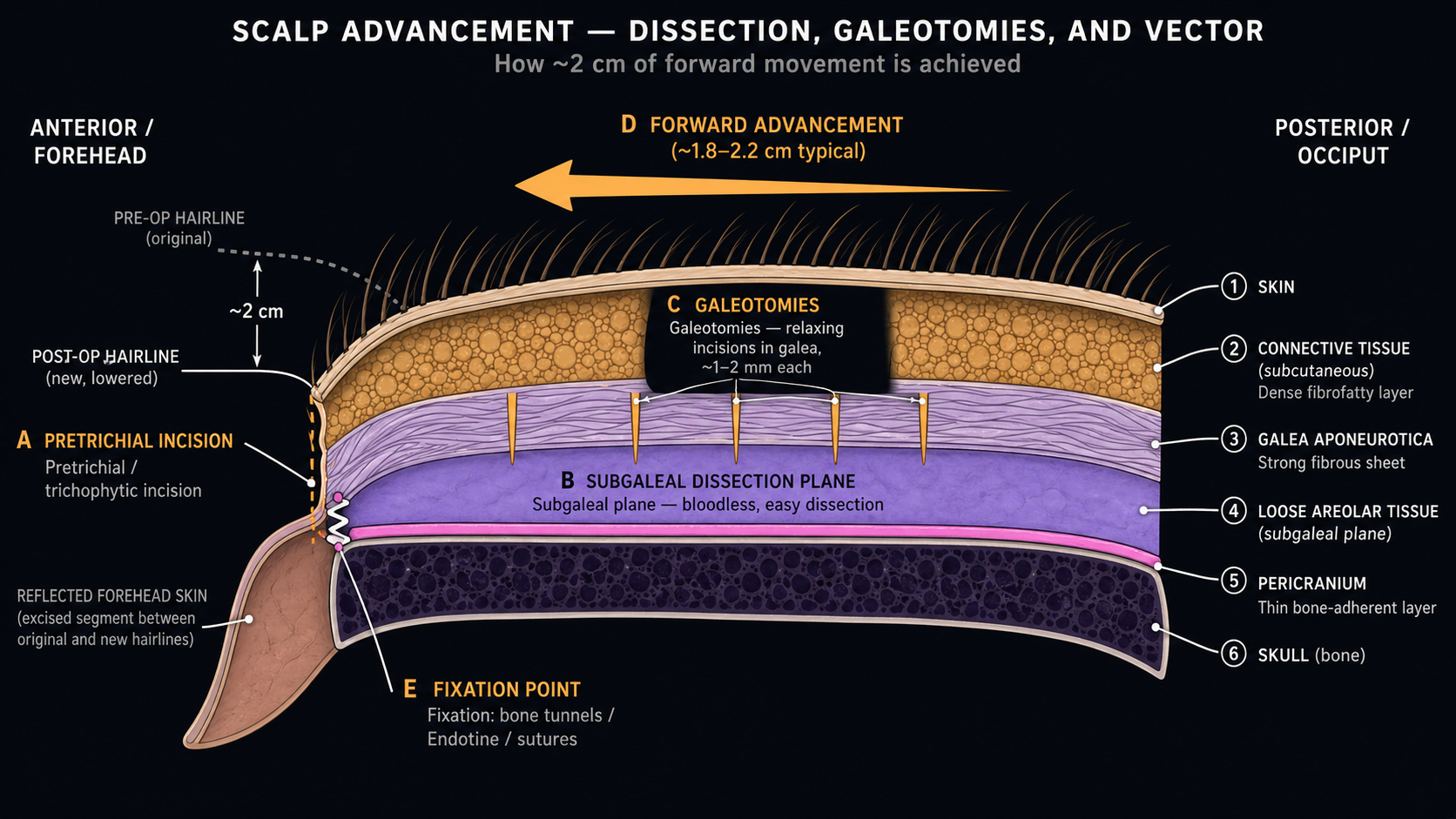
Operative technique: scalp advancement
The classic one-stage operation. Across modern series the sequence is consistent:
- Design. The new hairline is marked, typically irregular and trichophytic to camouflage the scar.
- Tumescent infiltration. Saline + epinephrine + lidocaine is placed under the scalp for hydrodissection and bleeding control.
- Incision. Pretrichial / hyperbeveled, with the angle preserving follicles so hair can grow through the closed scar.
- Excision. The strip of non-hair-bearing forehead skin between the current and planned hairline is removed.
- Mobilization. The scalp is dissected free posteriorly, often up to the nuchal ridge. Galeotomies — incisions in the deep galea layer — are added as needed; each adds about 1–2 mm of advancement.
- Fixation. The scalp is anchored to the skull. Modern options include bone tunnels, Endotine bioabsorbable anchors, titanium miniscrews (sometimes temporary, removed at 10–14 days), or suture-only galeal advancement.
- Closure. Layered closure with precise follicle alignment; tension reduction is the most important scar-control maneuver.
Average advancement in modern series:
| Series | Advancement | Notes |
|---|---|---|
| 91-patient bone-tunnel cohort (2019) | 18.4 mm | Stable through 12 months |
| 26-patient prospective (2022) | 20.3 mm | |
| 21-patient FPS report (2025) | 22.5 mm | |
| 525-patient multiplane series (Ahn 2019) | 20 mm | The largest published series |
Roughly 2 cm is the typical achievable lowering without tissue expansion.
Variants of scalp advancement
Different surgeons use different fixation and dissection techniques. The most relevant variants:
| Variant | Distinguishing feature | Strength |
|---|---|---|
| Multiplane nerve-sparing | Modified dissection preserves the frontalis muscle and most sensory nerves | Best published numbness-resolution data: all sensory recovery normalized by 6 months in 525-patient series; only 2/525 incision-site alopecia; 1.7% "markedly visible" scars |
| Bone-tunnel fixation | Scalp anchored through small holes drilled in the skull, no bioabsorbable hardware | Stable advancement (18.4 mm in 91 patients) without implant-related issues |
| Endotine / anchor-based | Bioabsorbable scalp-to-skull anchors absorb over months | Strong anti-tension fixation; downside: 14% transient alopecia and 10% requiring additional surgery in the 100-patient Northwestern cohort |
| Coronal / posterior coronal | Incision behind the hairline, hidden in hair | Used when forehead bone work is needed but central hairline doesn't need lowering. Some high-volume centers harvest a strip simultaneously for transplant. |
| Inverted-U / limited trichial | Smaller pretrichial access | For minimal upper-face work that doesn't need full reconstruction |
Among these, the multiplane nerve-sparing technique has the strongest published outcome data; the bone-tunnel and Endotine techniques are credible alternatives with center-specific preferences.
Hair transplantation as primary or adjunct
Two harvesting methods:
- FUE (Follicular Unit Extraction) — individual follicles extracted from the donor area with no linear scar. Slower, more expensive per graft, but better for short hairstyles.
- FUT / FUSS (strip harvest) — a strip of donor scalp removed and dissected into grafts; leaves a linear donor scar. Efficient for high graft counts. Sometimes harvested from a coronal strip already being taken during forehead work.
A typical feminizing transplant uses single-hair grafts at the leading edge (1 hair per graft for naturalness) graduating to denser multi-hair grafts behind, with target recipient density around 50–60 follicular units per cm² in the front.
Standalone transplantation can lower a high hairline by up to ~1 cm and is the right operation for M-shape and temple correction. Two or three sessions over 12–18 months is typical for a full result; growth takes another 9–12 months on top of that.
Simultaneous transplant + scalp advancement in one operative session is practiced in some high-volume centers (e.g. via a posterior coronal strip harvest), but the literature is split on whether this is wise. One school argues that simultaneous extensive scalp dissection compromises graft healing; another reports good outcomes. If you want both, ask your surgeon's specific protocol and what their staged-vs-simultaneous data look like.
Recovery
| Phase | What to expect |
|---|---|
| Days 0–14 | Wound check, scalp swelling, expected sensory change. Temporary fixation screws (if used) removed at 10–14 days. |
| Weeks 2–8 | Numbness of the scalp anterior to the incision is universal — present in 100% of patients in some series. Don't be alarmed. Return to desk work in combined-FFS series is typically by ~30 days. |
| Months 2–6 | Numbness improves substantially; transient "shock loss" alopecia (if it happens) typically regrows. Hair growth through the beveled scar concealing it. |
| Months 6–12 | Scar maturation continues; final result. Some residual numbness in patches may persist. |
| Year 2 | A 641-patient long-term Asian series found 11.5–15.8% relapse (1.98–2.51 mm of forehead lengthening) at 2 years. Plan for slight regression of central lowering. |
The literature is much stronger on incision design and tension reduction than on scar-care protocols. Silicone sheeting, sun protection, and laser refinement are widely used in practice without high-quality FFS-specific comparative trials supporting any one regimen.
Risks and complications
The complication literature is messy because what gets counted varies hugely. A 2022 focused meta-analysis reported pooled rates of ≤1% for major complications. A broader 2026 meta-analysis reported 5.9% overall and ~97% for temporary sensory change. Both are accurate within their definitions — they're just counting different things.
| Complication | Reported incidence | Notes |
|---|---|---|
| Temporary sensory change / scalp numbness | ~97% in series that count it; resolves by 2–6 months | Universal. Expected, not a complication. |
| Persistent paresthesia | ≤1% pooled | Modern nerve-sparing technique reduces this further |
| Incision-site alopecia / shock loss | 0.7% pooled (modern); 2/525 in Ahn; 14% in Endotine cohort if temporary cases counted | Tension-driven; revision cases higher |
| Scar widening / poor cosmesis | 5.5% pooled (2026 broad); ≤1% pooled (2022 focused, "unacceptable" only) | Driven by tension and trichophytic design quality |
| Wound dehiscence | ~2% in 650-patient cohort | Smoking is the biggest modifiable risk factor |
| Seroma | 2.4% pooled | Usually managed by aspiration |
| Hematoma | ≤1% pooled | Most managed nonsurgically |
| Infection | ~1% | Antibiotic-treatable in most cases |
| Folliculitis / postop telogen effluvium | 25% folliculitis pooled; commonly self-limiting | Managed medically |
| Hairline relapse | 11.5–15.8% lengthening at 2 years (1.98–2.51 mm) | Plan for slight regression |
| Need for revision | 1.3% pooled | Higher in series that include scar refinement and adjunctive transplant as "revision" |
Two patterns dominate the bad outcomes:
- Tension drives almost every serious complication — widened scars, dehiscence, alopecia, even necrosis at extremes. Better fixation and conservative target-setting prevent more bad outcomes than any specific technique choice.
- Smoking approximately doubles odds of dehiscence and infection in surgery generally. The operation depends on flap perfusion and low-tension closure; smokers are much higher risk. Most surgeons will require cessation for several weeks pre- and post-op.
What to ask in consult
| Question | Why it matters |
|---|---|
| What's my central problem — height, M-shape, density, or some combination? | A surgeon who can't articulate what they're solving isn't doing the analysis. |
| Are you recommending advancement, transplant, or both? Why this one for me? | Should be tied to specific facts about your hairline, density, and laxity. |
| If advancement: what's your fixation method? | Bone tunnels, Endotine, miniscrews, suture-only — all viable; surgeon should know their own complication profile with their chosen method. |
| How much advancement is realistically achievable for me? | Should be answered after they assess your scalp laxity intraoperatively or with a manual test, not as a stock number. |
| If transplant: how many sessions, what density, and what's the timeline? | Set expectations early. |
| Do you do simultaneous advancement + transplant, or staged? | Both are practiced; protocols differ; ask for their specific data. |
| What's your scar revision rate, and what's it cost if I need one? | The 1.3% pooled revision rate is a benchmark. Your surgeon's own number matters more. |
| Smoking / nicotine policy? | If they don't have one, that's a flag. |
Sources
Foundational technique
- Ramirez, Ende, and Kabaker (2009) — Correction of the High Female Hairline (Archives of Facial Plastic Surgery) — original trichophytic / hyperbeveled incision design for hairline lowering.
- Garcia-Rodriguez, Thain, and Spiegel (2020) — Scalp Advancement for Transgender Women: Closing the Gap (Laryngoscope) — the UCSF 46-patient trichophytic FFS cohort: 4.6 mm mean brow elevation with simultaneous 5.9 mm hairline lowering.
- Hairline-Lowering Surgery (2020 review) — patient selection, incision logic, density/laxity assessment.
- Forehead and Hairline Surgery for Gender Affirmation (2020/2021) — FFS-specific incision choice, staging, and temple/hairline strategy.
- Louis, Travieso, Oles, and Coon (2021) — Narrative Review of Facial Gender Surgery: Approaches and Techniques for the Frontal Sinus and Upper Third of the Face (Annals of Translational Medicine) — upper-third FFS narrative review.
Operative series
- Ahn et al. (2019) — Multiplane Forehead Shortening: Sparing the Frontalis Muscle and Innervating Nerves (Plastic and Reconstructive Surgery) — 525-patient nerve-sparing series with the strongest single-cohort numbness, scarring, and alopecia data (2.0 cm mean shortening; 1.7% markedly-visible scars; sensory normalization by 6 months).
- Capitán et al. (2017) — Facial Feminization Surgery: Simultaneous Hair Transplant during Forehead Reconstruction (Plastic and Reconstructive Surgery) — 65-patient single-stage reconstruction + transplant protocol.
- Marques et al. (2025) — Forehead Reduction Surgery: Outcomes and Complications of 650 Cases in a Multiracial Population (Aesthetic Plastic Surgery) — outcomes by ethnicity; scar revision risk above 2.3 cm advancement.
- Abrahamson et al. (2026) — Stability of Hairline Lowering Using Small Footprint Soft Tissue Anchoring Devices (Laryngoscope) — Northwestern 100-patient Endotine cohort: stable long-term lowering; 14% transient alopecia and 10% requiring additional surgery when minor events counted honestly.
- Wu et al. (2025) — Enhancing Mid-Upper Facial Contours: Hairline Transplant Solutions for East Asian Women With High and Wide Foreheads (Journal of Cosmetic Dermatology) — 1.33 cm central / 1.47 cm intertemporal reduction with FUE-based design.
- Berenguer et al. (2022) — Aesthetic Forehead Reduction in Female Patients (prospective 26-patient cohort) (Journal of Cranio-Maxillofacial Surgery) — 2.03 cm average reduction; prospective design.
- Forehead Reduction with Hairline Advancement Surgery (2025) — recent FPS report; 22.48 mm mean reduction in 21 patients.
- Min Y et al. (2019) — Hairline Lowering Surgery With Bone Tunneling Suture Fixation: Effectiveness and Safety in 91 Patients (Aesthet Surg J) — 91-patient Korean series; 18.37 ± 2.90 mm advancement, stable through 12 months.
- Lee K et al. (2021) — Forehead Reduction Surgery via an Anterior Hairline Pretrichial Incision in Asians: A Review of 641 Cases (Aesthetic Plast Surg) — 641 cases; 85-patient long-term subgroup with 1.98–2.51 mm relapse / 11.5–15.8% lengthening at 2 years.
Reviews and meta-analyses
- Khetpal et al. (2024) — Feminization of the Forehead: A Scoping Literature Review and Cohort Study of Transfeminine Patients (Aesthetic Plastic Surgery) — 79% lateral recession prevalence in institutional transfeminine cohort.
- Forehead Length Reduction Surgery: Quantifying Complications and Outcomes Through Systematic Review and Meta-Analysis (2026) — broader 14-study meta-analysis with comprehensive minor-event accounting; 5.9% pooled overall complications, 97.3% temporary paresthesia, 25.1% folliculitis, 5.5% scarring.
- Vila PM et al. (2022) — Forehead Reduction: A Systematic Review and Meta-Analysis of Outcomes (Facial Plast Surg Aesthet Med) — earlier focused meta-analysis (≤1% major complication rates: alopecia, scarring, paresthesia, hematoma).
Endocrine and perioperative
- Nguyen et al. (2025) — Estrogen Hormone Therapy Stabilizes Lateral Hairline in Transfeminine Patients: Implications for Facial Feminization Surgery (Journal of Plastic, Reconstructive & Aesthetic Surgery) — 171-patient cohort showing reduced lateral recession with longer hormone exposure.
- Sørensen (2012) — Wound Healing and Infection in Surgery: The Clinical Impact of Smoking and Smoking Cessation: A Systematic Review and Meta-analysis (Archives of Surgery) — basis for the smoking-doubles-odds-of-dehiscence claim; OR 2.07 dehiscence, 1.79 surgical-site infection.
- Kim S et al. (2024) — Perioperative Estrogen Hormonal Therapy Does Not Increase Venous Thromboembolism Risk in Facial Feminization Surgery (Plast Reconstr Surg) — 953-patient FFS cohort; 1 VTE event total (0.10%), no signal from continuing perioperative estrogen.
Standards and frameworks
- Plastic Surgery Key — Facial Feminization Surgery and Facial Gender Confirmation Surgery — chapter-style FFS reference covering the 492-patient transfeminine series and transplant-first recommendations for M-shaped lines.
- Coleman et al. (2022) — WPATH Standards of Care v8 — hairline / forehead surgery as medically necessary; hormones not prerequisite.