Tracheal Shave (Chondrolaryngoplasty)
Reduces the prominence of the thyroid cartilage ("Adam's apple") by shaving down the anterior portion of the cartilage. A small horizontal incision is made in a natural neck crease — often under the chin or at the cervicomental junction — and the cartilage is reduced while protecting the underlying vocal folds.
In skilled hands the procedure reliably eliminates the Adam's apple with minimal discomfort and a quick recovery (most patients go home same-day or overnight). It can be performed standalone in 30–60 minutes or bundled into comprehensive FFS at low marginal cost. The dominant safety concern is the vocal folds, which insert on the thyroid cartilage and can be permanently damaged by over-resection.
This is not a minor add-on
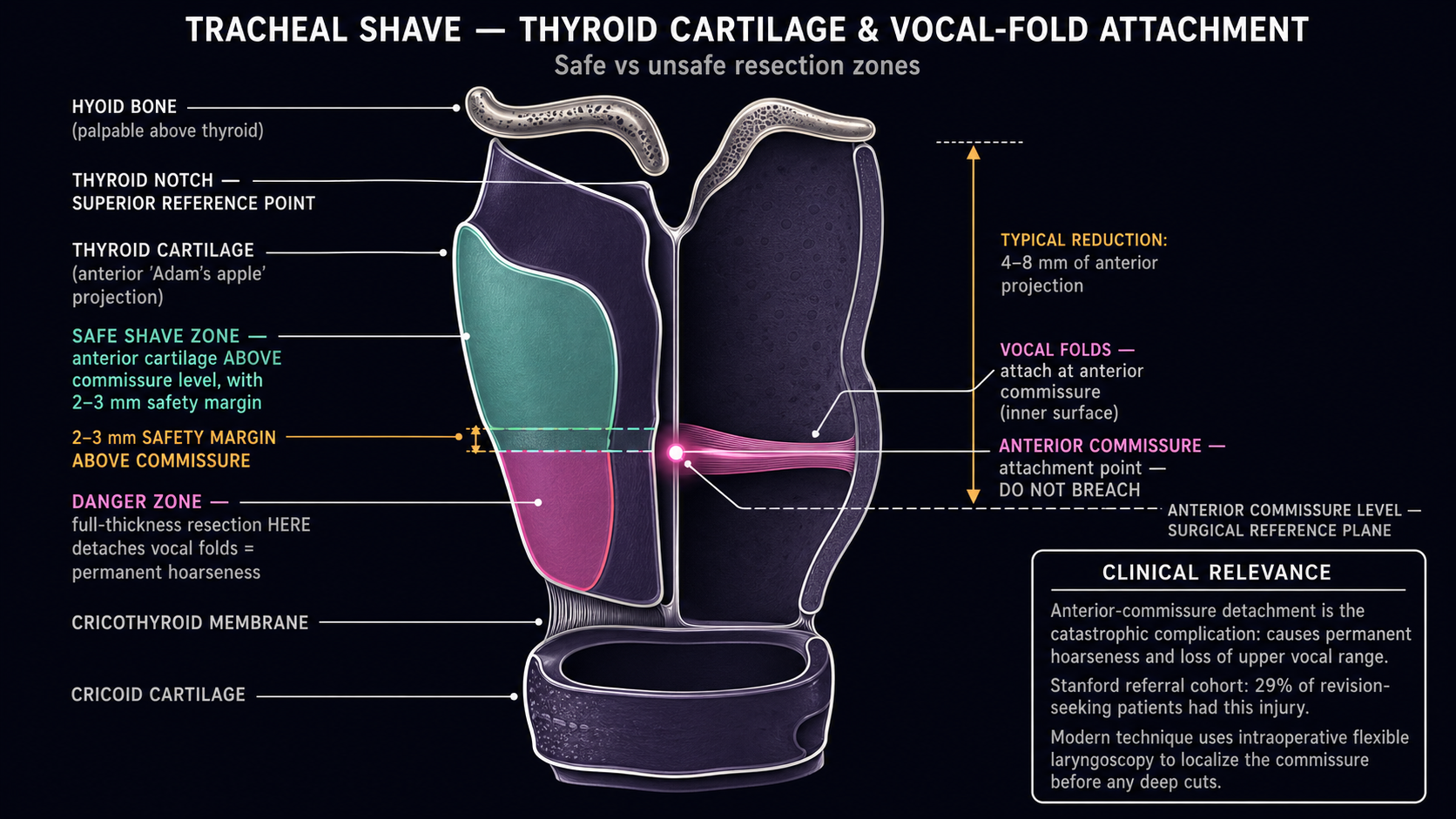
The catastrophic complication of tracheal shave is anterior commissure detachment — disruption of the point where the vocal folds attach to the thyroid cartilage. It causes permanent hoarseness, lowered speaking pitch, and loss of upper vocal range. A 94-patient review reported chronic hoarseness or pitch lowering in ~29% of patients who had inadequately-protected shaves at outside centers. Series using modern intraoperative visualization report zero vocal injuries in the same procedure. Choose a surgeon who routinely uses fiberoptic laryngoscopic guidance for this specific reason.
How much can safely be removed
The vocal folds insert on the thyroid cartilage roughly halfway down from the thyroid notch to its inferior border. Anything above that attachment can be reduced; anything at or below it cannot, without risking permanent voice damage.
Modern protocol:
- Mark the insertion point under fiberoptic laryngoscopy by passing a 22–25 gauge needle through the cartilage at the planned inferior limit, then verifying needle position relative to the anterior commissure on the scope.
- Resect only above the mark. Some high-volume groups stop 2–3 mm above the marked boundary for additional safety margin.
- Use precision tools — high-speed diamond burr or ultrasonic device with irrigation, especially for calcified cartilage in older patients. Brute-force tools (rongeurs) risk fracture and uncontrolled removal.
- Drape the soft tissue over the smoothed contour to confirm a flat neck profile before closing.
Some centers also obtain preoperative CT to estimate the vocal-fold insertion level before surgery and confirm intraoperatively with the needle marker.
Voice risk and how to mitigate it
Any chondrolaryngoplasty carries some voice risk because the vocal cords attach to the thyroid cartilage. The catastrophic outcome is destabilizing the anterior commissure, which causes permanent hoarseness, lowered pitch, and loss of falsetto/upper range.
Mitigation strategies, all standard at high-volume FFS centers:
| Strategy | What it does |
|---|---|
| Fiberoptic laryngoscopy via LMA | Direct intraoperative visualization of vocal folds and anterior commissure throughout the resection |
| Needle / landmark marking | 22–25G needle marks the inferior limit; surgeon resects only above the needle (Michigan FFS protocol) |
| Conservative resection | 2–3 mm safety margin above the vocal-fold insertion |
| Precision instruments | Diamond burrs, ultrasonic devices with irrigation; not blunt rongeurs |
When all four are used, permanent voice change is rare. A 27-patient FFS series with meticulous technique reported zero vocal injuries.
If the anterior commissure is disrupted, a subsequent voice feminization laryngoplasty can sometimes restore pitch — but this is reconstructive surgery for a complication, not a planned step. Don't treat it as a backup.
Patient counseling reality: mild hoarseness in the first 1–2 weeks is universal and resolves; significant or lasting voice change is uncommon when the precautions above are followed; the choice of surgeon is the dominant variable in voice safety.
Standalone vs combined with FFS
Tracheal shave is one of the easier FFS procedures to do as a standalone — it's quick (30–60 minutes), recovery is mild, and the incision is small. In a 27-patient series at a major center, 12 (44%) had it alone, 9 (33%) combined with other FFS, and the remainder bundled with unrelated procedures (vaginoplasty, breast augmentation).
| Approach | When it makes sense |
|---|---|
| Standalone (outpatient) | The Adam's apple is the only feature you want to address; you're not pursuing comprehensive FFS; you want a quick procedure with minimal recovery |
| Combined with full FFS | You're getting forehead, jaw, or other major work; bundling shares anesthesia and recovery; typically performed first in the operative sequence, before jaw/neck swelling makes airway visualization difficult (see Procedure Staging) |
Standalone procedures are typically done under general anesthesia with LMA airway management; outpatient setting; same-day discharge. Most patients return to desk work within 5–7 days.
Relationship to voice feminization surgery (VFS)
This is the single most important framing patients miss.
Tracheal shave does NOT raise your voice pitch
Removing the Adam's apple changes external neck contour only. It does not alter the vocal mechanism. Patients who want a higher-pitched voice need voice training and/or voice feminization surgery — not a tracheal shave. Done in isolation, an aggressive shave that disrupts the anterior commissure can actually lower speaking pitch.
| Procedure | What it changes | Voice effect |
|---|---|---|
| Tracheal shave (chondrolaryngoplasty) | Thyroid cartilage external contour | None intended; risk of pitch loss if over-resected |
| VFS (glottoplasty, cricothyroid approximation, Wendler glottoplasty) | Vocal folds and laryngeal framework | Raises fundamental frequency |
Sequencing tracheal shave with VFS
Some surgeons advocate shave first, VFS later so any unintended pitch drop from the shave can be addressed during voice surgery. The logic:
- If pitch is your top priority, do VFS last so it has the final word on your voice
- If neck contour is the priority and voice is secondary, you can do the shave first and address voice issues later
- Doing VFS without a shave can leave a still-prominent laryngeal bump on an otherwise feminized voice — visually mismatched
A few specialized surgeons offer "feminization laryngoplasty" — combined external thyroid reduction plus internal voice surgery in a single procedure — but this is uncommon and requires very specific expertise.
In practice: many patients have years of voice training after a shave; if the training reaches their goals, no further surgery is needed. If training plateaus below the desired pitch, VFS becomes the next step.
Recovery
Recovery is mild compared to bony FFS — no bone work, no major swelling, no diet restriction.
| Phase | What to expect |
|---|---|
| Day 0–2 | Throat soreness and mild hoarseness (often from the endotracheal tube, not the surgery itself). Most go home same-day or after one overnight observation. |
| Days 5–7 | Most patients feel substantially better. Speech back to normal volume; light activities resume. Sutures or surgical glue come off in the first week. |
| Weeks 2–3 | Swelling resolves; voice and swallowing back to baseline. Avoid heavy lifting, straining, or vigorous neck exercises for ~1 week postop to prevent edema or bleeding. |
| Weeks 4–6 | External scar matures under the skin. Silicone gel or sheets, plus SPF on the incision, are the standard scar-care protocol. |
| Months 3–6 | Neck feels fully healed. Final neck contour stable. Voice equilibrated. |
| Months 6–18 | Scar continues to mature and fade; redness usually resolves by 6 months, full maturation by 12–18 months. |
Postoperative pain is mild; most patients use only a few days of analgesics. Normal diet is generally allowed immediately. Persistent swallowing issues are uncommon — a 2022 survey reported >94% of patients had no long-term swallowing problems.
Risks and complications
| Risk | Frequency | Notes |
|---|---|---|
| Temporary hoarseness | Common (universal in first 1–2 weeks) | Expected; resolves spontaneously |
| Throat soreness / odynophagia | Common in first days | Resolves with swelling |
| Permanent voice change (anterior commissure injury) | Rare with proper technique; up to 29% in older series without intraoperative visualization | The dominant catastrophic risk; technique-dependent |
| Airway issues (laryngeal hematoma, laryngospasm) | Rare | Requires good intraoperative hemostasis and airway tools |
| Cartilage fracture | Rare | Heavily calcified cartilage + brute-force tools; one case in published series, repaired with miniplate |
| Scar issues | Uncommon | Small incision in a natural fold; thickening, redness, or keloid possible |
| Persistent swallowing problems | <6% | >94% have no long-term issues per 2022 survey |
| Bleeding requiring transfusion | Effectively never reported | Bloodless field; no patient in reported FFS series has required transfusion solely from a shave |
The single most important risk-reduction lever is surgeon choice: specifically, choosing one who routinely uses intraoperative fiberoptic laryngoscopy and the needle-marking protocol. The "greatest concern," per multiple authors, is tension loss in the vocal cords from over-resection — and that's almost entirely a function of how the operation is planned and visualized.
What to ask in consult
| Question | What a good answer sounds like |
|---|---|
| Do you use fiberoptic laryngoscopy intraoperatively? | Yes, via LMA, with direct visualization of the anterior commissure throughout. Anything less is a flag. |
| How do you mark the inferior limit of resection? | Needle marker through the cartilage, position confirmed on scope. Some surgeons additionally obtain pre-op CT. |
| What safety margin do you leave below the vocal-fold insertion? | 2–3 mm is the published practice. |
| What instruments do you use, especially for calcified cartilage? | Diamond burr, ultrasonic device with irrigation. Not rongeurs. |
| What's your protocol if I want VFS later? | Should be able to articulate sequencing — shave first vs VFS first — based on your priorities. |
| Will my voice get higher from this? | No. A surgeon who suggests otherwise is misinformed; walk out. |
| What's your cumulative experience with this specific procedure? | Volume matters; this is technically simple but the consequences of error are large. |
Sources
- 27-patient FFS chondrolaryngoplasty series (Michigan group) — needle-marking protocol; meticulous technique with intraoperative laryngoscopy; zero vocal injuries.
- 94-patient review of post-tracheal-shave complaints — ~29% with chronic hoarseness or pitch lowering attributed to anterior commissure disruption (older series without modern visualization).
- 2022 patient-reported outcomes survey — >94% no long-term swallowing issues.
- Anatomic studies of vocal-fold insertion on thyroid cartilage — ~halfway from notch to inferior border; basis for the safe-resection zone.
- See Procedure Staging for sequencing of tracheal shave within combined FFS (typically performed first, before jaw edema obscures airway visualization).
- Coleman et al. (2022) — WPATH Standards of Care v8 — gender-affirming surgery as medically necessary; tracheal shave specifically classified.