Hairline Design
Lowering or filling a hairline is mechanical; designing one that reads as feminine is judgment. The same surgeon, same graft count, same recipient bed will produce a very different result depending on where the leading edge sits, how irregular it is, how density grades front-to-back, how the temple corners turn, and how follicle direction is choreographed for the styles the patient actually wears.
Transplanted hair grows out exactly where it was placed. Design errors are permanent and visible from arm's length.
For the anthropometric targets (~7–9 cm glabella-to-mid-hairline, less lateral recession, softer corners) see Hairline Advancement → What "feminine hairline" actually means. This page is specifically about how a transplant achieves those targets, and where the design rules come from. For harvesting technique see FUE vs FUT; for who's doing this work and what it costs see Surgeons & Cost.
Most rules are inherited from cis female pattern hair loss
The published design conventions — density numbers, frontotemporal angles, transition-zone width — come from cis female-pattern hair-loss (FPHL) practice, applied to transfeminine patients without formal validation in the trans population. The Capitán 65-patient simultaneous-FFS+transplant series, Bared's transgender-specific feminization series, and Epstein's transgender hair-restoration chapters are the closest existing evidence base. There are essentially no randomized aesthetic-outcomes trials in this space.
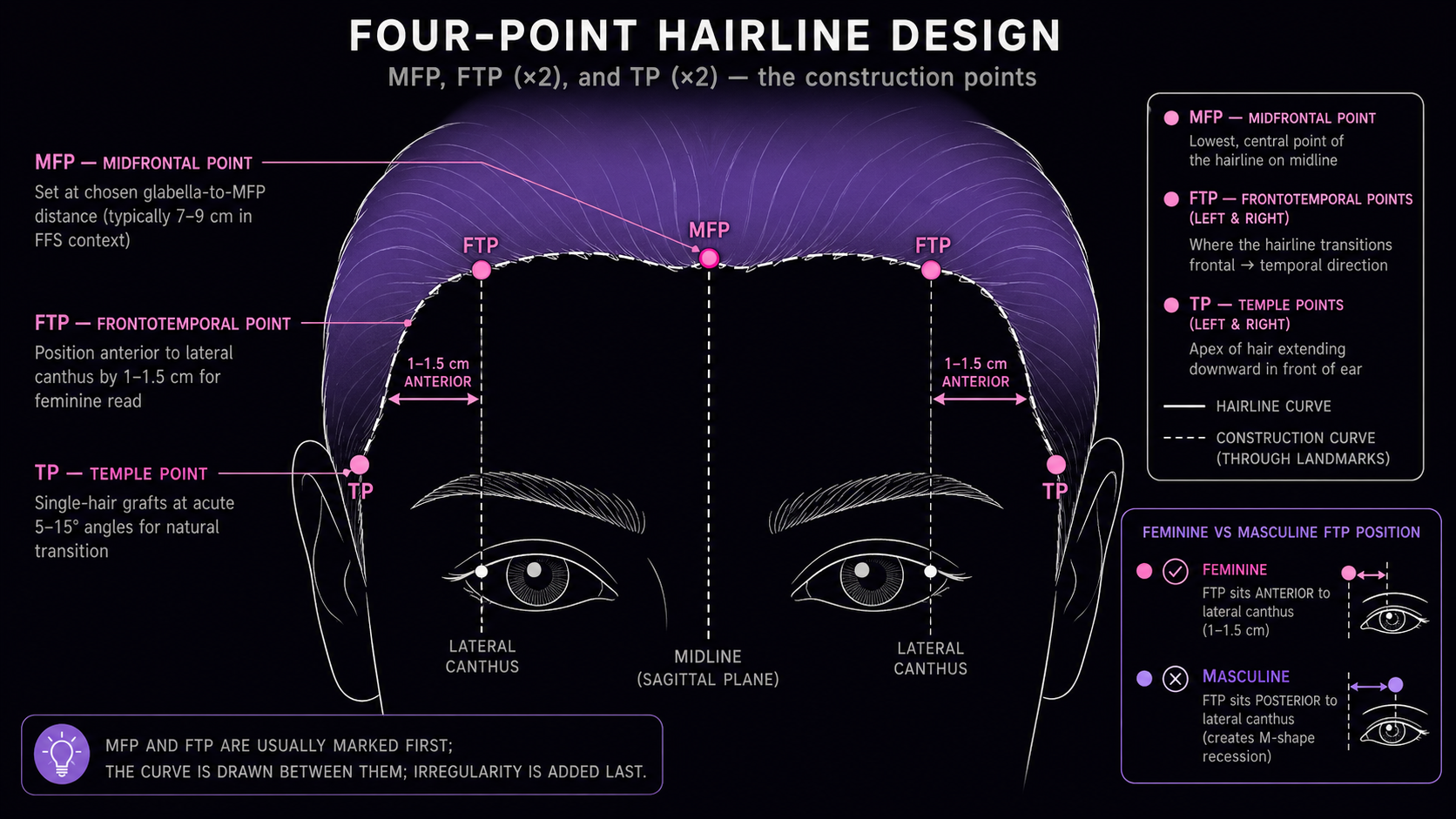
The four-point design
Most surgeons mark the hairline with a small set of named landmarks rather than drawing the whole curve freehand:
- Midfrontal point (MFP) — the lowest, central point of the line, set by the chosen glabella-to-MFP distance. Typically placed where the curvature of the frontal scalp begins (where a finger pressed firmly meets the inflection of the skull).
- Frontotemporal point (FTP) — where the curve turns laterally. In feminine designs this sits higher and more anterior than in male designs, opening the frontotemporal angle.
- Temple point (TP) — the apex of hair extending downward in front of the ear; a strong feminine feature when present, often partially or fully reconstructed in transfeminine patients.
The MFP and FTP are usually marked first, the curve drawn between them, and irregularity added last.
Where the leading edge goes
The 7–9 cm figure that circulates in FFS planning is not the same target a hair-transplant surgeon would pick for a cis female cosmetic patient. It is a pragmatic FFS-era bound — shorter is generally more feminine, but pushing the line below ~5 cm distorts proportion, looks doll-like, and burns graft inventory better spent on temples and density.
| Reference | Reported "feminine" range | Notes |
|---|---|---|
| Hair-restoration design textbooks (Unger & Shapiro) | ~5.0–6.5 cm | Youthful cis female cosmetic target |
| Anthropometry of attractive young women (Farkas) | ~5.5–6.5 cm trichion–glabella | Varies by ethnicity |
| FFS literature on masculine forehead | ~6.5–8.5 cm typical male, often with bitemporal recession | The starting state |
| Common transplant-design citation | ~7–9 cm glabella-to-MFP outer bound | Reflects FFS-population planning, not cis cosmetic ideal |
Designers anchor the midpoint to vertical facial thirds rather than to an absolute number — the upper third should match (or be slightly shorter than) the middle and lower thirds for a feminine read. Three modifiers genuinely change the right number:
- Ethnicity. Average vertical forehead height is shorter in many East Asian women (~5.0–5.5 cm) and longer in some patients of African descent.
- Brow position. A feminizing brow lift effectively lengthens the apparent forehead. Don't finalize the hairline before the brow plan is set.
- Forehead slope. A vertical or slightly anteriorly tilted forehead reads feminine; a posteriorly sloped forehead can make even a properly low hairline look receded.
Shape: the M-to-rounded transition
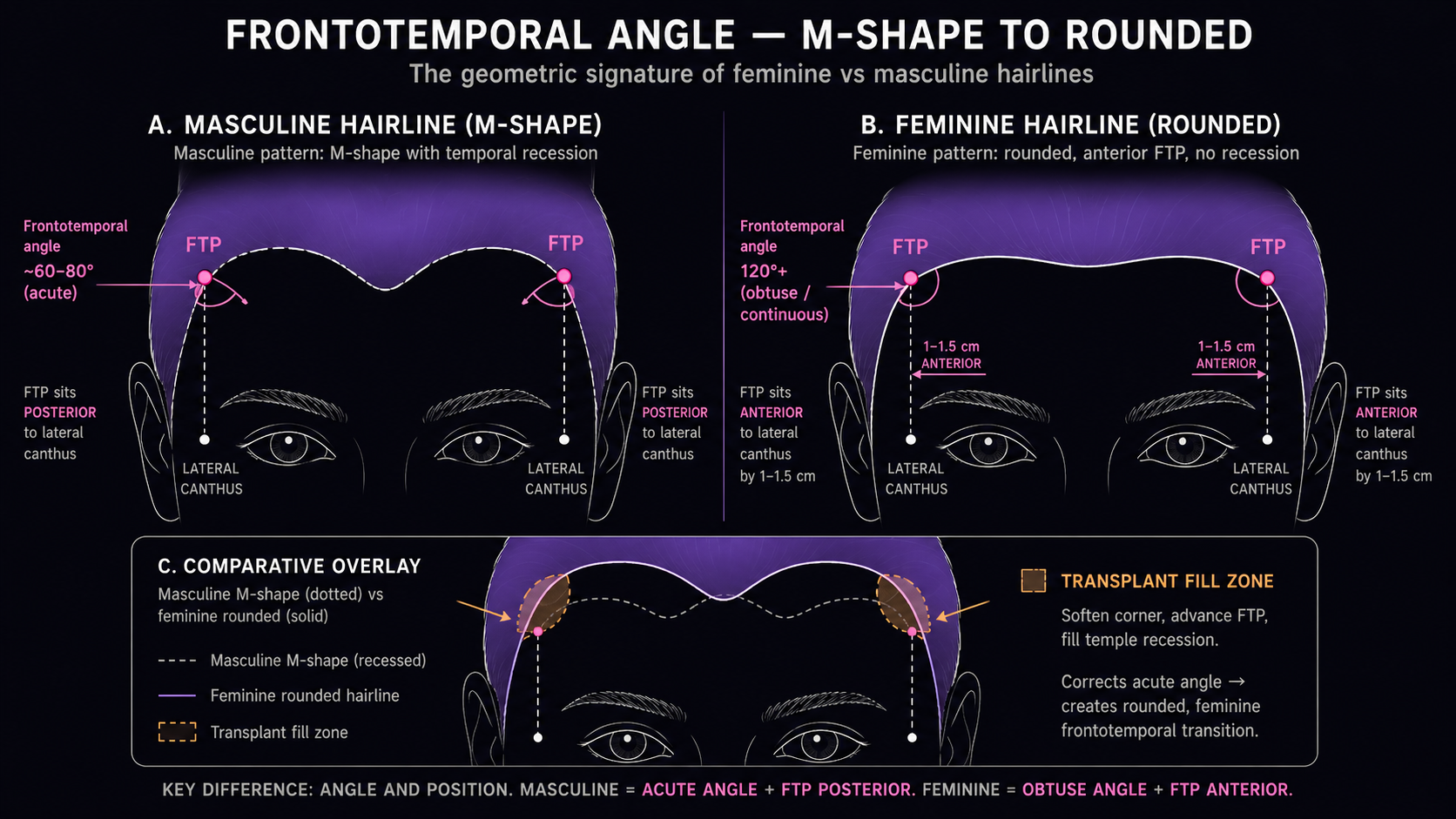
The clearest single male/female shape difference is the frontotemporal angle — the angle at the FTP between the frontal hairline and the temporal hairline. Male designs close it (acute, recedes posteriorly with age). Feminine designs open it and move the FTP forward and upward so the line curves smoothly rather than turning at a corner.
| Phenotype | Approx. frontotemporal angle | FTP position vs. lateral canthus |
|---|---|---|
| Adult male, no recession | ~60–80° | Above the lateral canthus or slightly posterior |
| Mature male / mild Norwood II–III | Sharper, M-shape | Posterior to lateral canthus |
| Adult female, attractive | More obtuse / continuous curve | Anterior to lateral canthus, often within ~1.5 cm anterior |
These are aesthetic conventions from transplant design literature, not measured population norms.
Temple points and frontotemporal recession
Temple-point reconstruction is one of the most distinctly feminizing maneuvers in the toolkit. In genetic males the temple points are often blunt; in transfeminine patients with recession they may be absent entirely. The rules:
- Acute angles. Temple-point hair is placed almost flat to the skin (5–15° to scalp), pointing inferiorly and slightly anteriorly. Steeper angles produce a doll-like appearance.
- Single-hair grafts only. Multi-hair grafts at temple points read as obviously transplanted.
- Fine-caliber donor hair. Often nape or fine occipital. Coarse hair at the temple looks pasted on.
- Asymmetry on purpose. Exact mirror-image temple points look manufactured. A few millimeters of intentional asymmetry is realistic.
Widow's peak: yes or no
There is no consensus. The literature is split:
- Pro-peak. A subtle midline projection ~3–5 mm anterior of the rest of the line reads as an evolved natural variant present in roughly a quarter of cis women.
- Anti-peak (default). Several FFS-population surgeons consider an explicit peak distracting and prefer a smooth curve, reserving a peak for patients who specifically request it or whose natural cowlick suggests one.
Patient preference plus surgeon style, not data.
Density gradient
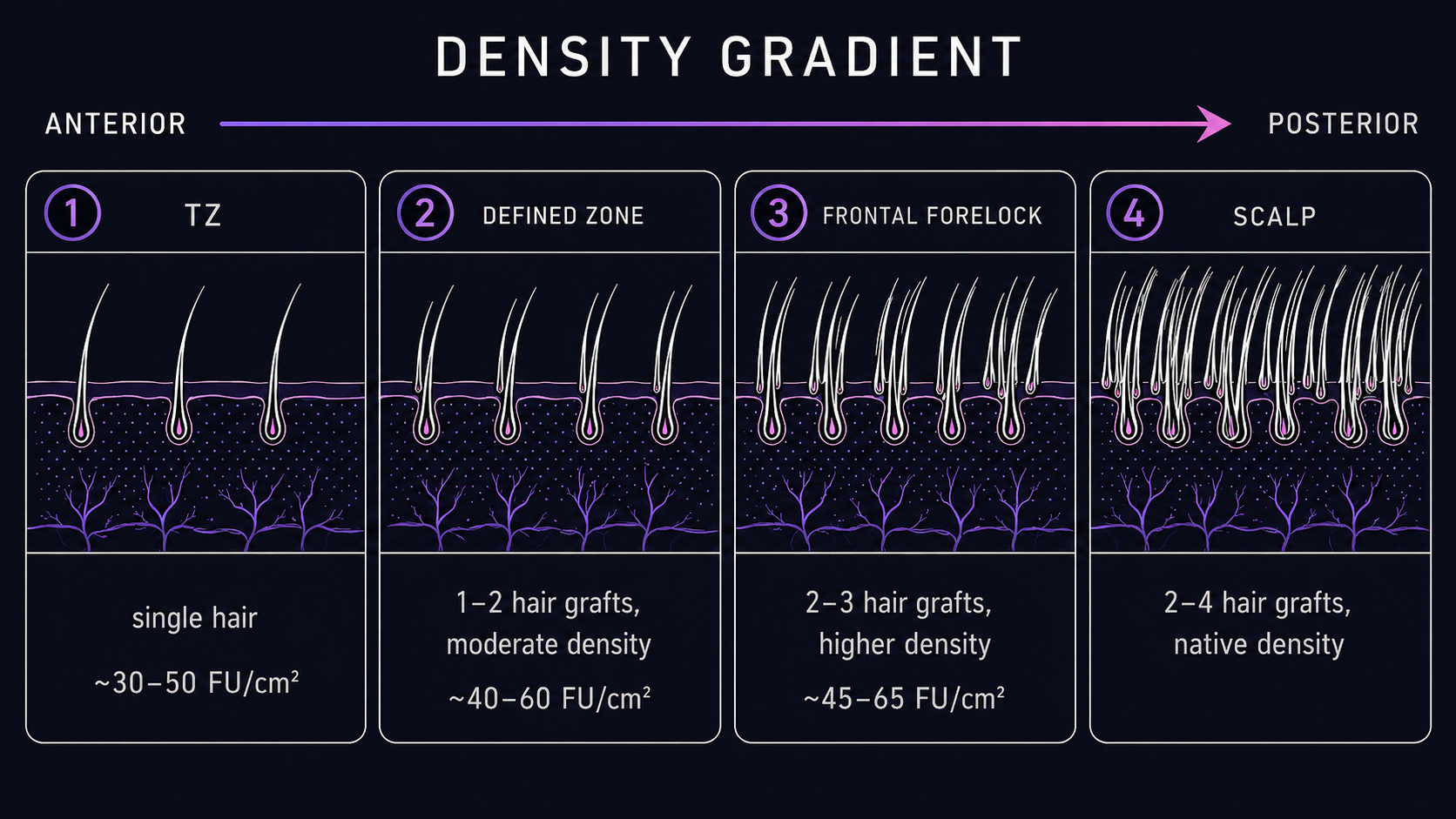
Most authors describe three or four zones moving posteriorly from the leading edge:
| Zone | Width | Graft type | Density (FU/cm²) | Aesthetic role |
|---|---|---|---|---|
| 1 — Transition zone (TZ) | 0.5–1.0 cm | 100% single-hair, finest available | 30–50 | Soft, irregular, see-through edge |
| 2 — Defined zone | 1.0–2.0 cm | Mostly single + some 2-hair | 40–60 | The visible "line" of the hairline |
| 3 — Frontal forelock | variable | 2–3 hair FUs | 45–65 | Bulk, frames the face |
| 4 — Mid-scalp blend | — | Native + 2–4 hair FUs | Native | Smooth transition into existing density |
Commonly cited frontal targets are 40–60 FU/cm² in the defined zone, with the Capitán transfeminine series and the recent East Asian FUE series both working at 50–60 FU/cm² at the leading edge. Native frontal density in cis women averages ~70–100 FU/cm²; full native density is rarely achievable in a single session.
Density without irregularity is doll hair
A high count of grafts placed in straight rows looks like a wig. Realism comes from random distribution within the TZ, sentinel hairs (isolated singles a few mm anterior to the main edge), and caliber matching — fine-caliber donor hair at the leading edge, coarser hair behind. Coarse curly hair placed at the front creates a "wig line" that no amount of density will rescue.
Why irregularity beats a straight line
A straight or geometrically smooth hairline is the single most common giveaway of an unsophisticated transplant. Three reasons:
- Cis hairlines are not lines. Photographic surveys of attractive women describe the leading edge as a zone 3–8 mm deep, populated by a stochastic pattern of single hairs of varying caliber and angle — not a curve.
- The eye recognizes regularity instantly. Even patients who can't articulate why describe geometric hairlines as "off." This is the same perceptual mechanism that makes uncanny faces uncanny.
- A straight line betrays under any updo. When hair is pulled back, the leading edge is the only feature visible from across a room. Updo-friendly design is the test most transfeminine patients should apply.
Designers describe three layers of noise:
- Macro-irregularity — the hairline curve is drawn with small forward bumps every 1–2 cm rather than as a smooth arc. "Scallops" or "swags."
- Micro-irregularity — within each cm, individual graft sites are placed in a slightly randomized pattern.
- Sentinel hairs — isolated singles 2–4 mm anterior to the main edge, mimicking the stray hairs cis women have at their natural edge.
- Asymmetry — small left-right differences in MFP height, FTP position, and temple-point shape.
Macro-irregularity vs. straight line:

Bad (ruled edge):
________________________________________________

Better (gentle curve, still "transplant-y"):
\____________________________________________/

Good (macro + micro irregularity, sentinel hairs):
        .
   .    .   .          .       .
\__/\__/_/\___/\___/\___/\__/\__/\__/
Graft angle and direction
Transplanted hair grows out at the angle the recipient site was made. Recipient-site angulation is the single largest determinant of how the result lies, drapes, and styles.
| Region | Angle to scalp | Direction | Notes |
|---|---|---|---|
| Leading edge / TZ | 10–20° (very acute, almost flat) | Forward | Hair must lie down; steeper angles stand up and read as transplanted |
| Defined zone | 20–30° | Forward | Blends into native pattern |
| Mid-frontal scalp | 30–45° | Forward, with native cowlick respected | Native scalp angles are 30–45° with regional whorls |
| Temple points | 5–15°, almost flat | Inferior + slightly anterior | Critical for naturalness; missed angle is highly visible |
| Lateral fringe | 15–25° | Inferior, curving toward the ear | — |
Angle errors at the leading edge are the most punishing of all design mistakes because they cannot be corrected without removing or destroying transplanted follicles. This is why surgeon experience with transfeminine hairlines specifically — not just transplants in general — matters.
Designing for the styles you actually wear
Transfeminine patients commonly want updos, ponytails, side parts, brushed-back styles, and short cuts that expose the hairline. Each style stresses a different part of the design:
| Style | What it exposes | Design implication |
|---|---|---|
| Updo / pulled-back ponytail | Full leading edge, temples, tail over the ear | Temple points must be reconstructed; TZ must be irregular and fine; sentinel hairs essential |
| High ponytail | The hairline in 360°, including nape and side fringe | Lateral hairline contour and sideburn integration matter |
| Side part | Asymmetric exposure of one frontal corner; the part exit at the leading edge | Macro-irregularity must hold up at the part — a single straight notch is visible |
| Brushed-back / slicked | Whole frontal hairline, light hits the leading edge | Density gradient and graft caliber must be perfect; the hardest style to design for |
| Bangs / fringe | Hides the leading edge entirely | Permits weaker design but commits the patient to bangs forever |
The back-of-head test used in design consults: photograph the planned hairline pulled flat against the scalp under bright direct light. If it looks plausible there, it will tolerate everyday styling. If it doesn't, the design needs more work.
How transfeminine design differs from cis-female design
Most transplant surgeons treating transfeminine patients started in cis hair restoration. The rules transfer, but with these emphasis shifts:
- Temple reconstruction is more often needed. Cis women with FPHL usually retain temples; transfeminine patients with male-pattern baseline often have lost or never had defined temple points.
- Frontotemporal-angle correction is the dominant maneuver. In FPHL the central density problem dominates; in transfeminine planning, opening the M is at least as important as filling the front.
- Coarser donor hair on average. Transfeminine donor hair is typically the same caliber as a male-pattern donor — heavier than typical cis female donor hair. Compensate by using nape or fine occipital for the leading edge.
- The forehead canvas has often been changed. When transplant follows FFS forehead contouring, the hairline must be designed to the post-FFS forehead, not the natal one — less bossing, recontoured supraorbital ridge, sometimes a scalp-advancement scar.
- Not every patient wants explicitly feminine. Some prefer a lower, fuller, but slightly squared hairline that reads as ambiguous rather than feminine. This is a legitimate design goal the published literature has not studied.
Common design errors that betray a transplant
| Error | What it looks like | Why it happens |
|---|---|---|
| Straight or geometric leading edge | Sharp ruled edge under updo lighting | Surgeon drew a curve, not a zone |
| Multi-hair grafts at the front | Tufted "doll-hair" appearance | Inadequate sorting in graft prep, or speed-driven density push |
| Steep graft angles at the leading edge | Hair stands up rather than lying down | Recipient sites made too vertical |
| Hairline placed too low | Doll-like, eats the upper-third proportion | Patient pressure or surgeon over-correction |
| Frontotemporal angle still acute | Subtle masculine M persists despite frontal density | Designer treated the front as a "shorter line" instead of a different shape |
| Temple points absent or symmetric | Square ends at the temple, or both sides identical | Temples not reconstructed, or reconstructed as twins |
| Caliber mismatch | Coarse, dark, wiry hair at the front | Donor hair selected by ease, not by leading-edge requirements |
| Abrupt density step | Visible "wall" where the transplanted zone ends | Designer used uniform density rather than a gradient |
| No sentinel hairs | The zone has a hard edge | Designer treated TZ as a thin line, not a feathered region |
| Mirror symmetry | Both halves of the hairline are identical | Designer drew one half and traced it; nature does not |
Markup approval is the patient's job
The single highest-leverage moment in the whole process is when the surgeon shows you the proposed markup. Bring photos of hairlines you find believable. Push back on anything that looks like a curve rather than a zone. Ask specifically about temple-point asymmetry, sentinel hairs, and the frontotemporal angle. Once the recipient sites are made, the design is permanent.
Where the literature is thin
- No transfeminine-specific aesthetic-outcomes trial. The evidence base is small case series, design chapters, and surgeon descriptions.
- Density targets are extrapolated from FPHL. The 40–60 FU/cm² figure comes from cis female and general hair-restoration practice.
- Anthropometric "feminine ideal" varies by population, era, and study. Treat any single number with skepticism; design to the individual face.
- Widow's peak, exact frontotemporal-angle degrees, and "right" amount of irregularity are all expert opinion. No formal morphometric trial validates the specific numbers cited above.
Sources
Transfeminine-specific
- Capitán L, et al. (2017) — Facial Feminization Surgery: Simultaneous Hair Transplant during Forehead Reconstruction (Plastic and Reconstructive Surgery) — 65-patient series; cited 50–60 FU/cm² frontal target.
- Bared A. (2019) — Hair restoration in the transgender patient (Facial Plastic Surgery Clinics of North America) — explicit temple-point and frontotemporal-angle protocols for feminization.
- Bared A, Epstein J. (2018) — Hairline-lowering surgery and hair restoration (Facial Plastic Surgery Clinics of North America).
- Epstein JS. (2013) — Hair restoration to soften the hairline and temples (Facial Plastic Surgery Clinics of North America).
- Epstein JS. (2017) — Hairline-lowering and hairline restoration in male-to-female transgender patients (Plastic and Reconstructive Surgery Global Open).
Hairline design (foundational)
- Shapiro R. (2001) — Principles and techniques used to create a natural hairline in surgical hair restoration (Facial Plastic Surgery Clinics of North America).
- Mayer M. (2013) — Hairline design and frontal hairline restoration (Facial Plastic Surgery Clinics of North America).
- Kabaker SS, Champagne JP. (2008) — Hairline lowering (Facial Plastic Surgery).
- Kabaker SS. (1986) — Juri flap procedure for the treatment of baldness (Archives of Otolaryngology).
- Lam SM. (2009) — Hair restoration in the female patient (Facial Plastic Surgery Clinics of North America).
- Marzola M. (2009) — Single-scar harvesting technique (Facial Plastic Surgery Clinics of North America).
- Rose PT. (2005) — The latest innovations in hair transplantation (Facial Plastic Surgery).
- Nusbaum BP, Fuentefria S. (2009) — Naturally occurring female hairline patterns (Dermatology Surgery).
- Unger WP, Shapiro R, Unger R, Unger M (eds.) — Hair Transplantation, 5th edition (CRC Press, 2010).
Density and follicular units
- Bernstein RM, Rassman WR. (2005) — Follicular unit transplantation (Dermatology Surgery).
- Jiménez F, Ruifernández JM. (1999) — Distribution of human hair in follicular units (Dermatology Surgery).
- Limmer BL. (1994) — Elliptical donor stereoscopically assisted micrografting (Dermatology Surgery).
Anthropometry and forehead context
- Farkas LG. (1994) — Anthropometry of the Head and Face, 2nd ed. (Raven Press).
- Farkas LG, et al. (2005) — International anthropometric study of facial morphology in various ethnic groups/races (Journal of Craniofacial Surgery).
- Spiegel JH. (2011) — Facial determinants of female gender and feminizing forehead cranioplasty (Laryngoscope).
- Capitán L, et al. (2014) — Forehead reconstruction in male-to-female transsexuals: a 5-year experience (Plastic and Reconstructive Surgery).