Blepharoplasty (Eyelid Surgery)
Reshapes the upper or lower eyelids. In FFS, blepharoplasty is a secondary refinement rather than a core procedure — it doesn't address bony dimorphism, and HRT-driven facial fat changes can significantly alter the periorbital area over the first 1–2 years. Most patients don't need it; some find it useful at the back end of an FFS plan once swelling from major bone work has fully resolved.
Two distinct procedures share the name:
| Procedure | What it does | Common reason in FFS |
|---|---|---|
| Upper blepharoplasty | Removes redundant upper-eyelid skin (dermatochalasis); sometimes a small wedge of orbicularis muscle and herniated fat | Heavy or hooded upper-lid skin obscuring the lid platform; perceived "tired" or masculine eye |
| Lower blepharoplasty | Removes or repositions herniated lower-lid fat; sometimes tightens skin and lateral canthal support | Under-eye bags or hollows; tear-trough deformity not amenable to filler |
Sequencing matters — a lot
If you are also getting a brow lift, the order is not optional: brow lift first, then upper blepharoplasty. Brow elevation eliminates 3–4 mm of apparent eyelid skin redundancy that would otherwise be resected. Doing them simultaneously without re-marking after brow fixation routinely produces over-resection — leading to lagophthalmos (incomplete eye closure) or a skeletonized look. See Procedure Staging for the full sequencing logic.
Is it actually feminizing?
Less directly than most FFS procedures. Sex differences in periorbital soft tissue are subtle; what's typically perceived as a more feminine eye comes from:
- Brow position (handled by brow lift)
- Forehead bone profile (handled by forehead contouring)
- Visible lid platform between the lashes and the brow — affected by all of the above plus skin redundancy
- Tear-trough volume — affected by cheek augmentation (especially fat grafting)
Many patients who think they want blepharoplasty find that brow lift, forehead work, and HRT-driven fat redistribution have produced enough periorbital change to make blepharoplasty unnecessary. This is a strong argument for staging blepharoplasty late — after the bone work and HRT effects have settled, you can decide if you actually need it.
Why timing in FFS is contested
Three intersecting factors:
- Brow position — covered above. Brow lift comes first.
- Periorbital edema after Type III cranioplasty — frontal-sinus setback creates significant periorbital swelling that can take months to fully resolve. Skin-redundancy assessment is unreliable during this period.
- HRT-driven fat redistribution — over 1–2+ years of feminizing hormones, malar and periorbital fat compartments change measurably. Aggressive blepharoplasty done early in transition can over-resect skin or fat that the body would otherwise have softened on its own.
The dominant FFS-specific recommendation is to defer blepharoplasty to a second stage 6–12 months after major bone work, particularly after Type III forehead contouring. This is also when you can best judge whether you actually need it.
If a surgeon proposes simultaneous Type III contouring plus aggressive upper blepharoplasty without explaining how they will avoid over-resection, ask them to walk through their re-marking protocol. A defensible answer involves intraoperative re-marking after brow fixation, conservative skin excision, and a low threshold to leave extra skin for safety.
Upper blepharoplasty technique (briefly)
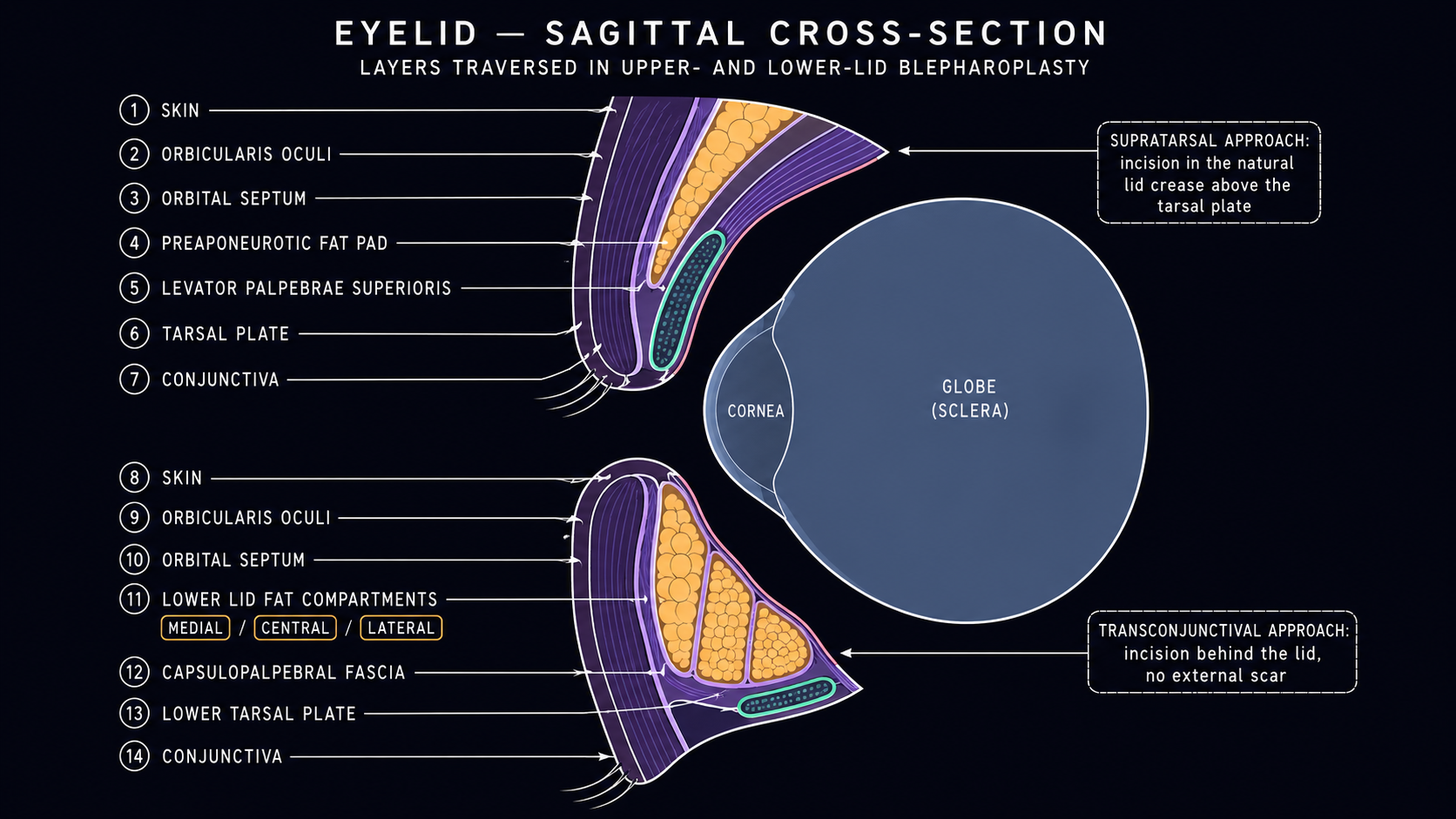
Standard approach: an incision in the natural upper-lid crease (or slightly above it for patients without a defined crease), excision of redundant skin in an elliptical pattern, optional removal of a strip of orbicularis oculi muscle, optional excision of herniated medial or central fat pads, layered closure with fine suture.
The supratarsal-crease incision typically heals to a near-invisible line within the natural fold. Closure tension and patient skin type drive the visible-scar risk.
Performed under local anesthesia with sedation or general; office or ambulatory setting. Operative time is short — 30–60 minutes per side.
Lower blepharoplasty technique (briefly)
Two approaches:
| Approach | Incision | Strengths | Weaknesses |
|---|---|---|---|
| Transconjunctival | Inside the lower lid (no external scar) | No visible scar; lower risk of lid retraction or ectropion (lid pulled outward) | Limited skin tightening; mostly addresses fat |
| Subciliary (skin-muscle flap) | Just below the lower lash line | Allows skin tightening and fat repositioning together | Risk of lid retraction, ectropion, persistent lid malposition |
Modern practice favors transconjunctival approach when the dominant problem is fat herniation, with optional canthal support and skin pinch / laser resurfacing for skin tightening. This minimizes the risk of post-op lid malposition.
For volume restoration over the orbital rim and tear trough, fat repositioning (releasing herniated fat and redraping it over the rim) or fat grafting addresses the hollow look that pure fat removal can create.
Recovery
| Phase | What to expect |
|---|---|
| Days 0–3 | Bruising and swelling around the eyes. Sleep with head elevated. Cold compresses commonly used in the first 48 hours. |
| Day 5–7 | Sutures removed. Bruising peaks then transitions purple → green → yellow. |
| Weeks 1–2 | Most patients comfortable in public 7–14 days post-op. Bruising fades. Some persistent swelling and lid stiffness. |
| Weeks 2–4 | Most external swelling resolved. Light cardio resumes ~2 weeks; full exercise 3–4 weeks. Contact-lens wear typically resumes 1–2 weeks. |
| Months 1–3 | Subtle residual swelling and scar maturation. Final lid contour emerging. |
| Months 6–12 | Final result. Scar maturation continues fully through the first year. |
Lagophthalmos (incomplete eye closure) is common in the first days/weeks and usually resolves as swelling subsides. Lubricating eye drops are standard. Persistent lagophthalmos beyond 4–6 weeks is a flag for over-resection.
Dry-eye symptoms can persist for weeks to months after upper blepharoplasty especially. Patients with pre-existing dry eye should be evaluated by an ophthalmologist before surgery.
Risks and complications
| Risk | Detail |
|---|---|
| Lagophthalmos | Incomplete eye closure, usually transient; persistent cases indicate over-resection |
| Lid retraction / ectropion | Lower-lid only; minimized by transconjunctival approach + canthal support |
| Dry eye | Common; usually transient; pre-existing dry eye is a relative contraindication |
| Asymmetry | Low single-digit % |
| Visible scarring | Upper crease scars usually inconspicuous; lower subciliary scars more visible |
| Hematoma | Rare; retrobulbar hematoma is a vision-threatening emergency requiring immediate decompression |
| Vision changes | Very rare with proper technique; most concerning with retrobulbar hematoma |
| Over-resection | The most consequential aesthetic complication for upper blepharoplasty in the FFS context. Often related to brow-lift sequencing. |
What to ask in consult
| Question | Why it matters |
|---|---|
| Do I actually need this, or will brow lift / HRT / fat grafting be enough? | Many patients don't need blepharoplasty as part of FFS. |
| If yes, are you doing it in the same session as forehead/brow work, or staged? | Should be staged after Type III contouring at most centers; if combined, ask about re-marking protocol. |
| Upper, lower, or both? | Should match a specific anatomic problem. |
| If lower: transconjunctival or subciliary approach, and why? | Transconjunctival preferred for fat-only problems; subciliary for skin-and-fat. |
| What's your protocol for retrobulbar hematoma? | Should be answered immediately and clearly. |
| Have I been evaluated for dry eye preop? | If you have any baseline symptoms, this is essential. |
Sources
- See Procedure Staging for the brow-lift-blepharoplasty sequencing logic and the FFS-specific deferral rationale.
- Coleman et al. (2022) — WPATH Standards of Care v8 — facial gender surgery medical necessity criteria.
- American Society of Plastic Surgeons — Blepharoplasty — general (non-FFS-specific) procedure overview and recovery guidance.