Voice Feminization Surgery (VFS)
Voice pitch is set by vocal-fold length, mass, and tension — characteristics that finalize during natal puberty and that estrogen does not reverse. The first-line approach to feminizing voice is gender-affirming voice training with an SLP experienced in trans voice work. Surgery is considered when training plateaus, when training isn't accessible, or when a patient wants to lock in a higher pitch baseline that voice work then refines.
VFS is never a substitute for voice training. Resonance, intonation, and word choice — the variables that matter most for sounding feminine — do not change with surgery. Patients who skip pre-op training typically end up with a higher pitch but a less convincing voice; patients who skip post-op training rarely realize the full benefit of their surgical pitch gain.
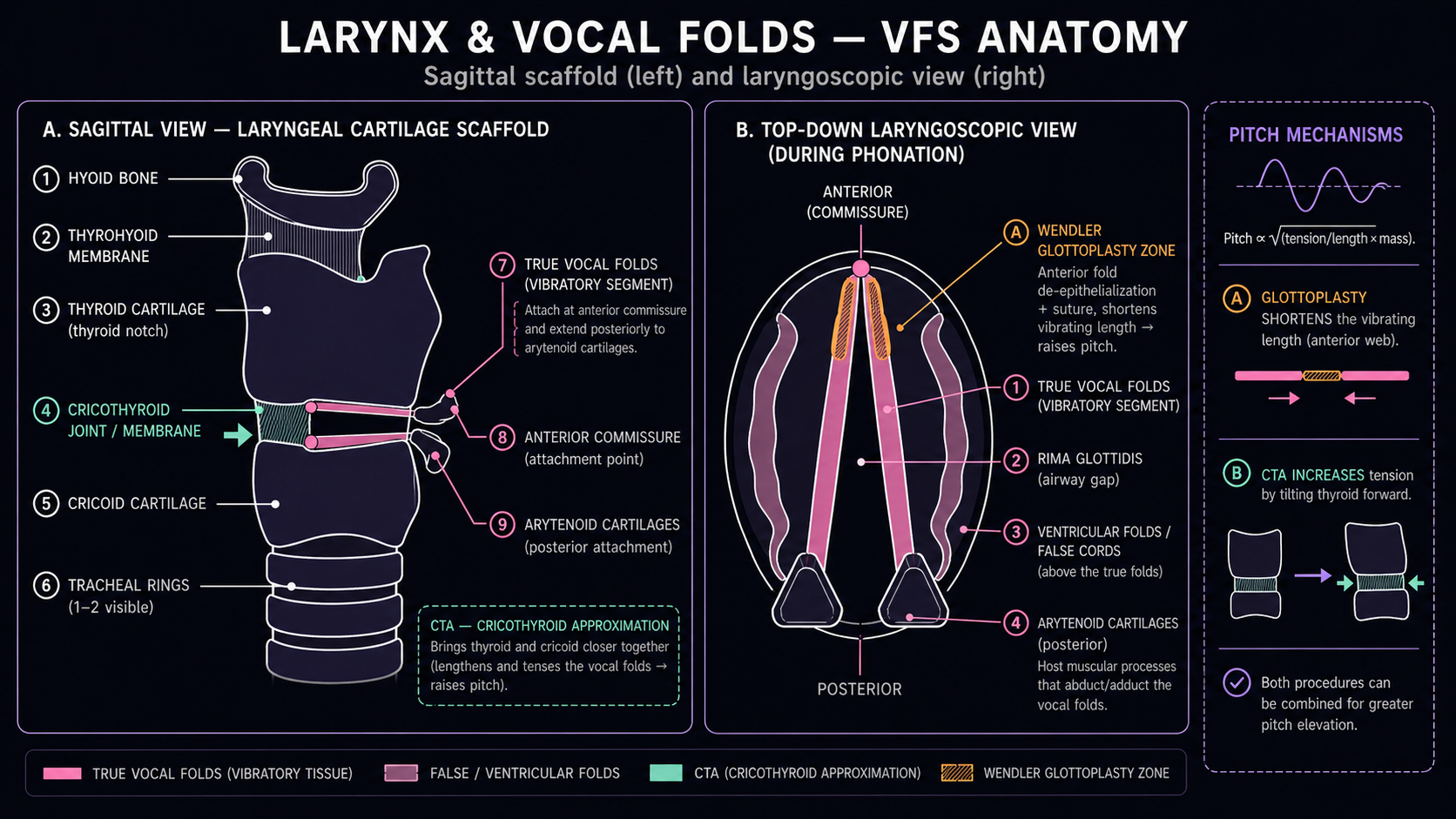
Subtopics
| Page | What it covers |
|---|---|
| Candidacy & Timing | Voice-training prerequisite, why pre-op SLP work matters, age and capacity, sequencing with FFS |
| Wendler's Glottoplasty | The dominant modern technique — endoscopic anterior-fold suturing, ~30–50 Hz pitch gain |
| Cricothyroid Approximation (CTA) | Older open technique — cartilage tilt rather than fold-shortening; known regression; sometimes used as adjunct or revision |
| Feminization Laryngoplasty (FemLar) | Comprehensive open approach with thyroid cartilage shortening; >100 Hz gains in published series |
| LAVA & Other Techniques | Laser-assisted voice adjustment, mass reduction, anterior commissure advancement, emerging combinations |
| Surgeons & Cost | Two-tier market, credentialing, regional cost ranges, Yeson Voice Center, insurance |
| Recovery & Voice Training | Voice-rest protocols, return-to-voice, post-op SLP coordination, final pitch settling |
| Risks & Complications | Pitch regression, scarring, breathiness, paralysis; revision options |
Procedures at a glance
| Procedure | Approach | Typical pitch gain | Reversible | Pitch-regression risk | Voice rest |
|---|---|---|---|---|---|
| Wendler's glottoplasty | Endoscopic | 30–50 Hz | Partially* | Low–moderate | 1–2 weeks |
| Cricothyroid approximation | Open neck | 20–40 Hz | Partially | High (multi-year drift) | 1–2 weeks |
| Feminization Laryngoplasty | Open neck | 80–120+ Hz | Limited | Low (cartilage-anchored) | 2–4 weeks |
| LAVA | Endoscopic | 20–40 Hz | Partially | Moderate | 1–2 weeks |
* Sutures can sometimes be released; cartilage modifications cannot.
Voice training first, always
A few practical points before considering surgery:
- Voice training reliably raises speaking pitch, modifies resonance, changes intonation patterns, and can be undone or adjusted at will. Surgery cannot.
- Most trans-experienced SLPs work via telehealth in 2026 — geography is rarely the bottleneck it once was.
- Apps like Voice Tools, Christella VoiceUp, and free YouTube programs (e.g. TransVoiceLessons) are useful adjuncts but not substitutes for an SLP if you can access one.
- Many people who consider VFS find that 6–12 months of focused training resolves their dysphoria without surgery.
VFS becomes the right consideration when training has produced as much pitch elevation as it can and the patient still wants higher baseline pitch — or when the cognitive load of "performing" voice is a continuous distress that a surgical baseline shift would relieve.
See the Voice Training section for training methodology, exercises, and the 8-week starter plan.
Cost & recovery (summary)
| Aspect | Typical range |
|---|---|
| Cost (US/EU) | \(5K–\)15K USD (glottoplasty); higher for FemLar |
| Cost (Yeson, Korea) | \(8K–\)12K USD plus travel/lodging |
| Voice rest | 1–2 weeks complete silence post-op (no whispering) |
| Soft return to voice | Weeks 2–6 |
| Final pitch settles | 3–6 months |
| Insurance (US) | Inconsistent; sometimes covered when documented as medically necessary, often categorized as cosmetic |
Full surgeon-shopping detail in Surgeons & Cost.
Sources & further reading
- WPATH Standards of Care v8 — voice care section including position on VFS
- Transfeminine Science — articles on feminization procedures
- TransVoiceLessons (YouTube) — community-respected voice training resource
- Community threads on r/transvoice and r/Transgender_Surgeries
- Yeson Voice Center materials (Seoul, KR) — widely cited for FemLar outcomes; included as reference, not endorsement