Sex Reassignment Surgery (SRS)
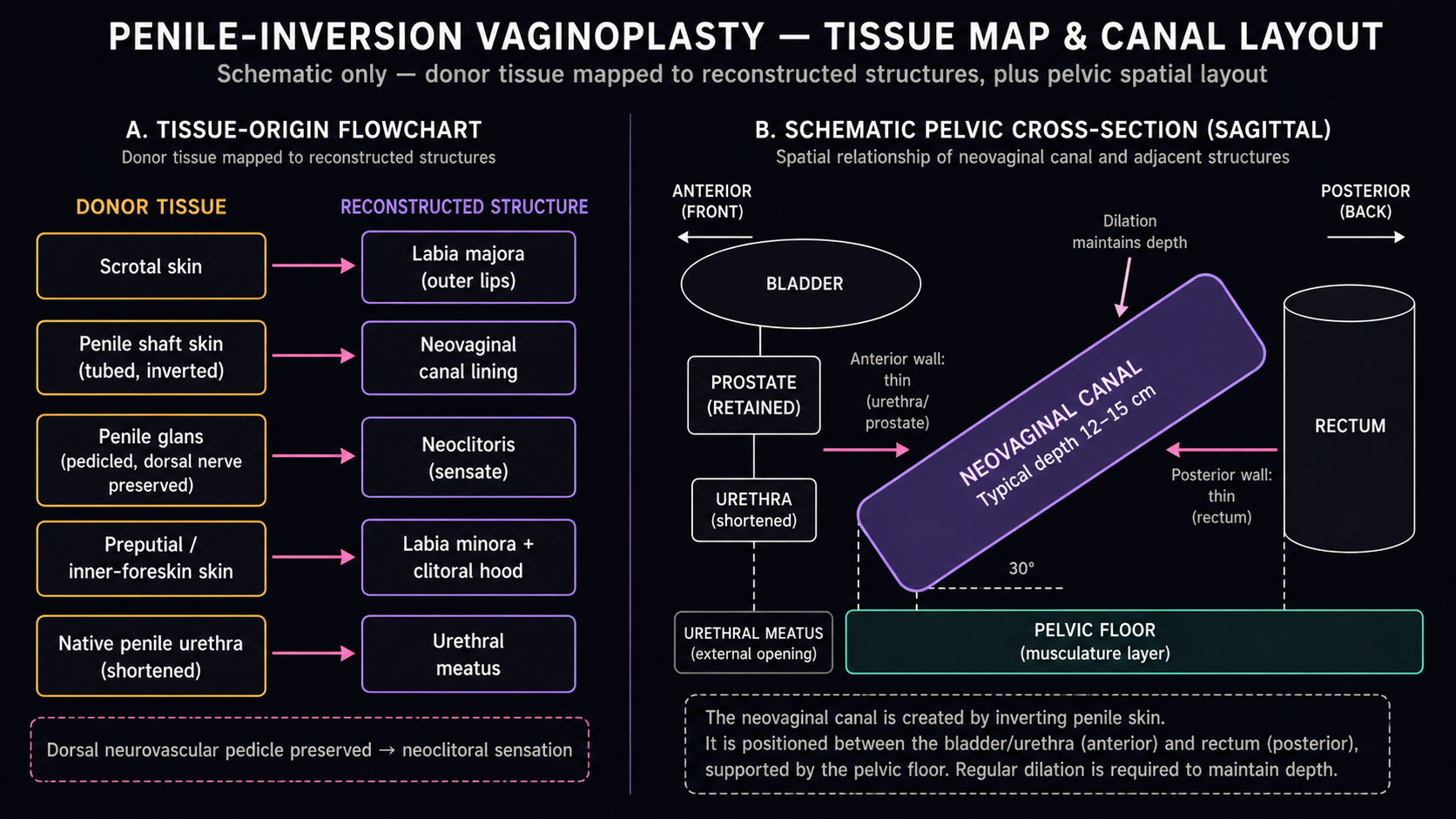
SRS — also called bottom surgery, gender-affirming genital surgery, or vaginoplasty — refers to surgical reconstruction of the genital region. For trans women the procedures cluster into four broad options: orchiectomy (testes removed, no canal), penile-inversion vaginoplasty (the standard, decades of track record), peritoneal pull-through (rapidly becoming the high-volume-center default in 2026), and vulvoplasty (no-depth or minimal-depth — full vulva, no canal).
Choosing among these is not a "more is better" decision. Each option has distinct candidacy criteria, recovery commitment, sensation profile, and maintenance burden. The most complex operation is not the right answer for everyone.
Subtopics
| Page | What it covers |
|---|---|
| Candidacy & Timing | WPATH SOC v8 criteria, HRT prerequisite, BMI/smoking/letter requirements, sequencing with FFS |
| Orchiectomy | Standalone procedure; HRT-management changes (anti-androgen discontinuation, estrogen reduction, LH/FSH/bone density) |
| Penile-Inversion Vaginoplasty | The standard technique — donor tissue mapping, depth, neoclitoris, pre-op hair removal of donor sites |
| Peritoneal Pull-Through | Davydov-derived flap technique; deeper canal, self-lubricating, reduced hair-removal burden, abdominal access |
| Vulvoplasty (Minimal-Depth) | Full external vulva, no canal — distinct choice with no dilation requirement |
| Pre-Op Hair Removal | The 6–12 month donor-site clearance that gates surgical scheduling |
| Surgeons & Cost | Two-tier market, credentialing, regional cost ranges, insurance documentation |
| Recovery & Dilation | Day-by-day recovery, the lifelong dilation commitment, when to call the surgeon |
| Complications & Revision | Granulation, stenosis, fistula; revision rates and what revision can fix |
Procedures at a glance
| Procedure | Canal depth | Lubrication | Dilation required | Hair-removal burden | Recovery (work) | Typical cost (US private) |
|---|---|---|---|---|---|---|
| Orchiectomy | N/A (no canal) | N/A | No | None | 1–2 weeks | \(2K–\)8K |
| Penile-inversion | 10–15 cm | None (lubricant) | Yes (lifelong) | High (donor sites) | 4–6 weeks | \(20K–\)50K |
| Peritoneal pull-through | 15–18+ cm | Self-lubricating | Yes (lifelong) | Reduced | 4–6 weeks | \(25K–\)60K |
| Vulvoplasty (minimal-depth) | None or 2–3 cm | N/A | Minimal/none | Low | 3–4 weeks | \(15K–\)40K |
Realistic timeline
| Phase | What's happening |
|---|---|
| Pre-op (1–2 years) | Hair removal, HRT stabilization, surgeon consults, insurance/funding |
| Hospital stay | 4–7 days for full vaginoplasty |
| Initial recovery (4–6 weeks) | Bedrest tapering to short walks; intensive dilation schedule begins |
| Return to desk work | 4–6 weeks |
| Return to physical activity | 8–12 weeks; no penetration, swimming, or heavy lifting until cleared |
| Full healing | 6–12 months for tissue to settle; final sensory recovery up to 18 months |
| Lifelong | Dilation routine (frequency tapers but never stops entirely) |
Cost & insurance landscape (summary)
| Aspect | Typical range |
|---|---|
| US (private, vaginoplasty) | \(20K–\)50K USD |
| US (insurance) | Often covered with documented medical necessity; coverage varies enormously by plan and state |
| Thailand / India (medical tourism) | \(10K–\)25K USD; surgeon quality at top centers is excellent, travel/recovery logistics add complexity |
| Canada / UK / EU | Generally publicly funded with significant wait times (2–5+ years) |
| Orchiectomy alone | \(2K–\)8K USD |
For the full insurance documentation playbook, regional details, and surgeon-shopping guidance see Surgeons & Cost.
Sources & further reading
- WPATH Standards of Care v8 — current standards on SRS
- Transfeminine Science — clinical-quality writing on feminization procedures
- Community resources: r/Transgender_Surgeries, r/MtF, /mtfg/ general threads — current surgeon recommendations and post-op support
- Trans Care BC — Lower surgery resources — Canadian provincial resource with broadly applicable patient education materials