Genioplasty (Chin Reshaping)
One of the highest-leverage procedures in FFS. The chin is one of the most reliably sexually dimorphic parts of the face — male and female chins differ in measurable, predictable ways — and it can be transformed in three dimensions in a single operation that leaves no external scar.
For most transfeminine patients the right operation is a sliding (osseous) genioplasty, not a chin implant. The reason matters: implants can only add bulk, while a typically masculine chin needs to be reduced — usually shortened, narrowed, and subtly reshaped. Sliding genioplasty cuts the chin bone, repositions it in three dimensions, and fixes it with small titanium plates and screws, all through an incision inside the mouth.
A 2024 systematic review pooling 12 studies and ~1,400 transfeminine patients reported an overall genioplasty complication rate of 0.55%, revision rate of 2.67%, and zero cases of permanent mental-nerve injury. Patient-reported satisfaction is consistently high on validated instruments (FACE-Q, WHOQOL-BREF).
The chin is part of a unit
The chin and the back portion of the lower jaw form a single visual unit. Reducing the mandibular angles without addressing a wide square chin still leaves a wide front-on view; narrowing the chin without softening the angles leaves a contradictory squared jaw behind it. In published FFS series, genioplasty is almost always performed in the same operation as mandibular angle reduction and body contouring — covered together on the Mandible Contouring page.
What "feminizing" the chin means
Synthesizing CT and skull studies (Sella Tunis 2020, Lee 2022, Fodor 2025) with surgical writings from Ousterhout, Deschamps-Braly, Spiegel, and the Facialteam group, four dimorphic features stand out:
| Feature | Typical male | Typical female | Surgical implication |
|---|---|---|---|
| Height | ~20.4 mm | ~18.6 mm | Most consistent sex difference per Fodor 2025; vertical reduction is one of the most commonly indicated maneuvers |
| Width | ~34 mm; bigonial 12–20% greater | ~31 mm | Wider chin disrupts the V-shape of the lower face |
| Shape | Square, often with two paramedian "high points" and a flat base | Rounder and more tapered toward a single midline point; slightly oval or subtly V-shaped | Drives the choice of T-genioplasty for narrowing |
| Projection | Further forward; pogonion ahead of E-line / S-line / Riedel's plane | Pogonion slightly behind these reference lines | Rarely advanced; sometimes set back; often the projection is left alone and the height + width are changed |
| Proportions | Lower third ~48% of face height | Lower third ~45% of face height | Vertical reduction also moves these proportions toward feminine |
A useful rough cue: feminine chin width approximates the width of the nose at its base, while masculine chin width approaches the inter-canthal (eye-corner-to-eye-corner) distance.
The honest caveat: the FFS literature is young, most series are single-surgeon, and the "feminine chin" is partly cultural. Surgeons individualize — a chin that suits a long, narrow face would look wrong on a shorter, wider one.
Sliding genioplasty vs chin implant
A genuinely fundamental distinction for feminization. Both procedures exist, but they do different things:
| Sliding genioplasty | Chin implant | |
|---|---|---|
| What it does | Cuts the bone, repositions it in 3D, fixes with hardware | Adds a piece of silicone, Medpor, or PEEK on top of the existing bone |
| Can shorten? | Yes (vertical wedge removal) | No |
| Can narrow? | Yes (T-genioplasty) | No |
| Can advance? | Yes | Yes (but only that) |
| Can set back? | Yes (rarely needed) | No |
| External scar? | None (intraoral) | None |
| Foreign material? | Titanium plate/screws (usually permanent) | Implant material |
| Long-term concerns | Minor bony remodeling (5–10% in year 1) | Bone resorption beneath implant; capsule formation; migration; palpability; infection |
As Deschamps-Braly puts it: "It is impossible to feminize a chin with an implant. Any implant will invariably have the effect of enlarging the chin in one dimension or another — the opposite outcome of what we're aiming to accomplish."
Sliding genioplasty also tightens submental soft tissue when the segment is advanced, and uses the patient's own bone — no implant maintenance issues over decades.
When implants might still play a role in FFS: if the starting chin is already small and feminine but slightly under-projected (uncommon in transfeminine anatomy), or as a custom PEEK prosthesis to augment the jaw angle when prior reduction or asymmetry has left a deficit. Otherwise, virtually all major FFS centers choose sliding genioplasty.
Three directions of movement
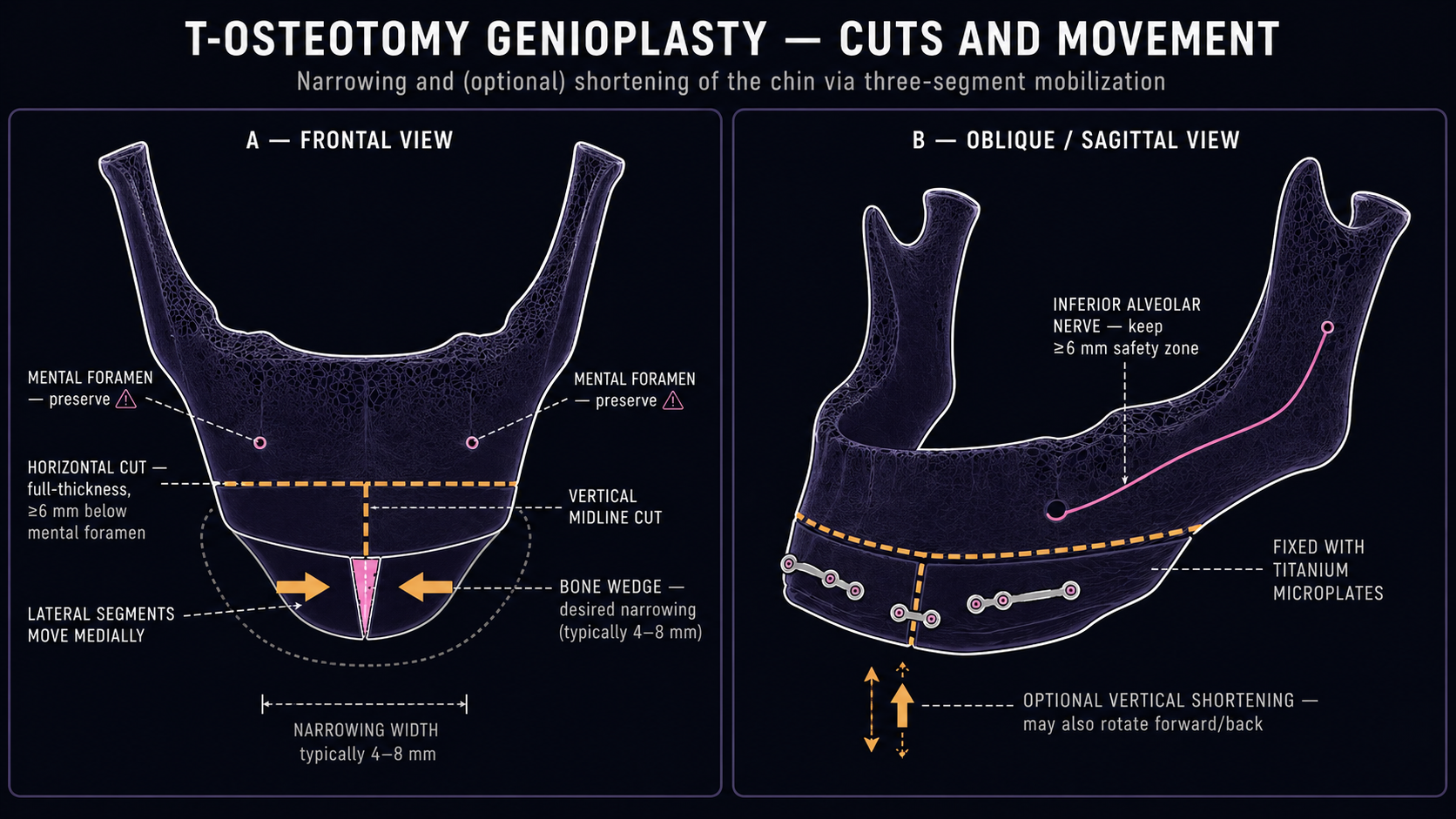
Modern FFS genioplasty is best understood not as a single operation but as a customizable set of bone movements. Wang and Rodman's 2023 review classifies the procedure into 1-piece (reshape and reduce), 2-piece (adjust projection), and 3-piece / T-genioplasty (adjust projection and narrow transversely).
Vertical reduction (shortens a tall chin)
Surgeons remove a horizontal wedge of bone parallel to the first cut, then bring the lower segment up before fixing it. Given Fodor's finding that height is the most consistent sex difference, vertical reduction is one of the most commonly indicated maneuvers — even when patients haven't specifically asked for it.
Horizontal movement (changes projection)
Advancement (forward) is far more common than setback in FFS. Sometimes used even when projection is already adequate because it deepens the labiomental fold (a feminine landmark) and tightens submental tissue. Stair-step plates allow millimetric control; advancements of 4–8 mm are typical.
Setback risks creating a "witch's chin" (soft-tissue sag) and is used sparingly.
Transverse narrowing (T-genioplasty / 3-piece)
The signature feminizing move for a wide, square chin. The surgeon makes the horizontal cut, then a vertical midline cut, removes a central wedge of bone, brings the two lateral halves together, and fixes them. This creates the tapered V-shape.
Park and Noh's foundational 2008 paper established narrowing genioplasty as a distinct procedure. Deschamps-Braly emphasizes that "it is almost impossible to correct both a square jaw and produce a slender V-line shape to the chin simultaneously without using this technique."
Most FFS chins need two or three of these moves combined. A tall, projecting, square chin might receive a T-genioplasty with central wedge removal and vertical wedge ostectomy and either a small setback or no advancement. A chin that's tall but well-proportioned in width might just be shortened.
Many FFS centers — Facialteam most prominently with their JAWContour® protocol — use 3D CT, virtual surgical planning, and 3D-printed cutting guides to design these movements before the operation. The 2024 systematic review found about two-thirds of FFS series use some form of virtual planning.
Inside the operation
Genioplasty is performed under general anesthesia through an intraoral incision in the lower lip vestibule, running roughly canine to canine.
- Mentalis muscle divided. The small muscle that lifts the lower lip and chin is incised; the periosteum is elevated.
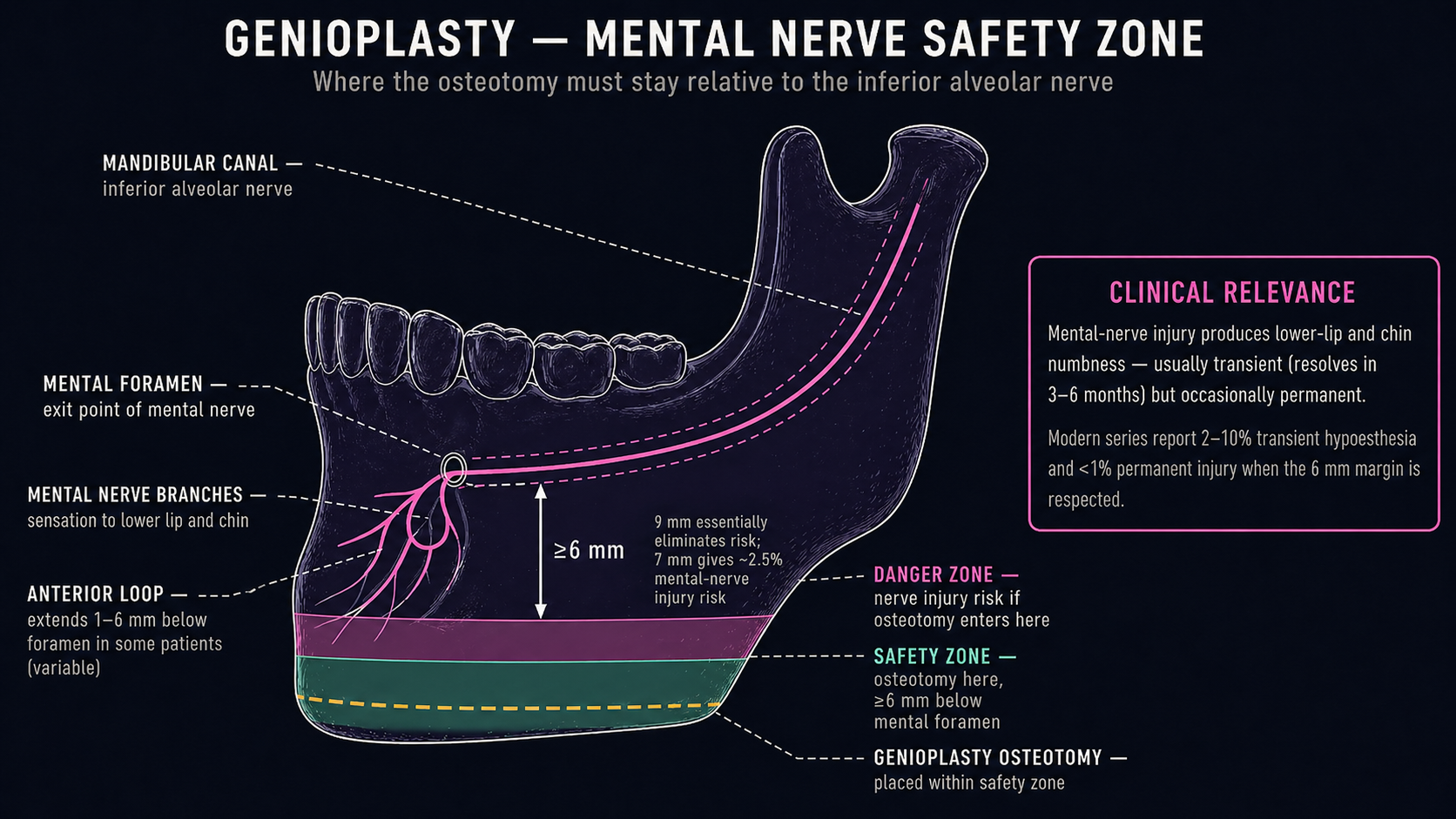
- Mental nerves identified and protected. The nerves exit their bony canals on each side; protecting them is the dominant safety concern.
- Horizontal osteotomy at least 5–6 mm below the mental foramen. This rule, established by Ousterhout in the 1990s, exists because the inferior alveolar nerve loops slightly downward (~4.5 mm) before exiting the foramen. Cutting too close risks permanent numbness. Most modern surgeons use a piezoelectric (ultrasonic) saw that cuts mineralized bone but spares nerves and soft tissue.
- Additional cuts as planned. Vertical midline for T-genioplasty; horizontal wedge cuts for vertical reduction.
- Reposition and fix. Titanium miniplates and 1.5 or 2.0 mm screws, often with stair-step plates for millimetric advancement control. Resorbable plates (e.g., Lactosorb) are an option for patients who don't want metal — slightly less stable.
- Mentalis re-approximation. Deliberately re-suspended to prevent soft-tissue sag. Critical step for avoiding "witch's chin."
- Closure. Dissolvable sutures; chin-strap dressing for the first weeks.
Isolated genioplasty takes 30–60 minutes; combined with mandibular contouring, the lower-jaw portion runs 2–4 hours. Most patients spend one night in the hospital. No external scar.
Recovery
Plan for the first several days to be the hardest, the first two weeks to look dramatic (in a swollen way), and the final result to take 6–12 months as deep tissue swelling fully resolves and the bone settles.
| Phase | What to expect |
|---|---|
| Days 0–7 | Swelling peaks day 3–5. Bulky head dressing comes off after 1–2 days. Pain mild-to-moderate; short opioid course 3–7 days, then acetaminophen. NSAIDs avoided 2 weeks (bleeding risk). Sleep with head elevated. Liquid / very soft diet ("nothing tougher than scrambled eggs"). Chlorhexidine mouthwash 3×/day reduces FFS infection rates. |
| Weeks 1–2 | Bruising mostly clears. Most patients return to desk work at 10–14 days. Light walking from day one; nothing that raises BP for 2 weeks. Showering OK after ~48h. Intraoral sutures dissolve — no removal appointment. |
| Month 1 | Most visible bruising and acute swelling resolved, but significant residual swelling persists. Soft diet often extends through week 4. Strenuous exercise can resume around 4 weeks; physical jobs need 4–6 weeks off. |
| Month 3 | Roughly 80% of the final result visible. Chin definition appears as midface and chin swelling subside. The lower face heals more slowly than the upper face. |
| Months 6–12 | Final shape. Contact sports and any activity with risk of facial impact typically cleared once bone healing is documented (~3 months, sometimes longer). |
Numbness of the lower lip, chin, and lower teeth is expected immediately — almost universal in the first weeks because the mental nerve is stretched even when not directly injured. The vast majority resolves in 2–4 weeks. The Facialteam series of 837 patients reported full resolution within 4–30 weeks. Permanent numbness is rare in FFS-specific cohorts (essentially 0% in the major published series).
There is no external scar. This is true across all major FFS practices and is one of the procedure's appeals.
Risks and complications
In experienced hands, FFS genioplasty is remarkably safe. The 2024 Gursky systematic review remains the best single source for FFS-specific rates.
| Complication | FFS-specific rate | Notes |
|---|---|---|
| Overall complication rate | 0.55% (Gursky 2024 systematic review) | Most common is infection at 0.48% |
| Permanent mental-nerve injury | ~0% across ~1,200 patients in studies that reported the outcome | The single most important safety figure. Depends on the ≥5–6 mm rule below the mental foramen. |
| Transient mental-nerve numbness | Nearly universal initially; resolves 4–30 weeks (Facialteam 837-patient series) | Older mixed-orthognathic series cite 9–100% transient; FFS-specific much lower with careful technique (Ducic 2.4%) |
| Bone resorption (pedicled, the standard) | 5–10% remodeling year 1; <2 mm relapse at pogonion | Free (non-pedicled) segments resorb up to 24% — pedicled preferred |
| Hardware palpability | ~3.45% (FFS quality-of-life meta-analysis) | Removal in <5% of cases — far less than orthognathic in general (9–27%) |
| Witch's chin (soft-tissue sag) | 3.03% (Gursky); 0% (NYU); historical broad-degloving rates as high as 24% | Almost entirely a function of mentalis re-suspension technique. Modern lag-screw "no-degloving" approaches keep this low. |
| Revision (chin-specific) | 2.67% (Gursky); 0.88% (NYU); ~3% (Facialteam) | Higher figures (17–25%) in some FFS literature refer to any secondary FFS procedure across the whole face, not chin-specific |
| Infection | 0.48% | Hazkour 2022 protocol bundle (perioperative antibiotics, betadine, interlocking gingival sutures, postop chlorhexidine) reduces further |
| Hematoma | 0.61% | Usually managed nonsurgically |
| Tooth-root injury | ~1% (1/126 in Ducic series) | Preoperative panoramic X-ray or CT identifies root depths |
| Step-off deformity | Not well-quantified; technique-driven | Bony shelf at junction between moved segment and unaltered mandibular body. Prevented by feathering with diamond bur and treating chin + mandibular body as one contour |
| Aesthetic dissatisfaction | ~3.5% (Gursky) | Most common reason for revision is undercorrection — chin not feminized enough |
Two themes drive the safety record:
- The ≥5–6 mm rule below the mental foramen — the single most important technical safeguard against permanent numbness.
- Mentalis re-approximation — the difference between modern no-witch's-chin rates (~3% or lower) and historical 24% rates is almost entirely the technique used to re-suspend this muscle.
What to ask in consult
| Question | Why it matters |
|---|---|
| Are you planning a 1-piece, 2-piece, or T (3-piece) genioplasty? | Surgeon should articulate which based on your specific anatomy. T is the workhorse for square/wide chins. |
| What dimensions are you reducing — height, width, projection, or some combination? | Most FFS chins need 2–3 dimensions changed. Vertical reduction is more commonly needed than patients realize. |
| How do you protect the mental nerve? | Should reference the ≥5–6 mm rule and use of piezoelectric saw or careful sharp osteotomy. |
| How do you prevent witch's chin? | Should describe specific mentalis re-suspension technique. "Lag-screw no-degloving" or careful periosteal release with explicit muscle re-attachment. |
| Are you treating my chin and mandibular angles in the same operation? | Almost always should be yes; otherwise you risk a step-off deformity or unbalanced lower face. See Mandible Contouring. |
| Do you use 3D virtual surgical planning? | Not mandatory, but ~2/3 of FFS centers use it; outcomes comparable in those that don't. |
| What's your specific revision rate, and what's the most common reason? | 2–3% chin-specific is the published benchmark. Most common reason is undercorrection. |
| How many feminizing genioplasties do you do per year? | Volume separates experienced from occasional surgeons. |
Sources
Peer-reviewed literature
- Gursky AS et al. (2024) — Facial Feminization Genioplasty: Systematic Review and Institutional Cohort (J Clin Med) — 12 studies, ~1,400 patients; 0.55% overall complication rate, 2.67% revision, 0% permanent nerve injury.
- Simon D, Capitán L, Bailón C, Bellinga RJ et al. (2022) — Facial Gender Confirmation Surgery: The Lower Jaw (Plast Reconstr Surg) — Facialteam 837-patient series; numbness resolution within 4–30 weeks.
- Deschamps-Braly J. (2019) — Feminization of the Chin: Genioplasty Using Osteotomies (Facial Plast Surg Clin North Am) — modern technique review; T-genioplasty rationale.
- Wang TD, Rodman R. (2023) — Gender Facial Affirmation Surgery: Techniques for Feminizing the Chin (Facial Plast Surg Clin North Am) — 1-piece / 2-piece / 3-piece classification.
- Raffaini M et al. (2022) — 3D Sliding Genioplasty in Facial Feminization
- Park HS, Noh JM. (2008) — Importance of the Chin in Lower Facial Contour: Narrowing Genioplasty (Plast Reconstr Surg) — foundational paper establishing narrowing genioplasty as a distinct procedure.
- Ousterhout DK. (1996) — Sliding Genioplasty: Avoiding Mental Nerve Injuries (J Craniofac Surg) — original ≥5–6 mm rule.
- Ducic Y. (2016) — A Simplified, Reliable Approach for Advancement Genioplasty (JAMA Facial Plast Surg) — 126-patient series, 2.4% transient nerve disturbance, ~1% tooth root injury.
- Ridgway EB et al. (2021) — The "No-Degloving" Technique to Prevent Chin Ptosis (Plast Reconstr Surg) — modern technique to prevent witch's chin.
- Morrison SD et al. (2020) — Multicenter Prospective FFS Quality-of-Life Study (Plast Reconstr Surg) — FACE-Q and quality-of-life outcomes.
- Rochlin DH et al. (2022) — Secondary Surgery in Facial Feminization (Ann Plast Surg) — revision-rate context.
- Hazkour N et al. (2022) — Reducing FFS Infection Complications (J Craniofac Surg) — protocol bundle for infection reduction.
Anatomic studies
- Fodor R et al. (2025) — Anatomic Study of Feminine vs Masculine Chin (J Craniofac Surg) — vertical height as the most consistent sex difference.
- Sella Tunis T et al. (2020) — Sex Differences in Mandibular Symphysis and Chin
- Mommaerts MY, Moerenhout BAMM. (2010) — Ideal Proportions in Full Face Front View (J Craniomaxillofac Surg) — 45% lower-third proportion target.
- Hwang K et al. (2005) — Anatomy of the Mental Nerve Relevant to Genioplasty (J Craniofac Surg).
- Khan MAA et al. (2021) — Genioplasty Complications: A Clinical Study (Int J Dent).
- Pokrowiecki R et al. (2024) — T-Genioplasty vs Lateralization for Chin Asymmetry (Medicina).
- Telang G et al. (2021) — AJR Review of Imaging in FFS (Am J Roentgenol).
- Bonnet F et al. — Surgical Techniques in Chin Feminization.
- Schrooten W et al. (2025) — Genioplasty Systematic Review (MDPI).
Surgeon and institutional patient-education resources
- Deschamps-Braly Clinic — Chin Recontouring
- Facialteam — Jaw and Chin Feminization (JAWContour®)
- Facialteam — Post-operative Instructions (PDF)
- Spiegel Center — Mandible and Chin Contouring
- Gender Confirmation Center — Genioplasty
- Denver Health — FFS Patient Education (PDF)
- FFS Institute — Recovery Timeline
- Meltzer Clinic — FFS Recovery
- Cleveland Clinic — Facial Feminization Surgery Overview
- Johns Hopkins Medicine — Facial Feminization Surgery
- Stanford Health Care — Transgender Facial Plastic Surgery
- TransHub — Facial Surgery